The Controversy Surrounding the Toxicity of Biodegradable Plastics: PBAT as a Case Study
DOI:
https://doi.org/10.29356/jmcs.v70i1.2411Keywords:
TBTBT, 1,4-butanediol, adipic acid, terephthalic acid, TPA, TBTAbstract
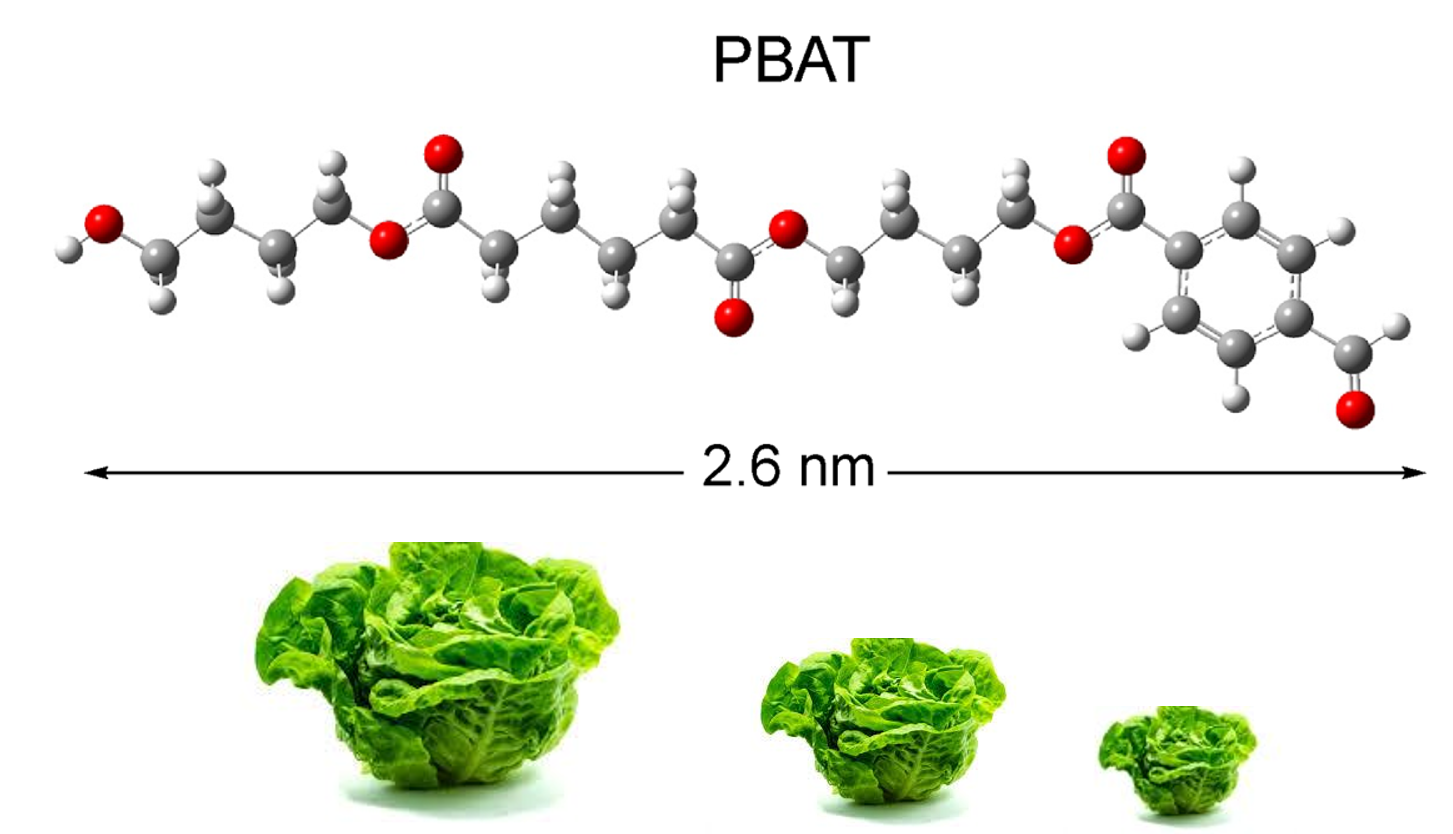
Abstract. Synthetic plastics contribute to increase human comfort, but they also represent a huge pollution problem. One way to avoid contamination is with biodegradable plastics, such as PBAT [poly(butylene-adipate-co-terephthalate)]. The controversy begins with the apparent negative effect of PBAT on plant growth, and also because it could cause behavioral abnormalities in zebrafish. Previous studies suggest that biodegradation products could be responsible for this. The potential toxicity of biodegradation products and PBAT can be analyzed through the binding energies with biomolecules such as guanine-cytosine (GC). This Density Functional Theory investigation analyzes the interaction of biodegradation products with GC. All compounds under study form stable systems with GC and may be toxic. These results are consistent with previous toxicity research which conclude that PBAT degradation products may be more toxic than PBAT microplastics.
Resumen. Los plásticos sintéticos contribuyen a aumentar el confort humano, pero también representan un enorme problema de contaminación. Una forma de evitar la contaminación es con plásticos biodegradables, como el PBAT [poli(butileno-adipato-co-tereftalato)]. La controversia comienza con el aparente efecto negativo del PBAT sobre el crecimiento de las plantas, y también porque podría causar anomalías de comportamiento en el pez cebra. Estudios previos sugieren que los productos de biodegradación podrían ser responsables de esto. La toxicidad potencial de los productos de biodegradación y el PBAT se puede analizar a través de las energías de enlace con biomoléculas como la guanina-citosina (GC). Esta investigación utiliza la Teoría de Funcionales de la Densidad para analizar la interacción de los productos de biodegradación con GC. Todos los compuestos estudiados forman sistemas estables con GC y podrían ser tóxicos. Estos resultados son consistentes con investigaciones de toxicidad que concluyen que los productos de degradación del PBAT pueden ser más tóxicos que los microplásticos de PBAT.
Downloads
References
1. Stanley, J.; Culliton, D.; Jovani-Sancho, A.-J.; Neves, A.C. Eng. 2025, 6, 17. DOI: https://doi.org/10.3390/eng6010017
2. “The Bakelizer” commemorative booklet produced by the National Historic Chemical Landmarks program of the American Chemical Society, 1993.
3. Uekert,T.; Singh, A.; DesVeaux, J.S.; Ghosh, T.; Bhatt, A.; Yadav, G.; Afzal, S.; Walzberg J.; Knauer, K.M.; Nicholson, S.R.; Beckham, G.T.; Carpenter, A.C. ACS Sustainable Chem. Eng. 2023, 11, 965-978.
4. Müller, R.J.; Witt, U.; Rantze, E.; Deckwer, W.D. Polym. Degrad. Stab. 1998, 59, 203-208.
5. Jian, J.; Xiangbin, Z.; Xianbo, H. Adv. Ind. Eng. Polym. Res. 2020, 3, 19-26.
6. Peng, W.; Nie, R.; Lü, F.; Zhang, H.; He, P. Waste Manage. 2024, 174, 218-228.
7. Yang, Y.; Min, J.; Xue, T.; Jiang, P.; Liu, X.; Peng, R.; Huang, J.W.; Qu, Y.; Li, X.; Ma, N.; Tsau, FCh.; Dai, L.; Zhang, Q.; Liu, Y.; Chen, Ch.; Guo, R.T. Nature Comm. 2023, 14, 1645.
8. Fukushima, K.; Wu, M.H.; Bocchini, S.; Rasyida, A.; Yang, MCh. Materials Sci. Eng. 2012, C32, 1331-1351.
9. Hong, S.H.; Hwang, S.H. ACS App. Polym. Mat. 2022, 4, 1775-1783.
10. Roy, S.; Ghosh, T.; Zhang, W.; Rhim, J.W. Food Chem. 2024, 437, 137822.
11. Sander, M. Env. Sci. Tech. 2019, 53, 2304-2315. DOI: https://doi.org/10.1021/acs.est.8b05208
12. Jian, J.; Xiangbin, Z.; Xianbo, H. Adv. Ind. Eng. Polym. Res. 2020, 3, 19-26.
13. Chandra, R.; Rustgi, R. Prog. Poly. Sci. 1998, 23, 1273-1335.
14. Huang, S.; Li, B.; Huang, S.; Wang, Y.; Zhang, L.; Li, J.; Yin, X. Eur. Polym. J. 2023, 22, 112492.
15. Okada, M. Prog. Polym. Sci. 2002, 27, 87-133.
16. Sintim, H.Y.; Flury, M. Environ. Sci. Technol. 2017, 51, 1068-1069. DOI: https://doi.org/10.1021/acs.est.6b06042
17. Souza, P.M.S.; Sommaggio, L.R.D.; Marin-Morales, M.A.; Morales, A.R. Chemosphere. 2020, 256, 126985. DOI: https://doi.org/10.1016/j.chemosphere.2020.126985
18. De Hoe, G.X.; Zumstein, M.Y.; Getzinger, G.J.; Ruegsegger, I.; Kohler, H.P.E.; Maurer-Jones, M.A.; Sander, M.; Hillmyer, M.A.; McNeill, K. Environ. Sci. Technol. 2019, 53, 2472-2481. DOI: https://doi.org/10.1021/acs.est.8b06458
19. Liu, Y.; Cai, H.; Wen, Y.; Song, X.; Wang, X.; Zhang, Z. Env. Res. 2024, 262, 119979.
20. Liu, J.; Wang, P.; Wang, Y.; Zhang, Y.; Xu, T.; Zhang, Y.; Xi, J.; Hou, L.; Li, L.; Yanbing, L. Z. J. Hazard. Mater. 2022, 437, 129294.
21. Martin-Closas, L.; Botet, R.; Pelacho, A.M. Polym. Degrad. Stab. 2014, 108, 250-256.
22. Liyuan, L.; Guoyuan, Z.; Zuo, Q.; Li, Ch.; Gu, J.; Kang, L.; Ma, M.; Liang, K.; Liu, D.; Du, L. J. Hazard. Mater. 2022, 438, 129507.
23. Han, Y.; Teng, Y.; Wang, X.; Wen, D.; Gao, P.; Yan, D.; Yang, N. Sci. Tot. Env. 2024, 912, 169048.
24. Serrano-Ruiz, H.; Martin-Closas, L.; Pelacho, A.M. Sci. Tot. Env. 2023, 856, 159167.
25. Martin-Closas, L.; Botet, R.; Pelacho, A.M. Polym. Degrad. Stab. 2014, 108, 250-256. DOI: https://doi.org/10.1016/j.polymdegradstab.2014.03.037
26. Yu, Y.; Chen, Y.; Wang, Y.; Xue, S.; Liu, M.; Tang, D.W.S.; Yang, X.; Geissen, V. Ecotox. Environ. Saf. 2023, 262, 115129. DOI: https://doi.org/10.1016/j.ecoenv.2023.115129
27. Zhang, D.; Xu, X.; Lu, Y.; Guo, L. Sci. Tot. Env. 2024, 928, 172354.
28. Martínez, A.; Perez-Sanchez, E.; Caballero, A.; Ramírez, R.; Quevedo, E.; Salvador-García, D. J. Mol. Mod. 2024, 30, 273. DOI: http://dx.doi.org/10.1007/s00894-024-06066-0
29. Frisch, M.J.; Trucks, G.W.; Schlegel, H.B.; Scuseria, G.E.; Robb, M.A.; Cheeseman, J.R. et al. Gaussian 09, Revision A.08, Wallingford, CT, 2009. D.01, Wallingford CT: Gaussian, Inc. 2016.
30. Zhao, Y.; Truhlar, D.G. Theor. Chem. Account. 2008, 120, 215–241. DOI: https://doi.org/10.1007/s00214-007-0310-x
31. Petersson, G.A.; Bennett, A.; Tensfeldt, T.G.; Al‐Laham, M.A.; Shirley, W.A.; Mantzariset, J. A. J. Chem. Phys. 1988, 89, 2193-2218. DOI: https://doi.org/10.1063/1.455064
32. Petersson, G.A.; Al-Laham, M.A. J. Chem. Phys. 1991, 94, 60816090. DOI: https://doi.org/10.1063/1.460447
33. Galano, A.; Álvarez-Idaboy, R. J. Comp. Chem. 2014, 35, 2019-2026. DOI: https://doi.org/10.1002/jcc.23715
34. Mardirossian, N.; Head-Gordon, M. Mol. Phys. 2017, 115, 2315-2372. DOI: https://doi.org/10.1080/00268976.2017.1333644
35. Boys, S.F.; Bernardi, F. Mol. Phys. 1970, 19, 553-566. DOI: https://doi.org/10.1080/00268977000101561
36. Martínez, A.; Barbosa A. PLoS ONE. 2024, 19, e0285515. DOI: https://doi.org/10.1371/journal.pone.0285515
37. Riaz, U.; Singh, N.; Banoo S. New J. Chem. 2022, 46, 4954-4973. DOI: https://doi.org/10.1039/D1NJ05352C
38. Suramitr, S.; Meeto, W.; Wolschann, P.; Hannongbua, S. Theor. Chem. Acc. 2010, 125, 35-44. DOI: https://doi.org/10.1007/s00214-009-0655-4
39. Liu, T.Y.; Zhen, ZCh.; Zang, X.L.; Xu, P.Y.; Wang, G.X.; Lu, B.; Li, F.; Wang, P.L.; Huang, D.; Ji, J.H. J. Hazard. Mater. 2023, 454, 131572. DOI: https://doi.org/10.1016/j.jhazmat.2023.131572
40. Martínez, A. J. Mol. Mod. 2024, 30, 97. DOI: https://doi.org/10.1007/s00894-024-05890-8
41. Liu, J.; Wang, P.; Wang, Y.; Zhang, Y.; Xu, T.; Zhang, Y.; Xi, J.; Hou, L.; Li, L.; Zhang, Z.; Lin, Y. J. Hazard. Mater. 2022, 437, 129294. DOI: https://doi.org/10.1016/j.jhazmat.2022.129294
Downloads
Published
Issue
Section
License
Copyright (c) 2025 Ana Martínez, Diana Salvador-García

This work is licensed under a Creative Commons Attribution-NonCommercial 4.0 International License.
Authors who publish with this journal agree to the following terms:
- Authors retain copyright and grant the journal right of first publication with the work simultaneously licensed under a Creative Commons Attribution License that allows others to share the work with an acknowledgement of the work's authorship and initial publication in this journal.
- Authors are able to enter into separate, additional contractual arrangements for the non-exclusive distribution of the journal's published version of the work (e.g., post it to an institutional repository or publish it in a book), with an acknowledgement of its initial publication in this journal.