Impact of Common Additives on the Micellization Properties of a Short-Alkyl-Chain Surface-Active Ionic Liquid in Aqueous Solution
DOI:
https://doi.org/10.29356/jmcs.v70i1.2548Keywords:
Surface-active ionic liquids, critical micellar concentration, thermodynamic properties, ionic-additives, diffusionAbstract
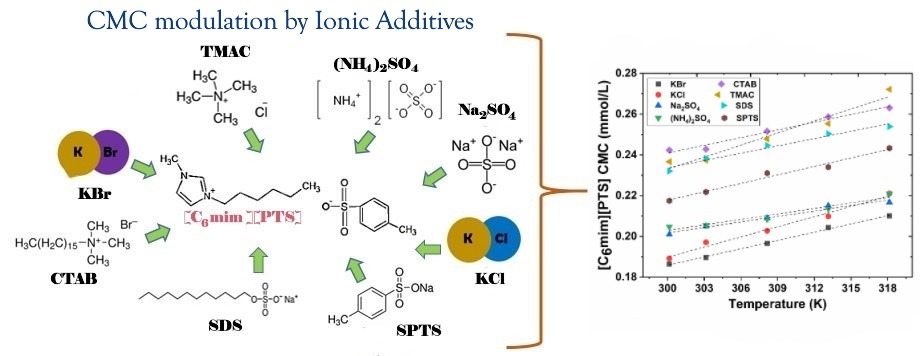
Abstract. The present study explores the influence of common organic and inorganic additives on the micellization behavior of the short-alkyl-chain surface-active ionic liquid 1-methyl-3-hexylimidazolium p-toluenesulfonate ([C₆mim][PTS]) in aqueous solution. Although [C₆mim][PTS] has shown promise for the dehydration of water-in-oil emulsions, its physicochemical properties remain underexplored. Critical micellar concentration (CMC), surface tension, diffusion coefficients, and thermodynamic parameters were evaluated using UV-Vis spectroscopy, ionic conductivity, and cyclic voltammetry, the latter proving equally reliable for CMC determination. All tested additives reduced both the CMC and surface tension, with amphiphilic organic compounds such as hexadecyltrimethylammonium bromide (CTAB) and sodium dodecyl sulfate (SDS) exhibiting the most pronounced effects. Thermodynamic analysis confirmed that micellization is spontaneous, exothermic, and entropically favored across the studied temperature range (300.15–318.15 K). Inorganic salts enhanced micellization primarily through enthalpic contributions, while organic additivespromoted entropy-driven aggregation. Diffusion measurements yielded a reference value on the order of 10-5 cm²/s for [C₆mim][PTS] in aqueous solution. These findings highlight the tunable aggregation behavior of [C₆mim][PTS] and support its potential for use in emulsion treatment and environmentally friendly separation processes.
Resumen. El presente trabajo explora la influencia de aditivos orgánicos e inorgánicos comunes en el comportamiento de micelización del líquido iónico surfactante de cadena corta 1-metil-3-hexilimidazolio p-toluensulfonato [C6mim][PTS]) en solución acuosa. Aunque el [C6mim][PTS] ha demostrado potencial para la deshidratación de emulsiones agua-en-aceite, sus propiedades fisicoquímicas han sido poco exploradas. Se evaluaron la concentración micelar crítica (CMC), la tensión superficial, los coeficientes de difusión y los parámetros termodinámicos mediante espectroscopía UV-Vis, conductividad iónica y voltametría cíclica, siendo esta última igualmente confiable para la determinación de la CMC. Todos los aditivos probados redujeron tanto la CMC como la tensión superficial, destacando los aditivos orgánicos como el bromuro de hexadeciltrimetilamonio (CTAB) y el dodecil sulfato de sodio (SDS) que resultaron en efectos más pronunciados. El análisis termodinámico confirmó que la micelización del líquido iónico es espontánea, exotérmica y entrópicamente favorecida en el intervalo de temperatura estudiado (300.15 - 318.15 K). Las sales inorgánicas favorecieron la micelización principalmente mediante contribuciones entálpicas, mientras que los aditivos orgánicos promovieron la agregación impulsada por cambios en la entropía. Las mediciones de coeficiente de difusión arrojaron un valor de referencia del orden de 10-5 cm2/s para el [C6mim][PTS] en solución acuosa. Estos hallazgos destacan el comportamiento de agregación modulable de [C6mim][PTS] y respaldan su potencial para aplicaciones en el tratamiento de emulsiones y procesos de separación ambientalmente sostenibles.
Downloads
References
1. Zaitsau, D. H.; Kabo, G. J.; Strechan, A. A.; Paulechka, Y. U.; Tschersich, A.; Verevkin, S. P.; Heintz, A. J. Phys. Chem. A. 2006, 110, 7303–7306. DOI: https://pubs.acs.org/doi/10.1021/jp060896f
2. Tröger-Müller, S.; Antonietti, M.; Liedel, C. Phys. Chem. Chem. Phys. 2018, 20, 11437–11443. DOI: https://doi.org/10.1039/C8CP00311D
3. Talip, R. A. A.; Yahya, W. Z. N.; Bustam, M. A. E3S Web Conf. 2021, 287, 02015. DOI: https://doi.org/10.1051/e3sconf/202128702015
4. Yang, H.; Liu, Y.; Ning, H.; Lei, J.; Hu, G. RSC Adv. 2017, 7, 33231–33240. DOI: https://doi.org/10.1039/c7ra05601j
5. Kaur, G.; Kumar, H.; Singla, M. J. Mol. Liq. 2022, 351, 118556. DOI: https://doi.org/10.1016/j.molliq.2022.118556
6. Buettner, C. S.; Cognigni, A.; Schröder, C.; Bica-Schröder, K. J. Mol. Liq. 2022, 347, 118160. DOI: https://doi.org/10.1016/j.molliq.2021.118160
7. Goutham, R.; Rohit, P.; Vigneshwar, S. S.; Swetha, A.; Arun, J.; Gopinath, K. P.; Pugazhendhi, A. J. Mol. Liq. 2022, 349, 118150. DOI: https://doi.org/10.1016/j.molliq.2021.118150
8. Zhang, L.; Yu, R.; Zhou, M.; Wang, C.; Zhang, D.; Ren, W.; Shao, Y. Food Chem. 2022, 379, 132161. DOI: https://doi.org/10.1016/j.foodchem.2022.132161
9. Kaur, R.; Kumar, H.; Singla, M. J. Mol. Liq. 2022, 354, 118904. DOI: https://doi.org/10.1016/j.molliq.2022.118904
10. McNeice, P.; Marr, P. C.; Marr, A. C. Catal. Sci. Technol. 2021, 11, 726–741. DOI: https://doi.org/10.1039/d0cy02274h
11. Earle, M. J.; Seddon, K. R. Pure Appl. Chem. 2000, 72, 1391–1398.
12. Kumar, R.; Sharma, A.; Sharma, N.; Kumar, V.; Sinha, A. K. Eur. J. Org. Chem. 2008, 33, 5577–5582. DOI: https://doi.org/10.1002/ejoc.200800657
13. Potdar, M. K.; Rasalkar, M. S.; Mohile, S. S.; Salunkhe, M. M. J. Mol. Catal. A Chem. 2005, 235, 249–252. DOI: https://doi.org/10.1016/j.molcata.2005.04.007
14. Xia, M.; Lu, Y. D. J. Mol. Catal. A Chem. 2007, 265, 205–208. DOI: https://doi.org/10.1016/j.molcata.2006.10.004
15. Biedroń, T.; Kubisa, P. J. Polym. Sci. A Polym. Chem. 2004, 42, 3230–3235. DOI: https://doi.org/10.1002/pola.20158
16. Lara Hernández, A. R.; Gallardo Rivas, N. V.; Páramo García, U.; Mayén-Mondragón, R.; Brachetti Sibaja, S. B. Int. J. Electrochem. Sci. 2021, 16, 21101. DOI: https://doi.org/10.20964/2021.10.49
17. Amde, M.; Liu, J. F.; Pang, L. Environ. Sci. Technol. 2015, 49, 12611–12627. DOI: https://pubs.acs.org/doi/10.1021/acs.est.5b03123
18. Wei, Y.; Wang, F.; Zhang, Z.; Ren, C.; Lin, Y. J. Chem. Eng. Data. 2014, 59, 1120–1129. DOI: https://doi.org/10.1021/je400861g
19. Villalobos Neri, E. E.; Páramo García, U.; Mayen-Mondragon, R.; Gallardo-Rivas, N. V. Int. J. Electrochem. Sci. 2021, 16, 210611. DOI: https://doi.org/10.20964/2021.06.59
20. Del Ángel Gómez, E. J.; Gallardo Rivas, N. V.; Paramo García, U.; Díaz Zavala, N. P.; Banda Cruz, E. E.; Martínez Orozco, R. D.; García-Alamilla, R. Petrol. Sci. Technol. 2022, 40, 2163–2178. DOI: https://doi.org/10.1080/10916466.2022.2036760
21. El Shafiee, C. C.; El-Nagar, R. A.; Nessim, M. I.; Khalil, M. M. H.; Shaban, M. E.; Alharthy, R. D.; Ismail, D. A.; Abdallah, R. I.; Moustafa, Y. M. Arab. J. Chem. 2021, 14, 103123. DOI: https://doi.org/10.1016/j.arabjc.2021.103123
22. McFarlane, J.; Ridenour, W. B.; Luo, H.; Hunt, R. D.; DePaoli, D. W.; Ren, R. X. Sep. Sci. Technol. 2005, 40, 1245–1265. DOI: https://doi.org/10.1081/SS-200052807
23. Nazar, M.; Ahmad, A.; Hussain, S. M. S.; Moniruzzaman, M. Mar. Pollut. Bull. 2024, 202, 116311. DOI: https://doi.org/10.1016/j.marpolbul.2024.116311
24. Rather, M. A.; Rather, G. M.; Pandit, S. A.; Bhat, S. A.; Bhat, M. A. Talanta. 2015, 131, 55–58. DOI: https://doi.org/10.1016/j.talanta.2014.07.046
25. Zha, J. P.; Zhu, M. T.; Qin, L.; Wang, X. H. Spectrochim. Acta A Mol. Biomol. Spectrosc. 2018, 196, 178–184. DOI: https://doi.org/10.1016/j.saa.2018.02.015
26. Tariq, M.; Freire, M. G.; Saramago, B.; Coutinho, J. A. P.; Lopes, J. N. C.; Rebelo, L. P. N. Chem. Soc. Rev. 2012, 41, 829–868. DOI: https://doi.org/10.1039/C1CS15146K
27. Fu, D.; Gao, X.; Huang, B.; Wang, J.; Sun, Y.; Zhang, W.; Kan, K.; Zhang, X.; Xie, Y.; Sui, X. RSC Adv. 2019, 9, 28799–28807. DOI: https://doi.org/10.1039/C9RA04226A
28. Bard, A. J.; Faulkner, L. R., in: Electrochemical Methods: Fundamentals and Applications; 2nd ed.; John Wiley & Sons: New York, 2001.
29. Singh, G.; Singh, G.; Kang, T. S. J. Phys. Chem. B. 2016, 120, 1092–1105. DOI: https://doi.org/10.1021/acs.jpcb.5b09688
30. Oremusová, J.; Vitková, Z.; Vitko, A.; Tárník, M.; Miklovičová, E.; Ivánková, O.; Murgaš, J.; Krchňák, D. Molecules. 2019, 24, 651. DOI: https://doi.org/10.3390/molecules24030651
31. Medoš, Ž.; Bešter-Rogač, M. J. Chem. Thermodyn. 2015, 83, 117–122. DOI: https://doi.org/10.1016/j.jct.2014.12.011
32. More, U. U.; Vaid, Z. S.; Rajput, S. M.; Malek, N. I.; El Seoud, O. A. Colloid Polym. Sci. 2017, 295, 2351–2361. DOI: https://doi.org/10.1007/s00396-017-4210-x
33. Sao, S.; Mukherjee, I.; De, P.; Chaudhuri, D. Chem. Commun. 2017, 53, 3994–3997. DOI: https://doi.org/10.1039/C7CC00554G
34. Friesen, S.; Buchecker, T.; Cognigni, A.; Bica, K.; Buchner, R. Langmuir. 2017, 33, 9844–9856. DOI: https://doi.org/10.1021/acs.langmuir.7b02201
35. De Vos, N.; Maton, C.; Stevens, C. V. ChemElectroChem. 2014, 1, 1258–1270. DOI: https://doi.org/10.1002/celc.201402086
36. Racaud, C.; Groenen Serrano, K.; Savall, A. J. Appl. Electrochem. 2010, 40, 1845–1851. DOI: https://doi.org/10.1007/S10800-010-0145-3
37. Tokuda, H.; Hayamizu, K.; Ishii, K.; Susan, M. A. B. H.; Watanabe, M. J. Phys. Chem. B. 2005, 109, 6103–6110. DOI: https://doi.org/10.1021/jp044626d
38. Heintz, A.; Lehmann, J. K.; Schmidt, E.; Wandschneider, A. J. Solution Chem. 2009, 38, 1079–1083. DOI: https://doi.org/10.1007/s10953-009-9431-2
39. Chauhan, S.; Sharma, K. J. Chem. Thermodyn. 2014, 71, 205–211. DOI: https://doi.org/10.1016/j.jct.2013.12.019
Downloads
Published
Issue
Section
License
Copyright (c) 2026 Elda Elizabeth Villalobos Neri, Ulises Páramo García, Nohra Violeta Gallardo Rivas, Margarita Navarrete Montesinos, Rodrigo Mayén-Mondragón

This work is licensed under a Creative Commons Attribution-NonCommercial 4.0 International License.
Authors who publish with this journal agree to the following terms:
- Authors retain copyright and grant the journal right of first publication with the work simultaneously licensed under a Creative Commons Attribution License that allows others to share the work with an acknowledgement of the work's authorship and initial publication in this journal.
- Authors are able to enter into separate, additional contractual arrangements for the non-exclusive distribution of the journal's published version of the work (e.g., post it to an institutional repository or publish it in a book), with an acknowledgement of its initial publication in this journal.