Electrogeneration of O-centered Radicals from N-alkoxyphthalimides and their use in δ-C-H functionalization. Comparison with the Photocatalytic Redox reaction
DOI:
https://doi.org/10.29356/jmcs.v70i1.2527Keywords:
Alkoxyl radicals, Organic electrosynthesis, N-alkoxyphthalimides (NAPIs), C-H allylation, δ-functionalizationAbstract
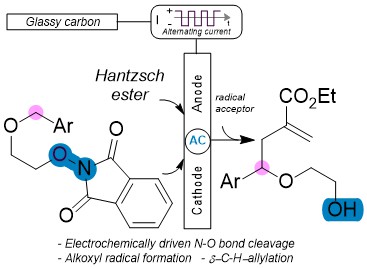
Abstract. The alkoxyl radicals have been proved to be useful synthetic intermediates in the δ-functionalization of C-H bonds, and their generation has progressed from the traditional harsh and toxic environments to benign reaction conditions provided by photoredox catalysis (PRC) and organic electrosynthesis (OES). This work describes the findings related to the reductive electrogeneration of oxygen-centered radicals from N-alkoxyphthalimides (NAPIs) and their use in remote C-H allylation. In this approach, the use of pulsed alternating polarity electrolysis, Hantzsch ester in the presence of δ-terpinene as a proton donor and hydrogen donor, respectively, in combination of an allyl sulfone led us to achieve the consecutive cathodic reduction, N-O cleavage, 1,5-hydrogen atom transfer, and radical allylation. Finally, the synthesized NAPIs were subjected to standard photocatalytic redox conditions, yielding comparable results.
Resumen. Los radicales alcoxilo han demostrado ser intermediarios sintéticos útiles en la funcionalización δ de enlaces C–H, y su generación ha evolucionado desde ambientes tradicionales severos y tóxicos hacia condiciones de reacción benignas proporcionadas por la catálisis fotoredox y la electroquímica orgánica. Este trabajo describe los hallazgos relacionados con la electrogeneración reductiva de radicales centrados en oxígeno a partir de N-alcoxiftalimidas y su uso en la alilación remota de enlaces C–H. En este estudio, el uso de electrólisis con polaridad alternante pulsada, éster de Hantzsch en presencia de γ-terpineno como donadores de protón e hidrógeno, respectivamente, en combinación con una alilsulfona, nos permitió lograr la reducción catódica, ruptura del enlace N–O, transferencia de átomo de hidrógeno 1,5 y alilación radicalaria. Finalmente, las N-alcoxiftalimidas sintetizadas se hicieron reaccionar en condiciones estándar de catálisis foto-redox, obteniéndose resultados comparables.
Downloads
References
1. Ali, M.; Sewell, S.; Li, J.; Wang, T. Organics. 2023, 4, 459–489. DOI: https://doi.org/10.3390/org4040033
2. Jia, K.; Chen, Y. Chem. Commun. 2018, 54, 6105-6112. DOI: https://doi.org/10.1039/C8CC02642D
3. Litwinienko, G.; Beckwith, A.L.J.; Ingold, K.U. Chem. Soc. Rev. 2011, 40, 2157–2163. DOI: https://doi.org/10.1039/C1CS15007C
4. Salamone, M.; Bietti, M. Synlett. 2014, 25, 1803–1816. DOI: https://doi.org/10.1055/s-0033-1341280
5. Hartung, J.; Gottwald, T.; Špehar, K. Synthesis. 2002, 1469-1498. DOI: https://doi.org/10.1055/s-0033-1341280
6. Banoun, C.; Magnier, E.; Dagousset, G. Synlett. 2024, 35, 268-278. DOI: https://doi.org/10.1055/a-2131-4126
7. Morcillo, S.P. Angew. Chem. Int. Ed. 2019, 58, 14044-14054. DOI: https://doi.org/10.1002/anie.201905218
8. Bietti, M.; Lanzalunga, O.; Salamone, M. J. Org. Chem. 2005, 70, 1417-1422. DOI: https://doi.org/10.1021/jo048026m
9. Salomone, M.; Bietti, M. Acc. Chem. Res. 2015, 48, 2895−2903. DOI: https://doi.org/10.1021/acs.accounts.5b00348
10. Stateman, L.M.; Nakafuku, K.M.; Nagib, D.A. Synthesis. 2018, 50, 1569–1586. DOI: https://doi.org/10.1055/s-0036-1591930
11. Luo, Y.-R., in: Comprehensive Handbook of Chemical Bond Energies; CRC Press: Boca Raton, FL, 2007. DOI: https://doi.org/10.1201/9781420007282
12. Chang, L.; An, Q.; Duan, L.; Feng, K.; Zuo, Z. Chem. Rev. 2022, 122, 2429−2486. DOI: https://doi.org/10.1021/acs.chemrev.1c00256
13. El Gehani, A.A.M.A.; Maashi, H.A.; Harnedy, J.; Morril, L.C. Chem. Commun. 2023, 59, 3655-3664. DOI: https://doi.org/10.1039/D3CC00302G
14. Budnikov, A.S.; Krylov, I.B.; Lastovko, A.V.; Yu, B.; Terent’ev, A.O. Asian J. Org. Chem. 2022, 11, e202200262. DOI: https://doi.org/10.1002/ajoc.202200262
15. Liu, J.; Jin, J.; Zhang, K.; Cai, L. Asian J. Org. Chem. 2023, 12, e202300160. DOI: https://doi.org/10.1002/ajoc.202300160
16. Kim, S.; Lee, T.A.; Song, Y. Synlett. 1998, 471-472. DOI: https://doi.org/10.1055/s-1998-1711
17. Crespi, S.; Fagnoni, M. Chem. Rev. 2020, 120, 9790−9833. DOI: https://doi.org/10.1021/acs.chemrev.0c00278
18. Chatgilialoglu, C.; Ferreri, C.; Landais, Y.; Timokhin, V.I. Chem. Rev. 2018, 118, 6516−6572. DOI: https://doi.org/10.1021/acs.chemrev.8b00109
19. Frontana-Uribe, B.A.; Little, R.D.; Ibanez, J.G.; Palma, A.; Vasquez-Medrano, R. Green Chem. 2010, 12, 2099–2119. DOI: https://doi.org/10.1039/C0GC00382D
20. Cembellín, S.; Batanero, B. Chem. Rec. 2021, 21, 2453–2471. DOI: https://doi.org/10.1002/tcr.202100128
21. Syroeshkin, M.A.; Krylov, I.B.; Hughes, A.M.; Alabugin, I.V.; Nasybullina, D.V.; Sharipov, M.Y.; Gultyai, V.P.; Terent’ev, A.O. J. Phys. Org. Chem. 2017, 30, e3744. DOI: https://doi.org/10.1002/poc.3744
22. Chicas-Baños, D.F.; López-Rivas, M.; Gonzalez, F.J.; Sartillo-Piscil, F.; Frontana-Uribe, B.A. Heliyon. 2024, 10, e23808. DOI: https://doi.org/10.1016/j.heliyon.2023.e23808
23. Romero-Ibañez, J.; Chicas-Baños, D.F.; Sartillo-Piscil, F.; Frontana-Uribe, B.A. Curr. Res. Green Sustain. Chem. 2024, 8, 100404. DOI: https://doi.org/10.1016/j.crgsc.2024.100404
24. Fu, X.; Ran, T.; Liu, J. Org. Chem. Front. 2024, 11, 6760-6767. DOI: https://doi.org/10.1039/D4QO01607F
25. Ibanez, J.G.; Frontana-Uribe, B.A.; Vasquez-Medrano, R. J. Mex. Chem. Soc. 2016, 60, 247-260. DOI: https://doi.org/10.29356/jmcs.v60i4.117
26. Zhang, J.; Li, Y.; Zhang, F.; Hu, C.; Chen, Y. Angew.Chem. Int. Ed. 2016, 55, 1872–1875. DOI: https://doi.org/10.1002/anie.201510014
27. Minke, C.; Suermann, M.; Bensmann, B.; Hanke-Rauschenbach, R. Int. J. Hydrog. Energy. 2021, 46, 23581-23590. DOI: https://doi.org/10.1016/j.ijhydene.2021.04.174
28. White, A.R.; Kozlowski, R.A.; Tsai, S.-C.; Vanderwal, C.D. Angew.Chem. Int. Ed. 2017, 56, 10525-10529. DOI: https://doi.org/10.1002/anie.201704119
29. Andrieux, C.P.; Combellas, C.; Kanoufi, F.; Savéant, J.-M.; Thiébault, A. J. Am. Chem. Soc. 1997, 119, 9527-9540. DOI: https://doi.org/10.1021/ja971094o
30. Box, J.R.; Avanthay, M.E.; Poole, D.L.; Lennox, A.J.J. Angew. Chem. Int. Ed. 2023, 62, e202218195. DOI: https://doi.org/10.1002/anie.202218195.
31. Mena, S.; Bernad, J.; Guirado, G. Catalysts. 2021, 11, 880. DOI: https://doi.org/10.3390/catal11080880
32. IKA. ElectraSyn 2.0 Electrochemistry Kit; https://www.ika.com/en/Products-LabEq/Electrochemistry-Kit-pg516/; accessed in August 2025.
33. Atkins, A.P.; Lennox, A.J.J. Curr. Opin. Electrochem. 2024, 44, 101441. DOI: https://doi.org/10.1016/j.coelec.2024.101441
34. Jamshidi, M.; Fastie, C.; Hilt, G. Synthesis. 2022, 54, 4661-4672. DOI: https://doi.org/10.1055/s-0042-1751367
35. Nguyen, J.D.; D’Amato, E.M.; Narayanam, J.M.R.; Stephenson, C.R.J. Nature Chem. 2012, 4, 854-859. DOI: https://doi.org/10.1038/nchem.1452
36. de Pedro Beato, E.; Spinnato, D.; Zhou, W.; Melchiorre, P. J. Am. Chem. Soc. 2021, 143, 12304-12314. DOI: https://doi.org/10.1021/jacs.1c05607
37. Leone, M.; Arnaldi, D.; Fagnoni, M. Org. Chem. Front. 2025, 12, 4970-4979. DOI: https://doi.org/10.1039/D5QO00399G
38. Bai, Y.; Shi, L.; Zheng, L.; Ning, S.; Che, X.; Zhang, Z.; Xiang, J. Org. Lett. 2021, 23, 2298−2302. DOI: https://doi.org/10.1021/acs.orglett.1c00430
39. Xochicale-Santana, L.; Cortezano-Arellano, O.; Frontana-Uribe, B.A.; Jimenez-Pérez, V.M.; Sartillo Piscil, F. J. Org. Chem. 2023, 88, 4880-4885. DOI: https://doi.org/10.1021/acs.joc.3c00251
40. Romero-Ibañez, J.; Guarneros-Cruz, K.A.; Sartillo-Piscil, F.; Frontana-Uribe, B.A. ChemSusChem. 2025, 18, e202501605. DOI: https://doi.org/10.1002/cssc.202501605
Downloads
Published
Issue
Section
License
Copyright (c) 2026 Edgar A. Colindres-Diaz, Diego Francisco Chicas-Baños, Julio Romero-Ibañez, Bernardo Antonio Frontana-Uribe

This work is licensed under a Creative Commons Attribution-NonCommercial 4.0 International License.
Authors who publish with this journal agree to the following terms:
- Authors retain copyright and grant the journal right of first publication with the work simultaneously licensed under a Creative Commons Attribution License that allows others to share the work with an acknowledgement of the work's authorship and initial publication in this journal.
- Authors are able to enter into separate, additional contractual arrangements for the non-exclusive distribution of the journal's published version of the work (e.g., post it to an institutional repository or publish it in a book), with an acknowledgement of its initial publication in this journal.