Exploring the Performance of Dye-Sensitized Solar Cells with Escontria chiotilla and Stenocereus sp. dyes
DOI:
https://doi.org/10.29356/jmcs.v70i1.2426Keywords:
Natural dye, DSSC, cacti, photovoltaic responseAbstract
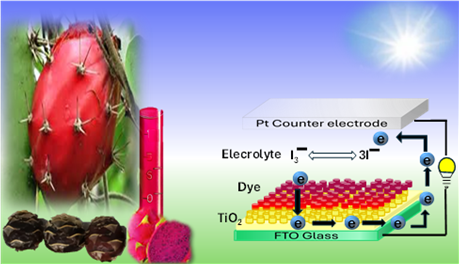
Abstract. In this study, natural dyes were extracted from two different cacti: Stenocereus sp. and Escontria chiotilla peel. The dyes were used as potential sensitizers for Dye-Sensitized Solar Cells (DSSCs). For Stenocereus sp. fruit, microfiltration and ultrafiltration processes were applied to obtain a purified sample and to investigate their effects on the photovoltaic response of DSSCs. The Escontria chiotilla peel extract was used directly. The chemical properties and stability of the dyes were investigated using UV-Vis spectroscopy, while FT-IR and XRD were used to identify the dye chemical composition and the structural features of working electrodes. Additionally, the photovoltaic properties of the fabricated devices were examined by measuring the J-V curves. It was found that the best performance was achieved using the Escontria chiotilla extract, yielding an efficiency of approximately 0.039 % due to the presence of chlorophyll as a sensitizer agent.
Resumen. En este estudio, se extrajeron colorantes naturales de dos distintos cactus: Stenocereus sp. y de Escontria chiotilla. Los colorantes se utilizaron como posibles colorantes para Celdas Solares Sensibilizadas por Tinte. Para el caso de Stenocereus sp, el extracto se sometió a procesos de microfiltración y ultrafiltración para obtener una muestra purificada y posteriormente, investigar sus efectos en la respuesta fotovoltaica de las DSSC. El extracto de cáscara de Escontria chiotilla se utilizó directamente. Las propiedades químicas y la estabilidad de los tintes se investigaron mediante espectroscopia UV-Vis, mientras que las técnicas FT-IR y XRD se utilizaron para identificar la composición química de los tintes y la estructura de los electrodos de trabajo respectivamente. Adicionalmente, las propiedades fotovoltaicas de los dispositivos fabricados se examinaron midiendo las curvas J-V. Se encontró que el mejor rendimiento fue alcanzado utilizando el extracto de Escontria chiotilla, obteniéndose una eficiencia de aproximadamente 0.039 % debido a la presencia de clorofila como agente sensibilizador.
Downloads
References
1. Rusilowati, U.; Ngemba, H. R.; Anugrah, R. W.; Fitriani, A.; Astuti, E. D. Int. Trans. Artif. Intell. 2024, 2, 114–120. DOI: https://doi.org/10.33050/italic.v2i2.537
2. Milani, S. J.; Bidhendi, G. N. Water Sci. Eng. 2023, 17, 283–291. DOI: https://doi.org/10.1016/j.wse.2023.11.003
3. Upadhyaya, H. M.; Senthilarasu, S.; Hsu, M.; Kumar, D. K. Sol. Energy Mater. Sol. Cells. 2013, 119, 291–295. DOI: https://doi.org/10.1016/j.solmat.2013.08.031
4. Devadiga, D.; Selvakumar, M.; Shetty, P.; Santosh. J. Power Sources. 2021, 493, 229698. DOI: https://doi.org/10.1016/j.jpowsour.2021.229698
5. Francis, O. I.; Ikenna, A. Nat. Sci. 2021, 13, 496–509. DOI: https://doi.org/10.4236/ns.2021.1312043
6. Best Research-Cell Efficiency Chart. Natl. Renewable Energy Lab. https://www.nrel.gov/pv/cell-efficiency.html, accessed in June 2025
7. Agrawal, A.; Siddiqui, S. A.; Soni, A.; Sharma, G. D. Sol. Energy. 2022, 233, 378–407. DOI: https://doi.org/10.1016/j.solener.2022.01.027
8. Buitrago, E.; Novello, A. M.; Meyer, T. Helv. Chim. Acta. 2020, 103. DOI: https://doi.org/10.1002/hlca.202000074
9. Jitchati, R.; Thathong, Y.; Wongkhan, K. Int. J. Appl. Phys. Math. 2012, 2, 107–110. DOI: https://doi.org/10.7763/ijapm.2012.v2.64
10. Pramananda, V.; Fityay, T. A. H.; Misran, E. IOP Conf. Ser.: Mater. Sci. Eng. 2021, 1122, 012104. DOI: https://doi.org/10.1088/1757-899x/1122/1/012104
11. Ahmed, U.; Anwar, A., in: Elsevier eBooks; Elsevier: 2022, 45–73. DOI: https://doi.org/10.1016/b978-0-12-818206-2.00008-6
12. Taya, S. A.; El-Agez, T. A.; Elrefi, K. S.; Abdel-Latif, M. S. Turk. J. Phys. 2015, 39, 24–30. DOI: https://doi.org/10.3906/fiz-1312-12
13. Osolobri, B. U.; Enaroseha, O. E.; Anho, L. O. Mater. Res. Innov. 2024, 1–8. DOI: https://doi.org/10.1080/14328917.2024.2389355
14. Kumaresan, S.; Subban, R.; Balasundaram, J. Ionics. 2024. DOI: https://doi.org/10.1007/s11581-024-05771-3
15. Bist, A.; Chatterjee, S. Energy Technol. 2021, 9. DOI: https://doi.org/10.1002/ente.202001058
16. Dizama-Tzec, F. I.; García-Rodríguez, R.; Rodríguez-Gattorno, G.; Canto-Aguilar, E. J.; Vega-Poot, A. G.; Heredia-Cervera, B. E.; Villanueva-Cab, J.; Morales-Flores, N.; Pal, U.; Oskam, G. RSC Adv. 2016, 6, 37424–37433. DOI: https://doi.org/10.1039/c5ra25618f
17. Erande, K.; Hawaldar, P.; Suryawanshi, S.; Babar, B.; Mohite, A.; Shelke, H.; Nipane, S.; Pawar, U. Mater. Today Proc. 2021, 43, 2716–2720. DOI: https://doi.org/10.1016/j.matpr.2020.06.357
18. Risnah, I. A.; Aisyah, A.; Iswadi; Saokani, J. Al-Kimia. 2018, 6, 1–9. DOI: https://doi.org/10.24252/al-kimia.v6i1.4826
19. Taya, S. A. Int. J. Mater. Sci. Appl. 2013, 2, 37. DOI: https://doi.org/10.11648/j.ijmsa.20130202.11
20. Ganta, D.; Jara, J.; Villanueva, R. Chem. Phys. Lett. 2017, 679, 97–101. DOI: https://doi.org/10.1016/j.cplett.2017.04.094
21. Obi, K.; Frolova, L.; Fuierer, P. Sol. Energy. 2020, 208, 312–320. DOI: https://doi.org/10.1016/j.solener.2020.08.006
22. Girón-Juárez, K.; Messina-Fernández, S.; Navarro-Santos, P.; Vázquez-Guevara, M.; Mendoza-Pérez, J. Optik. 2024, 306, 171793. DOI: https://doi.org/10.1016/j.ijleo.2024.171793
23. Joseph, S.; Winston, A. J. P. P.; Muthupandi, S.; Shobha, P.; Margaret, S. M.; Sagayaraj, P. J. Nanomater. 2021, 2021, 1–12. DOI: https://doi.org/10.1155/2021/5540219
24. Kabir, F.; Bhuiyan, M. M. H.; Hossain, M. R.; Manir, M. S.; Rahaman, M. S.; Islam, M. T.; Ullah, S.M. Optik 2022, 251, 168452. DOI: https://doi.org/10.1016/j.ijleo.2021.168452
25. Martínez, E. M. M.; Sandate-Flores, L.; Rodríguez-Rodríguez, J.; Rostro-Alanis, M.; Parra-Arroyo, L.; Antunes-Ricardo, M.; Serna-Saldívar, S. O.; Iqbal, H. M. N.; Parra-Saldívar, R. Plants. 2021, 10, 368. DOI: https://doi.org/10.3390/plants10020368
26. Weiss, C. Ann. N.Y. Acad. Sci. 1975, 244, 204–213. DOI: https://doi.org/10.1111/j.1749-6632.1975.tb41532.x
27. Jahan, R.; Polash, M.; Karim, M.; Juthee, A.; Fakir, A.; Hossain, A. Res. Crops. 2021, 22. DOI: https://doi.org/10.31830/2348-7542.2021.060
28. Da Silva, D. V. T.; Baião, D. D. S.; Magalhães, A.; Almeida, N. F.; Conte, C. A.; Paschoalin, V. M. F. Antioxidants. 2023, 12, 1823. DOI: https://doi.org/10.3390/antiox12101823
29. Ghann, W.; Kang, H.; Sheikh, T.; Yadav, S.; Chavez-Gil, T.; Nesbitt, F.; Uddin, J. Sci. Rep. 2017, 7. DOI: https://doi.org/10.1038/srep41470
30. Rajaramanan, T.; Gourji, F. H.; Elilan, Y.; Yohi, S.; Senthilnanthanan, M.; Ravirajan, P.; Velauthapillai, D. Sci. Rep. 2023, 13. DOI: https://doi.org/10.1038/s41598-023-40437-6
31. Lopera, A.; Restrepo, J.; Vélez, E. Adv. Theory Simul. 2024, 7. DOI: https://doi.org/10.1002/adts.202400145
32. S, S.; Pesala, B. ACS Omega. 2019, 4, 18023–18034. DOI: https://doi.org/10.1021/acsomega.9b01875
33. Gonzalez-Flores, C. A.; Pourjafari, D.; Escalante, R.; Canto-Aguilar, E. J.; Poot, A. V.; Castán, J. M. A.; Kervella, Y.; Demadrille, R.; Riquelme, A. J.; Anta, J. A.; Oskam, G. ACS Appl. Energy Mater. 2022, 5, 14092–14106. DOI: https://doi.org/10.1021/acsaem.2c02609
34. Rezaee, M.; Khoie, S. M. M.; Liu, K. H. CrystEngComm. 2011, 13, 5055. DOI: https://doi.org/10.1039/c1ce05185g
35. Gonçalves, L. C. P.; de Souza Trassi, M. A.; Lopes, N. B.; Dörr, F. A.; Santos, M. T. D.; Baader, W. J.; Oliveira, V. X.; Bastos, E. L. Food Chem. 2011, 131, 231–238. DOI: https://doi.org/10.1016/j.foodchem.2011.08.067
Downloads
Published
Issue
Section
License
Copyright (c) 2025 Romero-Contreras A., González-Juárez E., Sandate-Flores L., Sinagawa-García S., De La Fuente-Loera R., Sánchez-Cervantes E.

This work is licensed under a Creative Commons Attribution-NonCommercial 4.0 International License.
Authors who publish with this journal agree to the following terms:
- Authors retain copyright and grant the journal right of first publication with the work simultaneously licensed under a Creative Commons Attribution License that allows others to share the work with an acknowledgement of the work's authorship and initial publication in this journal.
- Authors are able to enter into separate, additional contractual arrangements for the non-exclusive distribution of the journal's published version of the work (e.g., post it to an institutional repository or publish it in a book), with an acknowledgement of its initial publication in this journal.