Relationships of Structural, Electronic and Energy Properties of Free and Adsorbed Molecules Over MoS₂ Model Clusters, Involved in the DDS and HYDS Pathways for the HDS Of 4,6-DMDBT. A CDFT Study
DOI:
https://doi.org/10.29356/jmcs.v70i1.2498Keywords:
DFT, CDFT, HDS, 4,6-DMBT, Catalizador de MoS2Abstract
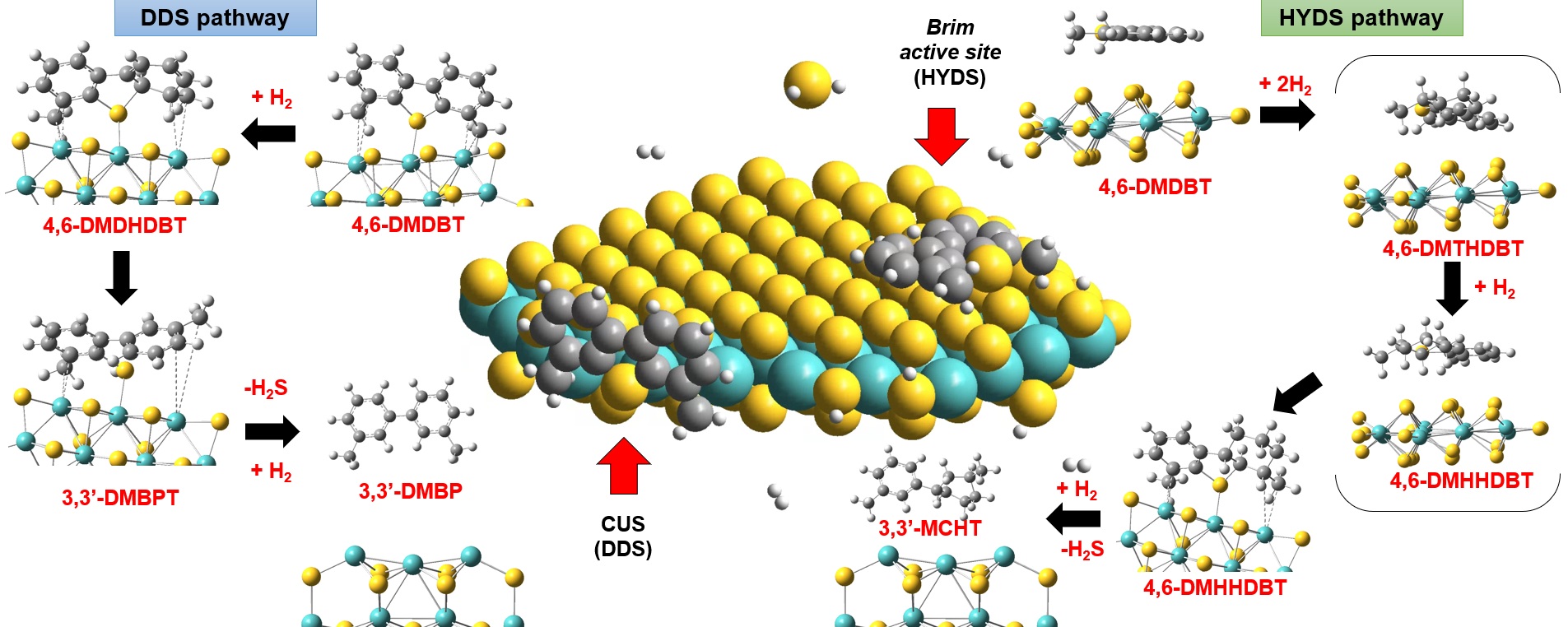
Abstract. The reaction pathways, direct desulfurization (DDS) and hydrogenation-desulfurization (HYDS), in the HDS of 4,6-DMDBT on MoS2 clusters representing different models of coordinatively unsaturated sites (CUS) and brim active sites are analyzed using Density Functional Theory (DFT) and related concepts (CDFT). Reactivity indices of free molecule are related to the structural and energy properties of the chemisorbed molecules in model clusters. The results show that the bond lengths between the S atom of the adsorbed organic molecules and the Mo atom at CUS are multilinearly related to nucleophilic indices of nucleophilic centers of free molecules. In the DDS pathway, the high adsorption energy and the large S-Mo bond length of 3,3'-dimethyl-biphenyl-2-thiol suggest that the controlling reaction step is the hydrogenolysis of its S-C bond. It was found that a multilinear relationship exists between surface reaction energies (hydrogenation, hydrogen transfer, and hydrogenolysis) and reaction energies calculated for free molecules, electrophilicity global indices, and HOMO-LUMO gaps of free sulfur-containing molecules. Similarly, multilinear relationships were found between adsorption energies of the molecules on CUS and brim sites of model clusters and the nucleophilic indices of the different nucleophilic centers in free molecule.
Resumen. Se analizan las rutas de reacción, desulfuración directa (DDS) e hidrogenación-desulfuración (HYDS), en la HDS de 4,6-DMDBT en cúmulos modelos de MoS2 que representan diferentes sitios coordinativamente insaturados (CUS) y sitios activos brim mediante la Teoría del Funcional de la Densidad (DFT) y los conceptos relacionados (CDFT). Los índices de reactividad de moléculas libres son relacionados con las propiedades estructurales y de energía de las moléculas quimisorbidas en los cúmulos modelo. Los resultados muestran que las longitudes de enlace entre el átomo de S de las moléculas orgánicas adsorbidas y el átomo de Mo en un CUS están relacionadas multilinealmente con los índices nucleofílicos de los centros nucleofílicos de las moléculas libres. En la ruta DDS, la alta energía de adsorción y la gran longitud de enlace S-Mo del 3,3'-dimetil-bifenil-2-tiol sugieren que el paso de reacción controlante es la hidrogenólisis de su enlace S-C. Se encontró una relación multilínea entre las energías de reacción superficial (hidrogenación, transferencia de hidrógeno e hidrogenólisis) y las energías de reacción calculadas para moléculas libres, los índices globales de electrofilicidad y las brechas HOMO-LUMO de las moléculas libres que contienen azufre. De igual manera, se encontraron relaciones multilíneas entre las energías de adsorción de las moléculas en los sitios brim y CUS de los cúmulos modelo y los índices nucleofílicos de los diferentes centros nucleofílicos en las moléculas libres.
Downloads
References
1. Rana, M. S.; Sámano, V.; Ancheyta, J.; Diaz, J. A. I. Fuel. 2007, 86, 1216–1231 DOI: https://doi.org/10.1016/j.fuel.2006.08.004
2. Stanislaus, A.; Marafi, A. M. J.; Rana, M. S. Catal. Today. 2010, 153, 1–68 DOI: https://doi.org/10.1016/j.cattod.2010.05.011
3. Brorson, M.; Carlsson, A.; Topsøe, H. Catal. Today 2007, 123, 31–36 DOI: https://doi.org/10.1016/j.cattod.2007.01.073.
4. Topsøe, H. The Role of Co–Mo–S Type Structures in Hydrotreating Catalysts. Appl. Catal. Gen. 2007, 322, 3–8 DOI: https://doi.org/10.1016/j.apcata.2007.01.002.
5. Houalla, M.; Nag, N. K.; Sapre, A. V.; Broderick, D. H.; Gates, B. C. Hydrodesulfurization of Dibenzothiophene Catalyzed by Sulfided CoO-MoO3γ-Al2O3: The Reaction Network. AIChE J. 1978, 24 (6), 1015–1021 DOI: https://doi.org/10.1002/aic.690240611.
6. Ding, L.; Zhang, Z.; Zheng, Y.; Ring, Z.; Chen, J. Effect of Fluorine and Boron Modification on the HDS, HDN and HDA Activity of Hydrotreating Catalysts. Appl. Catal. Gen. 2006, 301 (2), 241–250 DOI: https://doi.org/10.1016/j.apcata.2005.12.014.
7. Nicosia, D.; Prins, R. The Effect of Phosphate and Glycol on the Sulfidation Mechanism of CoMo/Al2O3 Hydrotreating Catalysts: An in Situ QEXAFS Study. J. Catal. 2005, 231 (2), 259–268 DOI: https://doi.org/10.1016/j.jcat.2005.01.018.
8. Ramírez, J.; Sánchez-Minero, F. Support Effects in the Hydrotreatment of Model Molecules. Catal. Today 2008, 130 (2), 267–271 DOI: https://doi.org/10.1016/j.cattod.2007.10.103.
9. Bai, Z.; Wang, L.; Cao, H.; Zhang, X.; Li, G. Symbiosis of 1 T and 2H Phases in the Basal Plane of Defective MoS2 Nanoflowers for Efficient Hydrodesulfurization. Fuel 2022, 322, 124252 DOI: https://doi.org/10.1016/j.fuel.2022.124252.
10. Wang, L.; Bai, Z.; Zhang, X.; Li, G. Co-Doped MoS2 Nanosheets Vertically Grown on Ti3C2 MXenes for Efficient Hydrodesulfurization in High-Temperature Environments. ACS Appl. Nano Mater. 2022, 5 (7), 9666–9677 DOI: https://doi.org/10.1021/acsanm.2c01892.
11. Cao, H.; Bai, Z.; Li, Y.; Xiao, Z.; Zhang, X.; Li, G. Solvothermal Synthesis of Defect-Rich Mixed 1T-2H MoS2 Nanoflowers for Enhanced Hydrodesulfurization. ACS Sustain. Chem. Eng. 2020, 8 (19), 7343–7352 DOI: https://doi.org/10.1021/acssuschemeng.0c00736.
12. Zhang, T.; Bai, Z.; Wang, L.; Zhang, X.; Li, G. Modulating Crystallization of MoS2 Nanostructures by Dimethyl Sulfoxide for Enhanced Hydrodesulfurization. ACS Appl. Nano Mater. 2023, 6 (23), 21752–21762 DOI: https://doi.org/10.1021/acsanm.3c03951.
13. Zheng, P.; Duan, A.; Chi, K.; Zhao, L.; Zhang, C.; Xu, C.; Zhao, Z.; Song, W.; Wang, X.; Fan, J. Influence of Sulfur Vacancy on Thiophene Hydrodesulfurization Mechanism at Different MoS2 Edges: A DFT Study. Chem. Eng. Sci. 2017, 164, 292–306 DOI: https://doi.org/10.1016/j.ces.2017.02.037.
14. Prodhomme, P.-Y.; Raybaud, P.; Toulhoat, H. Free-Energy Profiles along Reduction Pathways of MoS2 M-Edge and S-Edge by Dihydrogen: A First-Principles Study. J. Catal. 2011, 280 (2), 178–195 DOI: https://doi.org/10.1016/j.jcat.2011.03.017.
15. Rosen, A. S.; Notestein, J. M.; Snurr, R. Q. Comprehensive Phase Diagrams of MoS2 Edge Sites Using Dispersion-Corrected DFT Free Energy Calculations. J. Phys. Chem. C 2018, 122 (27), 15318–15329 DOI: https://doi.org/10.1021/acs.jpcc.8b02524.
16. Sharifvaghefi, S.; Yang, B.; Zheng, Y. New Insights on the Role of H2S and Sulfur Vacancies on Dibenzothiophene Hydrodesulfurization over MoS2 Edges. Appl. Catal. Gen. 2018, 566, 164–173 DOI: https://doi.org/10.1016/j.apcata.2018.05.033.
17. Mundotiya, S.; Singh, R.; Saha, S.; Kakkar, R.; Pal, S.; Kunzru, D.; Pala, R. G. S.; Sivakumar, S. Effect of Sodium on Ni-Promoted MoS2 Catalyst for Hydrodesulfurization Reaction: Combined Experimental and Simulation Study. Energy Fuels 2021, 35 (3), 2368–2378 DOI: https://doi.org/10.1021/acs.energyfuels.0c02879.
18. Liu, Y.; Guan, S.; Du, X.; Chen, Y.; Yang, Y.; Chen, K.; Zheng, Z.; Wang, X.; Shen, X.; Hu, C.; Li, X. S-Vacancy Defect and Transition-Metal Atom Doping to Trigger Hydrogen Evolution of Two-Dimensional MoS2. Energy Fuels 2023, 37 (7), 5370–5377 DOI: https://doi.org/10.1021/acs.energyfuels.2c03942.
19. Del Plá, J.; Bof, L. P.; Pis Diez, R. MoCo and MoWNi Clusters as Models for Hydrodesulfurization: A DFT Study of the Geometric, Electronic, and Magnetic Properties of MomCon (3 ≤ m + n ≤ 8) and MoxWyNiz (3 ≤ x + y + z ≤ 8) Clusters. J. Phys. Chem. C 2019, 123 (1), 868–877 DOI: https://doi.org/10.1021/acs.jpcc.8b09773.
20. De Proft, F. Basic Functions. In Conceptual Density Functional Theory; Liu, S., Ed.; John Wiley & Sons, Ltd, 2022; pp 17–46 DOI: https://doi.org/10.1002/9783527829941.ch2.
21. Domingo, L. R.; Ríos-Gutiérrez, M.; Pérez, P. Applications of the Conceptual Density Functional Theory Indices to Organic Chemistry Reactivity. Molecules 2016, 21 (6) DOI: https://doi.org/10.3390/molecules21060748.
22. Huck, L. A.; Leigh, W. J. Kinetic and Mechanistic Studies of the Reactions of Diarylgermylenes and Tetraaryldigermenes with Carbon Tetrachloride. Can. J. Chem. 2011, 89 (2), 241–255 DOI: https://doi.org/10.1139/V10-128.
23. Domingo, L. R.; Sáez, J. A. Understanding the Mechanism of Polar Diels–Alder Reactions. Org. Biomol. Chem. 2009, 7 (17), 3576–3583 DOI: https://doi.org/10.1039/B909611F.
24. Bagaria, P.; Roy, R. K. Correlation of Global Electrophilicity with the Activation Energy in Single-Step Concerted Reactions. J. Phys. Chem. A 2008, 112 (1), 97–105 DOI: https://doi.org/10.1021/jp073357z.
25. Pérez, P.; Domingo, L. R.; José Aurell, M.; Contreras, R. Quantitative Characterization of the Global Electrophilicity Pattern of Some Reagents Involved in 1,3-Dipolar Cycloaddition Reactions. Tetrahedron 2003, 59 (17), 3117–3125 DOI: https://doi.org/10.1016/S0040-4020(03)00374-0.
26. Yang, H.; Fairbridge, C.; Chen, J.; Ring, Z. Structure-HDS Reactivity Relationship of Dibenzothiophenes Based on Density Functional Theory. Catal. Lett. 2004, 97 (3), 217–222 DOI: https://doi.org/10.1023/B:CATL.0000038587.25800.7e.
27. García-Cruz, I.; Valencia, D.; Klimova, T.; Oviedo-Roa, R.; Martínez-Magadán, J. M.; Gómez-Balderas, R.; Illas, F. Proton Affinity of S-Containing Aromatic Compounds: Implications for Crude Oil Hydrodesulfurization. J. Mol. Catal. Chem. 2008, 281 (1), 79–84 DOI: https://doi.org/10.1016/j.molcata.2007.08.031.
28. Li, H.; Zhu, W.; Zhu, S.; Xia, J.; Chang, Y.; Jiang, W.; Zhang, M.; Zhou, Y.; Li, H. The Selectivity for Sulfur Removal from Oils: An Insight from Conceptual Density Functional Theory. AIChE J. 2016, 62 (6), 2087–2100 DOI: https://doi.org/10.1002/aic.15161.
29. Frisch, M. J.; Trucks, G. W.; Schlegel, H. B.; Scuseria, G. E.; Robb, M. A.; Cheeseman, J. R.; Scalmani, G.; Barone, V.; Petersson, G. A.; Nakatsuji, H.; Li, X.; Caricato, M.; Marenich, A. V.; Bloino, J.; Janesko, B. G.; Gomperts, R.; Mennucci, B.; Hratchian, H. P.; Ortiz, J. V.; Izmaylov, A. F.; Sonnenberg, J. L.; Williams-Young, D.; Ding, F.; Lipparini, F.; Egidi, F.; Goings, J.; Peng, B.; Petrone, A.; Henderson, T.; Ranasinghe, D.; Zakrzewski, V. G.; Gao, J.; Rega, N.; Zheng, G.; Liang, W.; Hada, M.; Ehara, M.; Toyota, K.; Fukuda, R.; Hasegawa, J.; Ishida, M.; Nakajima, T.; Honda, Y.; Kitao, O.; Nakai, H.; Vreven, T.; Throssell, K.; Montgomery Jr., J. A.; Peralta, J. E.; Ogliaro, F.; Bearpark, M. J.; Heyd, J. J.; Brothers, E. N.; Kudin, K. N.; Staroverov, V. N.; Keith, T. A.; Kobayashi, R.; Normand, J.; Raghavachari, K.; Rendell, A. P.; Burant, J. C.; Iyengar, S. S.; Tomasi, J.; Cossi, M.; Millam, J. M.; Klene, M.; Adamo, C.; Cammi, R.; Ochterski, J. W.; Martin, R. L.; Morokuma, K.; Farkas, O.; Foresman, J. B.; Fox, D. J. Gaussian 09, Revision D.01; Gaussian, Inc.: Wallingford, CT, 2013.
30. Perdew, J. P.; Burke, K.; Ernzerhof, M. Generalized Gradient Approximation Made Simple. Phys. Rev. Lett. 1996, 77 (18), 3865–3868 DOI: https://doi.org/10.1103/PhysRevLett.77.3865.
31. Perdew, J. P.; Burke, K.; Ernzerhof, M. Errata: Generalized Gradient Approximation Made Simple. Phys. Rev. Lett. 1997, 78 (7), 1396 DOI: https://doi.org/10.1103/PhysRevLett.78.1396.
32. Schäfer, A.; Huber, C.; Ahlrichs, R. Fully Optimized Contracted Gaussian Basis Sets of Triple Zeta Valence Quality for Atoms Li to Kr. J. Chem. Phys. 1994, 100 (8), 5829–5835 DOI: https://doi.org/10.1063/1.467146.
33. Schäfer, A.; Horn, H.; Ahlrichs, R. Fully Optimized Contracted Gaussian Basis Sets for Atoms Li to Kr. J. Chem. Phys. 1992, 97 (4), 2571–2577 DOI: https://doi.org/10.1063/1.463096.
34. Weigend, F. Accurate Coulomb-Fitting Basis Sets for H to Rn. Phys. Chem. Chem. Phys. 2006, 8 (9), 1057–1065 DOI: https://doi.org/10.1039/B515623H.
35. Weigend, F.; Ahlrichs, R. Balanced Basis Sets of Split Valence, Triple Zeta Valence and Quadruple Zeta Valence Quality for H to Rn: Design and Assessment of Accuracy. Phys. Chem. Chem. Phys. 2005, 7 (18), 3297–3305 DOI: https://doi.org/10.1039/B508541A.
36. Grimme, S.; Ehrlich, S.; Goerigk, L. Effect of the Damping Function in Dispersion Corrected Density Functional Theory. J. Comput. Chem. 2011, 32 (7), 1456–1465 DOI: https://doi.org/10.1002/jcc.21759.
37. Ding, S.; Zhou, Y.; Wei, Q.; Jiang, S.; Zhou, W. Substituent Effects of 4,6-DMDBT on Direct Hydrodesulfurization Routes Catalyzed by Ni-Mo-S Active Nanocluster—A Theoretical Study. Catal. Today 2018, 305, 28–39 DOI: https://doi.org/10.1016/j.cattod.2017.10.040.
38. Wang, W.; Li, H.; Han, W.; Zhang, L.; Zhao, X.; Li, M. A DFT Study on the Adsorption Behavior of Sulfur and Nitrogen Compounds on the NiMoS Phase. China Pet. Process. Petrochem. Technol. 2020, 22 (1), 40–48.
39. Liu, X.; Fan, X.; Wang, L.; Sun, J.; Wei, Q.; Zhou, Y.; Huang, W. Competitive Adsorption between Sulfur- and Nitrogen-Containing Compounds over NiMoS Nanocluster: The Correlations of Electronegativity, Morphology and Molecular Orbital with Adsorption Strength. Chem. Eng. Sci. 2021, 231, 116313 DOI: https://doi.org/10.1016/j.ces.2020.116313.
40. Sattayanon, C.; Namuangruk, S.; Kungwan, N.; Kunaseth, M. Reaction and Free-Energy Pathways of Hydrogen Activation on Partially Promoted Metal Edge of CoMoS and NiMoS: A DFT and Thermodynamics Study. Fuel Process. Technol. 2017, 166, 217–227 DOI: https://doi.org/10.1016/j.fuproc.2017.06.003.
41. Hirshfeld, F. L. Bonded-Atom Fragments for Describing Molecular Charge Densities. Theor. Chim. Acta 1977, 44 (2), 129–138 DOI: https://doi.org/10.1007/BF00549096.
42. Orita, H.; Uchida, K.; Itoh, N. Ab Initio Density Functional Study of the Structural and Electronic Properties of an MoS2 Catalyst Model: A Real Size Mo27S54 Cluster. J. Mol. Catal. Chem. 2003, 195 (1), 173–180 DOI: https://doi.org/10.1016/S1381-1169(02)00528-9.
43. McQuarrie, D. A.; Simon, J. D. Molecular Thermodynamics; University Science Books: : Sausalito, CA, 1999.
44. Egorova, M.; Prins, R. Hydrodesulfurization of Dibenzothiophene and 4,6-Dimethyldibenzothiophene over Sulfided NiMo/γ-Al2O3, CoMo/γ-Al2O3, and Mo/γ-Al2O3 Catalysts. J. Catal. 2004, 225 (2), 417–427 DOI: https://doi.org/10.1016/j.jcat.2004.05.002.
45. Bollinger, M. V.; Jacobsen, K. W.; Nørskov, J. K. Atomic and Electronic Structure of MoS2 Nanoparticles. Phys. Rev. B 2003, 67 (8), 085410 DOI: https://doi.org/10.1103/PhysRevB.67.085410. DOI: https://doi.org/10.1103/PhysRevB.67.129906
46. Raybaud, P. Understanding and Predicting Improved Sulfide Catalysts: Insights from First Principles Modeling. Appl. Catal. Gen. 2007, 322, 76–91 DOI: https://doi.org/10.1016/j.apcata.2007.01.005.
47. Dickinson, R. G.; Pauling, L. THE CRYSTAL STRUCTURE OF MOLYBDENITE. J. Am. Chem. Soc. 1923, 45 (6), 1466–1471 DOI: https://doi.org/10.1021/ja01659a020.
48. Lauritsen, J. V.; Kibsgaard, J.; Helveg, S.; Topsøe, H.; Clausen, B. S.; Lægsgaard, E.; Besenbacher, F. Size-Dependent Structure of MoS2 Nanocrystals. Nat. Nanotechnol. 2007, 2 (1), 53–58 DOI: https://doi.org/10.1038/nnano.2006.171.
49. Lauritsen, J. V.; Kibsgaard, J.; Olesen, G. H.; Moses, P. G.; Hinnemann, B.; Helveg, S.; Nørskov, J. K.; Clausen, B. S.; Topsøe, H.; Lægsgaard, E.; Besenbacher, F. Location and Coordination of Promoter Atoms in Co- and Ni-Promoted MoS2-Based Hydrotreating Catalysts. J. Catal. 2007, 249 (2), 220–233 DOI: https://doi.org/10.1016/j.jcat.2007.04.013.
50. Rangarajan, S.; Mavrikakis, M. DFT Insights into the Competitive Adsorption of Sulfur- and Nitrogen-Containing Compounds and Hydrocarbons on Co-Promoted Molybdenum Sulfide Catalysts. ACS Catal. 2016, 6 (5), 2904–2917 DOI: https://doi.org/10.1021/acscatal.6b00058.
51. Šarić, M.; Rossmeisl, J.; Moses, P. G. Modeling the Adsorption of Sulfur Containing Molecules and Their Hydrodesulfurization Intermediates on the Co-Promoted MoS2 Catalyst by DFT. J. Catal. 2018, 358, 131–140 DOI: https://doi.org/10.1016/j.jcat.2017.12.001.
52. Ataca, C.; Şahin, H.; Ciraci, S. Stable, Single-Layer MX2 Transition-Metal Oxides and Dichalcogenides in a Honeycomb-Like Structure. J. Phys. Chem. C 2012, 116 (16), 8983–8999 DOI: https://doi.org/10.1021/jp212558p.
53. Kuchitsu, K. Landolt-Bornstein: Group II: Atomic and Molecular Physics Volume 15: Structure Data of Free Polyatomic Molecules; Kuchitsu, K., Ed.; Springer-Verlag: Berlin, Heidelberg, 1987; Vol. 15 DOI: https://doi.org/10.1007/978-3-642-45748-7_1.
54. Moses, P. G.; Grabow, L. C.; Fernandez Sanchez, E.; Hinnemann, B.; Topsøe, H.; Knudsen, K. G.; Norskov, J. K. Trends in Hydrodesulfurization Catalysis Based on Realistic Surface Models. Catal. Lett. 2014, 144 (8), 1425–1432 DOI: https://doi.org/10.1007/s10562-014-1279-4.
55. Kaddouri, Y.; Abrigach, F.; Yousfi, E. B.; Kodadi, M. E. New Thiazole, Pyridine and Pyrazole Derivatives as Antioxidant Candidates: Synthesis, DFT Calculations and Molecular Docking Study. Heliyon 2020, 6 (1), 1–9 DOI: https://doi.org/j.heliyon.2020.e03185. DOI: https://doi.org/10.1016/j.heliyon.2020.e03185
56. Tuxen, A. K.; Füchtbauer, H. G.; Temel, B.; Hinnemann, B.; Topsøe, H.; Knudsen, K. G.; Besenbacher, F.; Lauritsen, J. V. Atomic-Scale Insight into Adsorption of Sterically Hindered Dibenzothiophenes on MoS2 and Co–Mo–S Hydrotreating Catalysts. J. Catal. 2012, 295, 146–154 DOI: https://doi.org/10.1016/j.jcat.2012.08.004.
Downloads
Published
Issue
Section
License
Copyright (c) 2026 Hector Martinez-Grimaldo, Alan Miralrio, Perla Castillo-Villalón, Miguel Castro, Jorge Ramírez

This work is licensed under a Creative Commons Attribution-NonCommercial 4.0 International License.
Authors who publish with this journal agree to the following terms:
- Authors retain copyright and grant the journal right of first publication with the work simultaneously licensed under a Creative Commons Attribution License that allows others to share the work with an acknowledgement of the work's authorship and initial publication in this journal.
- Authors are able to enter into separate, additional contractual arrangements for the non-exclusive distribution of the journal's published version of the work (e.g., post it to an institutional repository or publish it in a book), with an acknowledgement of its initial publication in this journal.