Cochineal Wax (Dactylopius coccus costa) as an Eco-Friendly Alternative for Thermal Insulating Materials: A Physicochemical Approach
DOI:
https://doi.org/10.29356/jmcs.v70i1.2637Keywords:
Cochineal, wax, insect, insulator, FTIR, environmentAbstract
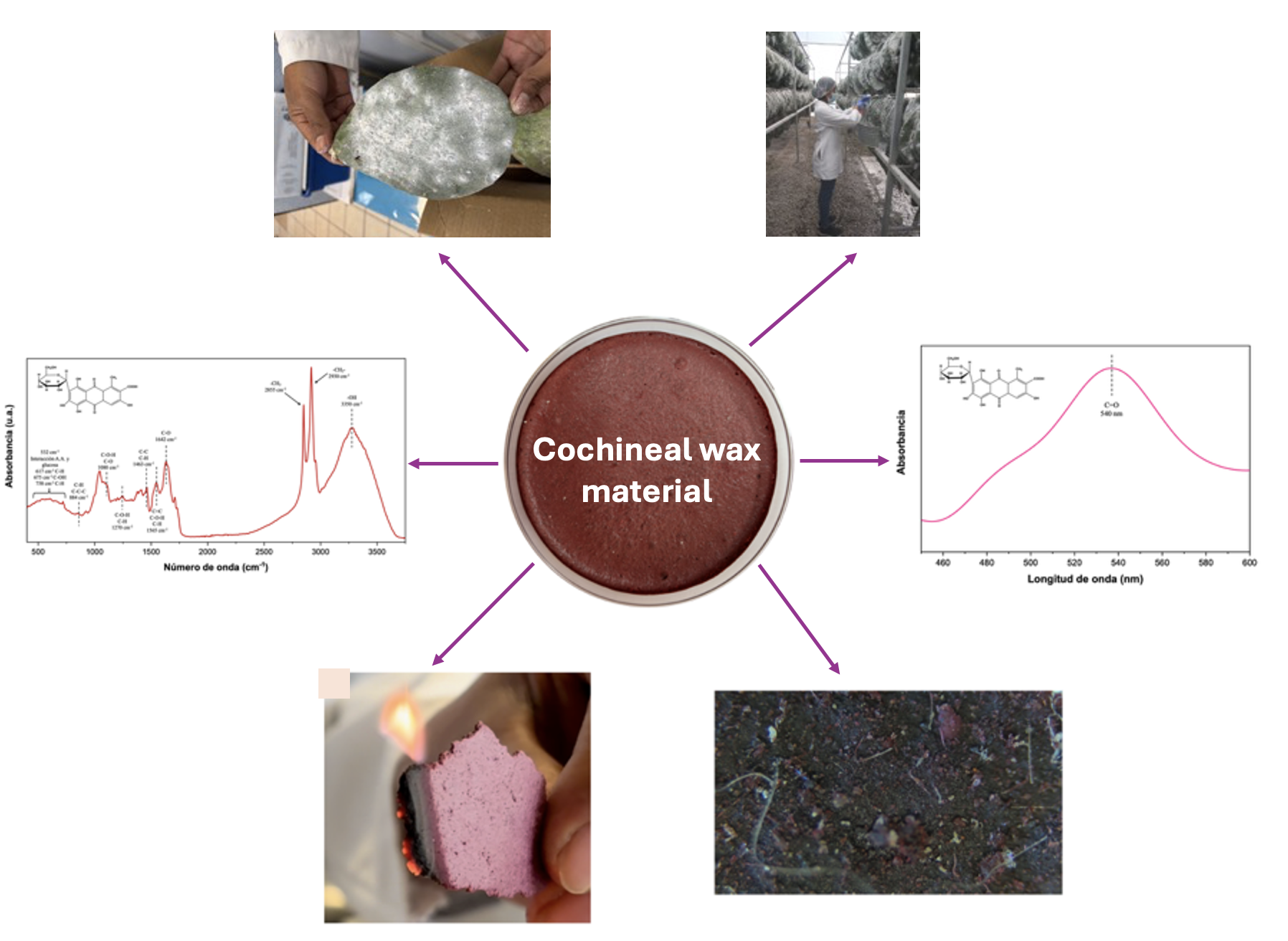
Abstract. Cochineal (Dactylopius coccus costa) is an insect of remarkable historical and contemporary value, whose wax represents a local, renewable, and biodegradable resource. In this study, an innovative material was developed from cochineal wax collected in San Francisco Tepeyecac (San Martín Texmelucan, Puebla, Mexico), aiming to explore its potential as an eco-friendly alternative for thermal insulation. The material was characterized using FTIR, UV-Visible, and GC-MS analyses, which revealed the presence of functional groups found in commercial insulating materials (CH2, CH3, C=O, C=C, COH) and identified nine compounds with insulating properties. Optical microscopy confirmed characteristic structures of both the wax and the fabricated material. In thermal conductivity tests, the material demonstrated stability under heat exposure, maintaining its structure after 10 seconds, and extinguishing the flame. At 50 °C, its performance in ice-melting experiments was comparable to that of wood and glass, while diamond detector measurements confirmed behavior similar to that of commercial insulators. These findings open a new line of research into the sustainable use of cochineal wax for thermal insulation materials, highlighting its potential industrial applications and its benefits to Mexican society.
Resumen. Cochineal (Dactylopius coccus costa) es un insecto de gran valor histórico y actual, cuya cera constituye un recurso local, renovable y biodegradable. En este trabajo se desarrolló un material innovador a partir de cera de grana cochinilla obtenida en San Francisco Tepeyecac (San Martín Texmelucan, Puebla, México), con el objetivo de explorar su potencial como alternativa eco-friendly para aislantes térmicos. El material fue caracterizado mediante FTIR, UV-Visible y GC-MS, identificándose enlaces funcionales relevantes (CH2, CH3, C=O, C=C, COH) y nueve compuestos con propiedades aislantes. La microscopía óptica reveló estructuras características de la cera y del material elaborado. En pruebas de conductividad térmica, el material mostró estabilidad frente a una fuente de calor, manteniendo su estructura después de 10 segundos de exposición. Además, a 50 °C, su desempeño en la fusión de hielo fue comparable al de la madera y el vidrio, y un detector de diamante confirmó un comportamiento similar al de los aislantes comerciales. Estos resultados abren una nueva línea de investigación sobre el aprovechamiento de la cera de cochinilla como insumo sustentable para materiales aislantes, con aplicaciones potenciales que podrían beneficiar tanto a la industria como a la sociedad mexicana.
Downloads
References
1. Vigueras, A.L.; Portillo, L. Revista Etnobiología. 2025, 72–75.
2. Reyes-Pérez, R.; Pérez-Hernández, J.; Rosas-Morales, M.; et al. Molecules. 2024, 29:5568. DOI: https://doi.org/10.3390/molecules29235568
3. Vakte, S.R.; Sonawane, C.P.; Saraf, K.V. et al. Int. J. Entomol. Res. 2024, 9.
4. Roque-Rodríguez, F.J. J. Insect. Sci. 2022, 22. DOI: https://doi.org/10.1093/jisesa/ieab098
5. Rosas-Flores, J.A.; Rosas-Flores, D. Energy Build. 2020, 209, 109698. DOI: https://doi.org/10.1016/j.enbuild.2019.109698
6. Griego, D.; Krarti, M.; Hernandez-Guerrero, A. Sustain Cities Soc. 2015, 17, 132–140. DOI: https://doi.org/10.1016/j.scs.2015.04.008
7. Khargotra, R.; Alam, T.; Thu, K. et al. Results Eng. 2024, 21, 101681. DOI: https://doi.org/10.1016/j.rineng.2023.101681
8. Alhabeeb, B.A.; Mohammed, H.N,; Alhabeeb, S.A. IOP Conf. Ser. Mater. Sci. Eng. 2021, 1067, 012097. DOI: https://doi.org/10.1088/1757-899X/1067/1/012097
9. Arroyo-Figueroa, G.; Medina-Saavedra, T.; Herrera-Mendez, C.H.; Dzul-Cauich, J.G. ECORFAN Journal Republic of Guatemala. 2023, 9, 7–11. DOI: https://doi.org/10.354297EJRG.2023.16.9.7.11.2023
10. Pomade, M.; Kieruzel, K.; Ujma, A.; Palutkiewicz, P.; Walasek, T.; Adamus, J. Materials. 2024, 17, 4718. DOI: https://doi.org/10.3390/ma17194718
11. Lian, X.; Tian, L.; Li, Z.; Zhao, X. Int. J. Heat Mass. Transf. 2023, 220, 124941. DOI: https://doi.org/10.1016/j.ijheatmasstransfer.2023.124941
12. Pavlovic, A.; Valzania, L.; Minak, G. Polymers. 2025, 17, 1996. DOI: https://doi.org/10.3390/polym17141996
13. Dobes, P., Izvolt, L.; Mecar, M.; Malachova, J. MATEC Web Conf. 2017, 117, 00039. DOI: https://doi.org/10.1051/matecconf/201711700039
14. Smetana, S.; Bhatia, A.; Batta, U. et al. Anim. Front. 2023, 13, 112–120. DOI: https://doi.org/10.1093/af/vfad033
15. Mitov, M.; Soldan, V.; Balor, S. Arthropod. Struct. Dev. 2018, 47, 622–626. DOI: https://doi.org/10.1016/j.asd.2018.10.003
16. Subramaniyan, N.K.; Elumalai, K.; Rajangam, J. et al. Egypt. J. Basic. Appl. Sci. 2023, 10, 12–24. DOI: https://doi.org/10.1080/2314808X.2022.2122289
17. Li, M.; Oswald, J.D.; Liu, Z. Insects. 2023, 14, 650. DOI: https://doi.org/10.3390/insects14070650
18. Ochoa-Manzo, G.M.; Martínez-Flores, H.E.; Rodiles-López, J.O.; Portillo, L. Cienc. Nicolaita. 2025, 26–34. DOI: https://doi.org/10.35830/cn.vi93.827
19. Çakmak, G.; Akay, C.; Donmez, M.B. et al. Materials. 2022, 15, 4232. DOI: https://doi.org/10.3390/ma15124232
20. Raimo, M. Materials. 2021, 14, 2136. DOI: https://doi.org/10.3390/ma14092136
21. Martínez, J.R.; Velázquez-Pérez, S.E.; Guerrero, G.; Espericueta, D.L.; Ortega-Zarzosa, G.; Herrera-González, A.M.; Barrientos-Hernández, F.R.; Lobo-Guerrero, A. Phys. B. 2020, 412438. DOI: https://doi.org/10.1016/j.physb.2020.412438
22. Ke, G.; Zhu, K.; Chowdhury, M.H. J. Nat. Fibers. 2019. DOI: https://doi.org/10.1080/15440478.2019.1623742
23. Sanches, N.B., Pedro, R., Diniz, M.F.; Mattos, E.; Navarro, S.; Lazzarini, R. J. Aerosp. Technol. Mang. 2013, 5, 421-430. DOI: https://doi.org/10.5028/jatm.v5i4.265
24. Goudarzi, M.; Mir, N.; Mousavi-Kamazani, M.; Bagheri, S.; Salavati-Niasari, M. Sci. Rep. 2016, 6, 32539. DOI: https://doi.org/10.1038/srep32539
25. Soto, M.; Rojas, C.; Cárdenas-Ramírez, J.P. Sustainability. 2023, 15. DOI: https://doi.org/10.3390/su15010058
26. Kocak, Y.; Yildiz, A. Int. J. Energy Res. 2021, 1-7. DOI: https://doi.org/10.1002/er.6883
27. Morales, K.M.; Berrie, B.H. e-Preserv Sci. 2015.
28. Predoi, D.; Groza, A.; Iconaru, S.L. et al. Materials. 2018, 11, 652. DOI: https://doi.org/10.3390/ma11050652
29. Lago, A.; Sanz, M.; Gordón, J.M. et al. J. Environ. Chem. Eng. 2022, 10, 107738. DOI: https://doi.org/10.1016/j.jece.2022.107738
30. Moreno, E., Cordobilla, R.; Calvet, T., et al. Acta Crystallogr. C. 2006, 62, o129–o131. DOI: https://doi.org/10.1107/S0108270106003106
31. Guo, Q.; Ai, L.; Cui, S.W., in: Methodology for Structural Analysis of Polysaccharides. Springer International Publishing, 2018, 69–71.
32. Syifa, F.; Hidayah, N.; Lukitaningsih, E. et al. Food Res. 2022, 6, 219–224. DOI: https://doi.org/10.26656/fr.2017.6(2).197
33. Sahariah, B.; Sarma, B.K. Chem. Sci. 2019, 10, 909–917. DOI: https://doi.org/10.1039/C8SC04221G
34. Abada, B.; Joag, S.; Alspach, B. et al. ACS EST Eng. 2023, 3, 1413–1423. DOI: https://doi.org/10.1021/acsestengg.3c00172
35. Kim, N.K.; Das, O. Molecules. 2021, 26, 6167. DOI: https://doi.org/10.3390/molecules26206167
36. Tawiah, B.; Ofori, E.A.; Bin, F. Sustainability. 2023, 15, 12185. DOI: https://doi.org/10.3390/su151612185
37. Liu, B.; Zhao, H.; Wang, Y. Adv. Mater. 2022, 34. DOI: https://doi.org/10.1002/adma.202107905
38. Lagüela, S.; Bison, P.; Peron, F.; Romagnoni, P. Thermochim. Acta. 2015, 600, 45–51. DOI: https://doi.org/10.1016/j.tca.2014.11.021
39. Samal, S.; Lee, J.; Jeong, D.Y.; Kim, H. Thermochim. Acta. 2015, 604:1–6. DOI: https://doi.org/10.1016/j.tca.2015.01.010
40. Feng, B.; Zhang, Y.H., Tu, J. et al. Case. Stud. Therm. Eng. 2022, 33, 101979. DOI: https://doi.org/10.1016/j.csite.2022.101979
41. Dou, R.; Ge, T.; Liu, X.; Wen, Z. Int. J. Heat Mass. Transf. 2016, 94, 156–163. DOI: https://doi.org/10.1016/j.ijheatmasstransfer.2015.11.069
42. Kidalov, S.V.; Shakhov, F.M. Materials. 2009, 2, 2467–2495. DOI: https://doi.org/10.3390/ma2042467
Downloads
Published
Issue
Section
License
Copyright (c) 2026 Francisco Javier Gómez-Montaño, Arlette Michelle García-de Jesús, Abdú Orduña-Díaz, Stephania Baena-Leyva, Jorge García-Dávila, Marisol López-Ruiz, Sulem Yali Granados-Balbuena

This work is licensed under a Creative Commons Attribution-NonCommercial 4.0 International License.
Authors who publish with this journal agree to the following terms:
- Authors retain copyright and grant the journal right of first publication with the work simultaneously licensed under a Creative Commons Attribution License that allows others to share the work with an acknowledgement of the work's authorship and initial publication in this journal.
- Authors are able to enter into separate, additional contractual arrangements for the non-exclusive distribution of the journal's published version of the work (e.g., post it to an institutional repository or publish it in a book), with an acknowledgement of its initial publication in this journal.