Electrostatic Interaction of Proteins Improves the Stability of A Food Powder Enriched with β-Carotene
DOI:
https://doi.org/10.29356/jmcs.v70i1.2501Keywords:
β-carotene, food powder, glass transition temperature, FTIR, water activityAbstract
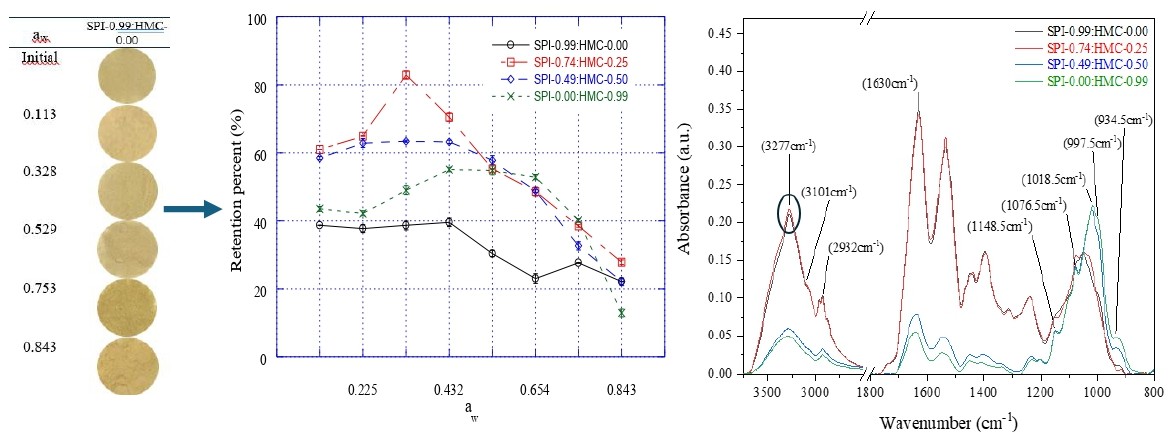
The aim of this work was to determine the effect of hydrolyzed marine collagen and soy protein isolate in the stability of protein food powder enriched with β-carotene. Four powders (SPI-0.99:HMC-0.00, SPI-0.74:HMC-0.25, SPI-0.49:HMC-0.50 and SPI-0.00:HMC-0.99) were prepared by freeze-drying with a concentration of 1 % (w/v) of β-carotene, varying the weight fraction of hydrolyzed marine collagen (HMC) and soy protein isolate (SPI). The powders were stored for 3 weeks in a water activity (aw) range from 0.11 to 0.84 at 25 °C and the degradation of β-carotene was determined by UV-vis spectrophotometry. After, it was caried out differential scanning calorimetry (DSC) at aw= 0 and aw= 0.328. Finally, the powders were analyzed by infrared spectroscopy (FTIR) at aw= 0.328 and were determined their technological properties. SPI-0.74:HMC-0.25 presented the highest intensity at 3277 cm-1 (N-H stretching), the highest percentage of β-carotene retention (83.84 %) and the highest glass transition temperature value (Tg=147.57 °C) at aw=0.328. The results showed that there is a greater interaction of marine collagen and soy protein in a specific ratio and water activity, which allows for the preservation of a greater amount of β-carotene.Therefore, the development of this study is an advance in identifying new factors that produce better stability of food powders rich in proteins and antioxidants.
Resumen. El objetivo de este trabajo fue determinar el efecto del colágeno marino hidrolizado y del aislado de proteína de soya en la estabilidad de un alimento proteico en polvo enriquecido con β-caroteno. En este trabajo se prepararon cuatro polvos (SPI-0.99:HMC-0, SPI-0.74:HMC-0.25, SPI-0.49:HMC-0.5 and SPI-0:HMC-0.99) mediante liofilización con una concentración de 1 % (p/v) de β-caroteno, variando la fracción en peso de colágeno marino hidrolizado (HMC) y aislado de proteína de soya (SPI). Los polvos se almacenaron durante 3 semanas en un rango de actividad de agua (aw) de 0.11 a 0.84 a 25 °C y la degradación del β-caroteno se determinó por espectrofotometría UV-vis. Después, se realizó calorimetría diferencia de barrido (DSC) a aw= 0 and aw= 0.328. Finalmente, los polvos fueron analizados por espectroscopia infrarroja (FTIR) a aw= 0.328 y se determinaron sus propiedades tecnológicas. SPI-0.74:HMC-0.25 presentó la mayor intensidad a 3277 cm-1 (estiramiento N-H), el mayor porcentaje de retención de β-caroteno (83.84 %) y el mayor valor de temperatura de transición vítrea (Tg=147.57 °C) a aw=0,328. Los resultados mostraron que existe una mayor interacción del colágeno marino y la proteína de soya en una especifica proporción y actividad de agua, lo que permite conservar una mayor cantidad de β-caroteno, por lo tanto, el desarrollo de este estudio es un avance para identificar nuevos factores que producen una mejor estabilidad de los polvos alimenticios ricos en proteínas y antioxidantes.
Downloads
References
1. Gupta, I.; Adin, S. N.; Panda, B. P.; Mujeeb, M.; Biotechnol. Appl. Biochem. 2022, 69, 2517–2529. DOI: http://dx.doi.org/10.1002/bab.2301 DOI: https://doi.org/10.1002/bab.2301
2. Boonlao, N.; Ruktanonchai, U. R.; Anal, A. K.; Colloids Surf. B Biointerfaces. 2022, 209, 112211. DOI: http://dx.doi.org/10.1016/j.colsurfb.2021.112211 DOI: https://doi.org/10.1016/j.colsurfb.2021.112211
3. Kim, W.; Wang, Y.; Vongsvivut, J.; Ye, Q.; Selomulya, C.; Food Chem. 2023, 426, 136565. DOI: http://dx.doi.org/10.1016/j.foodchem.2023.136565 DOI: https://doi.org/10.1016/j.foodchem.2023.136565
4. Geng, M.; Li, L.; Feng, X.; Xu, J.; Huang, Y.; Teng, F. L.; J. Mol. Liq. 2022, 360, 119511. DOI: http://dx.doi.org/10.1016/j.molliq.2022.119511 DOI: https://doi.org/10.1016/j.molliq.2022.119511
5. Deng, X. X.; Zhang, N.; Tang, C. H.; J. Sci. Food Agric. 2017, 97, 2230–2237. DOI: http://dx.doi.org/10.1002/jsfa.8033 DOI: https://doi.org/10.1002/jsfa.8033
6. Li, S.; Liu, Y.; Qin, W.; Zhang, Q.; Chen, D.; Lin, D.; Liu, S.; Huang, Z.; Chen, H. LWT. 2022, 157, 113120. DOI: https://doi.org/10.1016/j.lwt.2022.113120
7. Geng, M.; Feng, X.; Wu, X.; Tan, X.; Shang, B.; Huang, Y.; Li, Y.; Food Chem. 2023, 417, 135842. DOI: http://dx.doi.org/10.1016/j.foodchem.2023.135842 DOI: https://doi.org/10.1016/j.foodchem.2023.135842
8. Tyug Tan, S.; Shin Tan, S.; Xuan Tan, C.; PharmaNutrition. 2023, 25, 100352. DOI: http://dx.doi.org/10.1016/j.phanu.2023.100352 DOI: https://doi.org/10.1016/j.phanu.2023.100352
9. Cui, Q.; S. X.; Food Hydrocoll. 2023, 145, 109110. DOI: http://dx.doi.org/10.1016/j.foodhyd.2023.109110 DOI: https://doi.org/10.1016/j.foodhyd.2023.109110
10. Feng, Y.; Niu, L.; Sun, C.; Tu, J.; Yu, L.; Xiao, J.; Int. J. Biol. Macromol. 2023, 231, 123314. DOI: http://dx.doi.org/10.1016/j.ijbiomac.2023.123314 DOI: https://doi.org/10.1016/j.ijbiomac.2023.123314
11. Chatterjee, N.; Sukumaran, H. G.; Kumar, P. D.; Ganesan, B.; Ashraf, M.; Anandan, R.; Mathew, S.; Nagarajarao, R. C.; Food Hydrocoll. 2022, 2, 100061. DOI: http://dx.doi.org/10.1016/j.fhfh.2022.100061 DOI: https://doi.org/10.1016/j.fhfh.2022.100061
12. Han, S. B.; Won, B.; Yang, S. C.; Kim, D. H.; J. Ind. Eng. Chem. 2021, 98, 289–297. DOI: http://dx.doi.org/10.1016/j.jiec.2021.03.039 DOI: https://doi.org/10.1016/j.jiec.2021.03.039
13. Ucak, I.; Afreen, M.; Montesano, D.; Carrillo, C.; Tomasevic, I.; Simal-Gandara, J.; Barba, F. J.; Mar. Drugs. 2021, 19, 71. DOI: http://dx.doi.org/10.3390/md19020071 DOI: https://doi.org/10.3390/md19020071
14. Villalobos-Castillejos, F.; Alamilla-Beltrán, L.; Leyva-Daniel, D. E.; Monroy-Villagrana, A.; Jiménez-Guzmán, J.; Dorantes-Álvarez, L.; Gutiérrez-López, G. F.; Rev. Mex. Ing. Quim. 2017, 16, 221–228 DOI: https://doi.org/10.24275/rmiq/Alim824
15. Li, X.; Wu, Z.; Wang, Y.; Zhang, B.; Food Chem. 2020, 315, 126288. DOI: http://dx.doi.org/10.1016/j.foodchem.2020.126288 DOI: https://doi.org/10.1016/j.foodchem.2020.126288
16. Fongin, S.; Granados, A. E. A.; Harnkarnsujarit, N.; Hagura, Y.; Kawai, K.; J. Food Eng. 2019, 247, 95–103. DOI: http://dx.doi.org/10.1016/j.jfoodeng.2018.11.027 DOI: https://doi.org/10.1016/j.jfoodeng.2018.11.027
17. Van Soest, J. J.; Tournois, H.; de Wit, D.; Vliegenthart, J. F. G.; Carbohydr. Res. 1995, 279, 201–214. DOI: http://dx.doi.org/10.1016/0008-6215(95)00270-7 DOI: https://doi.org/10.1016/0008-6215(95)00270-7
18. Alvarez-Ossorio, C.; Orive, M.; Sanmartín, E.; Alvarez-Sabatel, S.; Labidi, J.; Zufia, J.; Bald, C. ACS Food Sci. Technol. 2022, 2, 125–135 DOI: http://dx.doi.org/10.1021/acsfoodscitech.1c00367 DOI: https://doi.org/10.1021/acsfoodscitech.1c00367
19. Chen, F.; Lin, L.; Zhao, M.; Food Hydrocoll. 2023, 138, 108472. DOI: http://dx.doi.org/10.1016/j.foodhyd.2023.108472 DOI: https://doi.org/10.1016/j.foodhyd.2023.108472
20. Shi, M. C.; Hwang, T. S.; Chou, H. Y.; J. Food Sci. Technol. 2016, 53, 902–908. DOI: http://dx.doi.org/10.1007/s13197-015-2057-z DOI: https://doi.org/10.1007/s13197-015-2057-z
21. Ma, X.; Yan, T.; Miao, S.; Mao, L.; Liu, D.; Foods. 2022, 11, 2410. DOI: https://doi.org/10.3390/foods11162410
22. Xu, Z.; Zhang, X.; Wu, X.; Ma, D.; Huang, Y.; Zhao, Q.; Zhang, S.; Li, Y.; Int. J. Biol. Macromol. 2024, 261, 129855. DOI: https://doi.org/10.1016/j.ijbiomac.2024.129855
23. Seow, C.; Cheah, P.; Chang, Y.; J. Food Sci. 1999, 64, 576–581. DOI: http://dx.doi.org/10.1111/j.1365-2621.1999.tb15088.x DOI: https://doi.org/10.1111/j.1365-2621.1999.tb15088.x
24. Flores-Miranda, G.; Del Toro, G. V.; Yáñez-Fernández, J.; Rev. Mex. Ing. Quim. 2015, 14, 667–680. DOI: https://www.redalyc.org/pdf/620/62043088009.pdf
25. Meister, K.; Paananen, A.; Bakker, H. J.; Phys. Chem. Chem. Phys. 2017, 19, 10804–10807. DOI: https://doi.org/10.1039/c6cp08325k
26. Cumming, M. H.; Hall, B.; Hofman, K.; Mar. Drugs. 2019, 17, 223. DOI: http://dx.doi.org/10.3390/md17040223 DOI: https://doi.org/10.3390/md17040223
27. Cheng, S. L.; Hongshun, Y.; Food Hydrocoll. 2015, 45, 72–82. DOI: http://dx.doi.org/10.1016/j.foodhyd.2014.10.021 DOI: https://doi.org/10.1016/j.foodhyd.2014.10.021
28. Ji, F.; Liu, H.; Wang, C.; Guo, N.; Shen, Y.; Luo, S.; Jiang, S.; Zheng, Z.; Food Hydrocoll. 2024, 147, 109439. DOI: http://dx.doi.org/10.1016/j.foodhyd.2023.109439 DOI: https://doi.org/10.1016/j.foodhyd.2023.109439
29. Pei, S.; Wang, Y.; Zhang, Y.; Wang, F.; J. Food Sci. Technol. 2023, 60, 2286–2295. DOI: http://dx.doi.org/10.1007/s13197-023-05756-6 DOI: https://doi.org/10.1007/s13197-023-05756-6
30. Wang, Y.; Truong, T.; Woodhead Publ. 2017, 153, 172. DOI: http://dx.doi.org/10.1016/B978-0-08-100309-1.00007-9 DOI: https://doi.org/10.1016/B978-0-08-100309-1.00007-9
31. Schmid, E. M.; Farahnaky, A.; Adhikari, B.; Savadkoohi, S.; Torley, P. J.; Int. J. Food Sci. Technol. 2024, 59, 1679–1693. DOI: http://dx.doi.org/10.1111/ijfs.16923 DOI: https://doi.org/10.1111/ijfs.16923
32. Acosta-Domínguez, L.; Cocotle-Ronzón, Y.; Alamilla-Beltrán, L.; Hernández-Martínez, E.; Food Hydrocoll. 2021, 119, 106871. DOI: http://dx.doi.org/10.1016/j.foodhyd.2021.106871 DOI: https://doi.org/10.1016/j.foodhyd.2021.106871
33. Foh, M. B. K.; Wenshui, X.; Amadou, I.; Jiang, Q.; Food Bioprocess Technol. 2012, 5, 2192–2200. DOI: http://dx.doi.org/10.1007/s11947-010-0496-0 DOI: https://doi.org/10.1007/s11947-010-0496-0
34. Awuchi, G. C.; Somtochukwu, V.; Kate, C. IJAAR. 2019, 5, 139–160.
35. Zamorano-Apodaca, J. C.; Olivia, G. S. C.; Carvajal-Millán, E.; Vallejo-Galland, B.; María, S. A. S.; Lugo-Sánchez, M. E.; Food Chem. 2020, 331, 127350. DOI: http://dx.doi.org/10.1016/j.foodchem.2020.127350 DOI: https://doi.org/10.1016/j.foodchem.2020.127350
36. Wang, L.; Min, W.; Liu, H. M.; Carbohydr. Polym. 2017, 163, 181–190. DOI: http://dx.doi.org/10.1016/j.carbpol.2017.01.069 DOI: https://doi.org/10.1016/j.carbpol.2017.01.069
Downloads
Published
Issue
Section
License
Copyright (c) 2026 Ari Gabriel Godínez-Segura, Samuel Garcia-Diaz, Ángeles García-Hernández, Liliana Alamilla-Beltrán, Laura Acosta Domíngeuz

This work is licensed under a Creative Commons Attribution-NonCommercial 4.0 International License.
Authors who publish with this journal agree to the following terms:
- Authors retain copyright and grant the journal right of first publication with the work simultaneously licensed under a Creative Commons Attribution License that allows others to share the work with an acknowledgement of the work's authorship and initial publication in this journal.
- Authors are able to enter into separate, additional contractual arrangements for the non-exclusive distribution of the journal's published version of the work (e.g., post it to an institutional repository or publish it in a book), with an acknowledgement of its initial publication in this journal.