Bee Pollen Extract-α-Cyclodextrin Inclusion Complexes for Improved Antioxidant Defense in Sperm Preservation
DOI:
https://doi.org/10.29356/jmcs.v70i1.2598Keywords:
Bee pollen, Quercetin, Encapsulation, Cyclodextrins, Antioxidant, Sperm cryopreservationAbstract
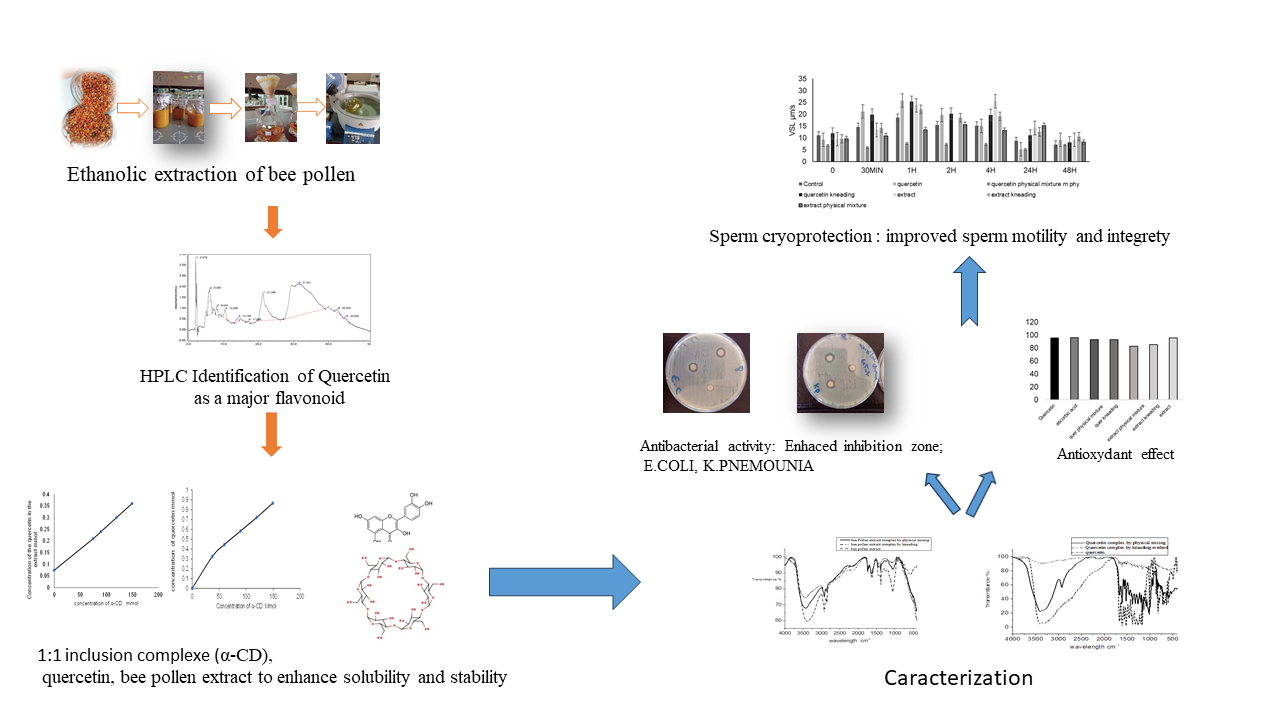
Bee pollen is a complex natural product rich in phenolic and flavonoid compounds with remarkable biological activities. However, its poor solubility limits its functional applications. In this study, bee pollen collected from Kherrata (Bejaia, Algeria) was extracted with ethanol and characterized using spectroscopic and chromatographic methods. High-performance liquid chromatography (HPLC) confirmed the presence of quercetin as one of the major bioactive compounds. To overcome its low solubility, inclusion complexes with α-cyclodextrin were prepared and analyzed by FTIR spectroscopy and phase solubility studies, revealing AL-type diagrams consistent with 1:1 stoichiometric inclusion. Encapsulation with α-cyclodextrin resulted in superior complex stability and enhanced aqueous solubility. The encapsulated bee pollen extract and quercetin exhibited improved antibacterial activity, particularly against E. coli and K. pneumoniae, while retaining cytocompatibility.
In sperm cryopreservation assays, the ethanolic extract and its α-cyclodextrin complexes significantly enhanced motility parameters (VCL, VSL, VAP) and preserved sperm integrity under oxidative stress. These effects are attributed to the sustained release and synergistic antioxidant action of phenolic constituents within the inclusion complex.
Finally, this study demonstrates that α-cyclodextrin encapsulation effectively enhances the physicochemical stability, solubility, and bioefficacy of bee pollen-derived bioactives. The combined antioxidant, antibacterial, and cryoprotective effects open new perspectives for the development of natural, functional, and biocompatible systems for biomedical and reproductive applications.
Resumen. El polen de abeja es un producto natural complejo, rico en compuestos fenólicos y flavonoides con notables actividades biológicas. Sin embargo, su baja solubilidad limita sus aplicaciones funcionales. En este estudio, el polen de abeja recolectado en Kherrata (Bejaia, Argelia) se extrajo con etanol y se caracterizó mediante métodos espectroscópicos y cromatográficos. La cromatografía líquida de alta resolución (HPLC) confirmó la presencia de quercetina como uno de los principales compuestos bioactivos. Para superar su baja solubilidad, se prepararon complejos de inclusión con α-ciclodextrina y se analizaron mediante espectroscopía FTIR y estudios de solubilidad de fases, que revelaron diagramas de tipo AL compatibles con una inclusión estequiométrica 1:1. La encapsulación con α-ciclodextrina aumentó la estabilidad del complejo y mejoró la solubilidad en medio acuoso. El extracto encapsulado de polen de abeja y la quercetina mostraron una mayor actividad antibacteriana, particularmente frente a E. coli y K. pneumoniae, al tiempo que conservaron su citocompatibilidad. En los ensayos de criopreservación de espermatozoides, el extracto etanólico y sus complejos con α-ciclodextrina mejoraron significativamente los parámetros de motilidad (VCL, VSL y VAP) y preservaron la integridad de los espermatozoides bajo condiciones de estrés oxidativo. Estos efectos se atribuyen a la liberación sostenida y a la acción antioxidante sinérgica de los constituyentes fenólicos del complejo de inclusión.
Finalmente, este estudio demuestra que la encapsulación con α-ciclodextrina mejora eficazmente la estabilidad fisicoquímica, la solubilidad y la bioeficacia de los compuestos bioactivos derivados del polen de abeja. La combinación de efectos antioxidantes, antibacterianos y crioprotectores abre nuevas perspectivas para el desarrollo de sistemas naturales, funcionales y biocompatibles destinados a aplicaciones biomédicas y reproductivas.
Downloads
References
1. Lu, P.; Takiguchi, S.; Honda, Y.; Lu, Y.; Mitsui, T.; Kato, S.; Kodera, R.; Furihata, K.; Zhang, M.; Okamoto, K.; Itoh, H.; Suzuki, M.; Kono, H.; Nagata, K. Food Chemistry: Molecular Sciences. 2022, 5, 100119. DOI: https://doi.org/10.1016/j.fochms.2022.100119
2. Zhang, H.; Liu, R.; Lu, Q. Molecules. 2020, 25, 1264. DOI: https://doi.org/10.3390/molecules25061264
3. Damulienė, V.; Kaškonienė, V.; Kaškonas, P.; Mickienė, R.; Maruška, A. Pharmaceuticals. 2024, 18(1), 15. DOI: https://doi.org/10.3390/ph18010015
4. Duan, H.; Dong, Z.; Li, H.; Li, W.; Shi, S.; Wang, Q.; Cao, W.; Fang, X.; Fang, A.; Zhai, K. Food Chem. Toxicol. 2019, 134, 110831. DOI: https://doi.org/10.1016/j.fct.2019.110831
5. Tang, H.; Liu, Y.; Xu, H.; Wang, F.; Xie, C.; Zhang, H.; Jiang, L. Food Biophys. 2024, 19, 269–283. DOI: https://doi.org/10.1007/s11483-023-09821-7
6. Yang, Y.; Zhang, J.; Zhou, Q.; Wang, L.; Huang, W.; Wang, R. J. Sci. Food Agric. 2019, 99, 5350–5357. DOI: https://doi.org/10.1002/jsfa.9774
7. Wangsawangrung, N.; Choipang, C.; Chaiarwut, S.; Ekabutr, P.; Suwantong, O.; Chuysinuan, P.; Techasakul, S.; Supaphol, P. Gels. 2022, 8, 573. DOI: https://doi.org/10.3390/gels8090573
8. Xu, Y.; Wang, Y.; Li, C.; Han, T.; Chen, H.; Chen, W.-X.; Zhong, Q.; Pei, J.; Haenen, G.; Li, Z.; Moalin, M.; Zhang, M.; Chen, W. AAPS Open. 2023, 9. DOI: https://doi.org/10.1186/s41120-023-00083-8
9. Christaki, S.; Spanidi, E.; Panagiotidou, E.; Athanasopoulou, S.; Kyriakoudi, A.; Mourtzinos, I.; Gardikis, K. Pharmaceuticals. 2023, 16, 1274. DOI: https://doi.org/10.3390/ph16091274
10. Ak, G.; Dall’Acqua, S.; Sut, S.; Selvi, S.; Eyupoglu, O. E.; Zengin, G. Sci. Rep. 2025, 15, 37049. DOI: https://doi.org/10.1038/s41598-025-20905
11. Poulson, G.; Alsulami, Q.; Sharfalddin, A.; Agammy, E. F.; Mouffouk, F.; Emwas, A.-H.; Jaremko, Ł.; Jaremko, M. Polysaccharides. 2021, 3, 1–32. DOI: https://doi.org/10.3390/polysaccharides3010001
12. Fatmi, S.; Bournine, L.; Iguer-ouada, M.; Malika, L.-S.; Bouchal, F.; Skiba, M. Acta Pol. Pharm.-Drug Res. 2015, 72, 179–192.
13. Fatmi, S.; Toutou, Z.; Chibani, N.; Lezrag, H. A.; Skiba, M.; Iguerouada, M. biopolymer applications journal. 2024, 3, 12-17.
14. Fatmi, S.; Taouzinet, L.; Skiba, M.; Iguer-ouada, M. Cryo Letters. 2023, 44, 89–99. DOI: https://doi.org/10.54680/fr23210110712
15. Santos, A. M.; Do Nascimento Júnior, J. A. C.; Cézar, S. V. S.; Quintans Júnior, L. J.; Araújo, A. A. D. S.; Aragón, D. M.; Serafini, M. R. Future Microbiology. 2023, 18, 1363–1379. DOI: https://doi.org/10.20944/preprints202304.0953.v1
16. Taouzinet, L.; Fatmi, S.; Lahiani-Skiba, M.; Skiba, M.; Iguer-Ouada, M. CryoLetters. 2021, 42, 1–12. DOI: https://doi.org/10.54680/fr21110110112
17. Toutou, Z. Fatmi, S.; Chibani, N.; Bensidhoum, L.; Skiba, M.; Iguer‑Ouada, M. Acta Fytotech Zootech. 2022, 24. DOI: https://doi.org/10.15414/afz.2022.25.04.269-278
18. Authaida, S.; Boonkum, W.; Chankitisakul, V. Animals. 2025, 15, 439. DOI: https://doi.org/10.3390/ani15030439
19. Al-Amery, K. S. M.; Banana, H. J. H. Biochem Cell Arch. 2020, 20, 723–729. DOI: https://doi.org/10.35124/bca.2020.20.1.723
20. Lawag, I.; Yoo, O.; Lim, L.; Hammer, K.; Locher, C. Antioxidants. 2021, 10, 1113. DOI: https://doi.org/10.3390/antiox10071113
21. Ali-Rachedi, F.; Meraghni, S.; Touaibia, N.; Mesbah, S. Bull Société R. Sci. Liège. 2018, 13–21. DOI: https://doi.org/10.25518/0037-9565.7398
22. Boudou, F.; Guendouzi, A.; Belkredar, A.; Rasheed, M. Notulae Scientia Biologicae. 2024, 16, 13837. DOI: https://doi.org/10.55779/nsb16211837
23. Zeghoud, S.; Rebiai, A.; Hemmami, H.; Ben Seghir, B.; Elboughdiri, N.; Ghareba, S.; Ghernaout, D.; Abbas, N. ACS Omega. 2021, 6, 4878–4887. DOI: https://doi.org/10.1021/acsomega.0c05816
24. Aylanc, V.; Ertosun, S.; Peixoto, A. F.; Santamaria-Echart, A.; Russo-Almeida, P.; Vale, N.; Freire, C.; Vilas-Boas, M. Emergent Mater. 2025, 8, 3107–3122. DOI: https://doi.org/10.1007/s42247-025-01002-1
25. Toutou, Z.; Fatmi, S.; Chibani, N.; Taouzinet, L.; Harrate, I.; Inouri‑Iskounen, A.; Skiba, M.; Iguerouada, M. Starch. 2023, 75, 2300017. DOI: https://doi.org/10.1002/star.202300017
26. Viswalingam, M.; Prabu, S.; Sivakumar, K.; Rajamohan, R. J. Macromol. Sci., Part A. 2016, 53, 781–790. DOI: https://doi.org/10.1080/10601325.2016.1237817
27. Benkő, B.-M.; Tóth, G.; Moldvai, D.; Kádár, S.; Szabó, E.; Szabó, Z.-I.; Kraszni, M.; Szente, L.; Fiser, B.; Sebestyén, A.; Zelkó, R.; Sebe, I. Int. J. Pharm. 2024, 657, 124187. DOI: https://doi.org/10.1016/j.ijpharm.2024.124187
28. Leila, K.; Djebli, N.; Pokajewicz, K.; Mostefa, N.; Wieczorek, P. Molecules. 2024, 29, 1997. DOI: https://doi.org/10.3390/molecules29091997
29. Çelik, S.; Kutlu, N.; Gerçek, Y.; Bayram, S.; Pandiselvam, R.; Bayram, N. Foods. 2022, 11, 3652. DOI: https://doi.org/10.3390/foods11223652
30. Guérin, Y.; Locatelli, Y.; Comizolli, P.; Mauget, R.; Mermillod, P.; Legendre, X.; Gatti, J.-L.; Dacheux, J.-L. Les Actes du BRG. 2003, 4, 173–183.
31. Messina, C.; Panettieri, V.; Arena, R.; Renda, G.; Espinosa Ruiz, C.; Morghese, M.; Piccolo, G.; Santulli, A.; Bovera, F. T. Front. Vet. Sci. 2020, 7. DOI: https://doi.org/10.3389/fvets.2020.00095
32. Mayda, N.; Özkök, A.; Ecem Bayram, N.; Gercek, Y.; Sorkun, K. J. Food Meas. Charact. 2020, 14. DOI: https://doi.org/10.1007/s11694-020-00427-y
33. Khadra, L.; Mokhnache, K.; Bouriche, H.; Ibrahim, D.; Harzallah, D. Int. J. Res. Pharm. Chem. 2019, 9. DOI: https://doi.org/10.33289/IJRPC.9.4.2019.972
34. Mladenova, R.; Aleksieva, K.; Solakov, N.; Loginovska, K. Proc. Bulg. Acad. Sci. 2022, 75, 672–679. DOI: https://doi.org/10.7546/CRABS.2022.05.06
35. Oroian, M.; Ursachi, F.; Dranca, F. Antioxidants. 2020, 9, 322. DOI: https://doi.org/10.3390/antiox9040322
36. De-Melo, A. A. M.; Estevinho, M. L. M. F.; Sattler, J. A. G.; Souza, B. R.; Freitas, A. D. S.; Barth, O. M.; Almeida-Muradian, L. B. LWT - Food Sci. Technol. 2016, 65, 808–815. DOI: https://doi.org/10.1016/j.lwt.2015.09.014
37. Kacemi, R.; Campos, M. G. Molecules. 2024, 29, 5893. DOI: https://doi.org/10.3390/molecules29245893
38. Aziza, N.; Khaydarov, K.; Zafar, M.; Alsakkaf, W.; Alkahtani, J.; Ahmad, M.; Makhkamov, T.; Djumayeva, Z.; Zengin, G.; Eshboyevich, T.; Beilerli, A.; Gareev, I.; Ochilov, U.; Islamov, B.; Iskandarovna, U.; Wibawa, I. Biomed. Chromatogr. 2024, 38. DOI: https://doi.org/10.1002/bmc.5852
39. Prđun, S.; Svečnjak, L.; Valentić, M.; Marijanović, Z.; Jerkovic, I. Foods. 2021, 10, 2103. DOI: https://doi.org/10.3390/foods10092103
40. Zheng, H.; Sun, Y.; Zeng, Y.; Zheng, T.; Jia, F.; Xu, P.; Xu, Y.; Cao, Y.; He, K.; Yang, Y. Molecules. 2023, 28, 4800. DOI: https://doi.org/10.3390/molecules28124800
41. Munot, N.; Kandekar, U.; Giram, P. S.; Khot, K.; Patil, A.; Cavalu, S. Pharmaceutics. 2022, 14, 1601. DOI: https://doi.org/10.3390/pharmaceutics14081601
42. Gulcin, İ.; Alwasel, S. H. Processes. 2023, 11, 2248. DOI: https://doi.org/10.3390/pr11082248
43. Tian, B. R.; Liu, Y. M. Turk. J. Chem. 2021, 45, 1707-1724. DOI: https://doi.org/10.3906/kim-2106-51
44. Benberkane, A.; Khellouf, A.; Karim, B.; Fatmi, S.; Iguer-ouada, M. Cryo Letters. 2019, 40, 219–225.
45. Lezrag, H. A.; Fatmi, S.; Taouzinet, L.; Toutou, Z.; Pokajewicz, K.; Merzeg, F. A.; Skiba, M.; Wieczorek, P. P.; Iguerouada, M. J. Incl. Phenom. Macrocycl. Chem. 2025, 105, 537–548. DOI: https://doi.org/10.1007/s10847-025-01308-x
Downloads
Published
Issue
Section
License
Copyright (c) 2026 Wissam Bouyahmed, Sofiane Fatmi, Nacéra Chibani, Hayet Ahlem Lezrag, Zahra Toutou, Mohamed Skiba, Mokrane Iguerouada

This work is licensed under a Creative Commons Attribution-NonCommercial 4.0 International License.
Authors who publish with this journal agree to the following terms:
- Authors retain copyright and grant the journal right of first publication with the work simultaneously licensed under a Creative Commons Attribution License that allows others to share the work with an acknowledgement of the work's authorship and initial publication in this journal.
- Authors are able to enter into separate, additional contractual arrangements for the non-exclusive distribution of the journal's published version of the work (e.g., post it to an institutional repository or publish it in a book), with an acknowledgement of its initial publication in this journal.