Mapping Reactivity and Stereochemical Evolution of Benzothiazolium Salts in [3+2] Cycloadditions Using Molecular Electron Density Theory
DOI:
https://doi.org/10.29356/jmcs.v70i1.2572Keywords:
[3+2] cycloaddition reaction, Electron Localization Function, Molecular Electron Density Theory, Bond Evolution Theory, Non-Covalent InteractionsAbstract
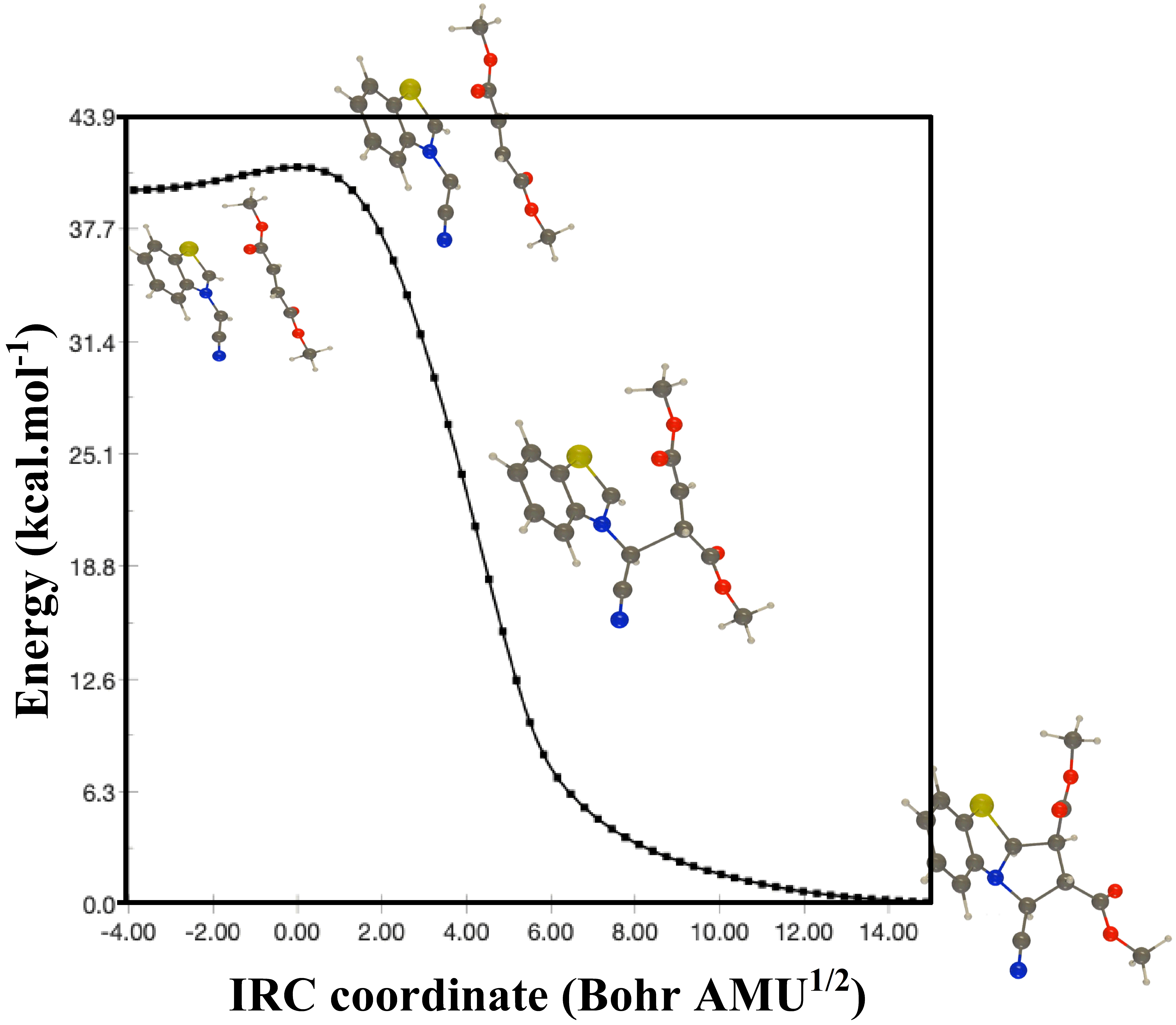
The electronic structure of the benzothiazolium salt 1 (1-(cyanomethyl)-2,3-dihydro-1H-benzothiazol-1-ium) and its reactivity in [3+2] cycloaddition (32CA) reactions with dimethyl(Z)-2-butenedioate 2 have been investigated using Molecular Electron Density Theory (MEDT) combined with Density Functional Theory (DFT) calculations at the M06-2X/6-311+G(d,p) level. Topological analysis of the Electron Localization Function (ELF) reveals that 1 act as a carbenoid-type three-atom component (TAC), characterized by a carbenoid C3 center. Conceptual DFT reactivity indices identify this TAC as a moderate electrophile and a supernucleophile. The polar 32CA reaction proceeds via a one-step asynchronous mechanism, as revealed by the Bond Evolution Theory (BET), and involves the formation of two stable molecular complexes. The activation barriers are low for both the endo and exo pathways. DFT calculations indicate that the endo pathway is slightly both kinetically and thermodynamically preferred over the exo one, in agreement with experimental findings. Non-covalent interactions (NCIs) analysis attributes this endo selectivity to a combination of weaker attractive interactions and enhanced van der Waals and repulsive interactions in TS-endo, which alleviates steric strain and stabilizes the TS.
Resumen. La estructura electrónica de la sal de benzotiazolio 1 (1-(cianometil)-2,3-dihidro-1H-benzotiazol-1-io) y su reactividad en reacciones de cicloadición [3+2] (32CA) con el dimetil (Z)-2-butendioato 2 se investigaron utilizando la Teoría de la Densidad Electrónica Molecular (MEDT) en combinación con cálculos de la Teoría del Funcional de la Densidad (DFT) al nivel M06-2X/6-311+G(d,p). El análisis topológico de la Función de Localización Electrónica (ELF) revela que el compuesto 1 actúa como un componente de tres átomos (TAC) de tipo carbenoide, caracterizado por un centro carbenoide C3. Los índices de reactividad de la DFT conceptual identifican a este TAC como un electrófilo moderado y un supernucleófilo. La reacción polar de cicloadición 32CA transcurre mediante un mecanismo asincrónico de una sola etapa, tal como lo revela la Teoría de la Evolución del Enlace (BET), e implica la formación de dos complejos moleculares estables. Las barreras de activación son bajas tanto para las vías endo como exo. Los cálculos DFT indican que la vía endo está ligeramente favorecida, tanto desde el punto de vista cinético como termodinámico, con respecto a la vía exo, en concordancia con los resultados experimentales. El análisis de las interacciones no covalentes (NCI) atribuye esta selectividad endo a una combinación de interacciones atractivas más débiles y de interacciones de van der Waals y repulsivas más intensas en el estado de transición TS-endo, lo que reduce la tensión estérica y estabiliza dicho estado de transición.
Downloads
References
1. Padwa, A. I.; Pearson, W. H., in: Synthesis Applications of 1,3-Dipolar Cycloaddition Chemistry; Wiley, New York, 1984.
2. Feuer, H. Nitrile Oxides, Nitrones and Nitronates in Organic Synthesis: Novel Strategies in Synthesis; John Wiley & Sons, 2008.
3. Acharjee, N.; Mohammad-Salim, H. A.; Chakraborty, M. Struct. Chem. 2022, 33, 555–570. DOI: https://doi.org/10.21203/rs.3.rs-1122676/v1
4. Pérez, P.; Domingo, L. R.; Aurell, M. J.; Contreras, R. Tetrahedron 2003, 59, 3117–3125.
5. Domingo, L. R.; Saéz, J. A.; Zaragozá, R. J.; Arnó, M. J. Org. Chem. 2008, 73, 8791–8799.
6. Ríos-Gutiérrez, M.; Darù, A.; Tejero, T.; Domingo, L. R.; Merino, P. Org. Biomol. Chem. 2017, 15, 1618–1627.
7. Domingo, L. Molecules 2016, 21, 1319. DOI: https://doi.org/10.3390/molecules21101319
8. Xiao, Z.; Ding, T.; Mao, S.; Ning, X.; Kang, Y. ChemInform 2016, 47. DOI: https://doi.org/10.1002/chin.201641153
9. Wilson, A. K., in: Frontiers in Computational Chemistry: Volume 5; Bentham Science Publishers, 2020; Vol. 5.
10. Ríos-Gutiérrez, M.; Domingo, L. R. Eur. J. Org. Chem. 2019, 2019, 267–282. DOI: https://doi.org/10.1002/ejoc.201800916
11. Parr, R. G.; Yang, W. J. Am. Chem. Soc. 1984, 106, 4049–4050. DOI: https://doi.org/10.1021/ja00326a036
12. Yang, W.; Mortier, W. J. J. Am. Chem. Soc. 1986, 108, 5708–5711. DOI: https://doi.org/10.1021/ja00279a008
13. Domingo, L. R.; Ríos-Gutiérrez, M. Molecules. 2017, 22, 750. DOI: https://doi.org/10.3390/molecules22050750
14. Wang, Y.; Wei, D.; Zhang, W.; Wang, Y.; Zhu, Y.; Jia, Y.; Tang, M. Org. Biomol. Chem. 2014, 12, 7503–7514
15. Nasri, L.; Ríos-Gutiérrez, M.; Nacereddine, A. K.; Djerourou, A.; Domingo, L. R. Theor. Chem. Acc. 2017, 136, 1–12
16. Domingo, L. R.; Chamorro, E.; Pérez, P. Lett. Org. Chem. 2010, 7, 432–439. DOI: https://doi.org/10.2174/157017810791824900
17. Domingo, L. R.; Ríos-Gutiérrez, M.; Pérez, P. J. Org. Chem. 2018, 83, 2182–2197. DOI: https://doi.org/10.1021/acs.joc.7b03093
18. Domingo, L. R.; Ríos-Gutiérrez, M.; Acharjee, N. Molecules. 2019, 24, 832. DOI: https://doi.org/10.3390/molecules24050832
19. Parr, R. G.; Yang, W. Annu. Rev. Phys. Chem. 1995, 46, 701–728. DOI: https://doi.org/10.1146/annurev.pc.46.100195.003413
20. Kohn, W.; Becke, A. D.; Parr, R. G. J. Phys. Chem. 1996, 100, 12974–12980. DOI: https://doi.org/10.1021/jp960669l
21. Ayers, P. W.; Parr, R. G. J. Am. Chem. Soc. 2000, 122, 2010–2018. DOI: https://doi.org/10.1021/ja9924039
22. De Proft, F.; Geerlings, P. Chem. Rev. 2001, 101, 1451–1464. DOI: https://doi.org/10.1021/cr9903205
23. Geerlings, P.; De Proft, F.; Langenaeker, W. Chem. Rev. 2003, 103, 1793–1874. DOI: https://doi.org/10.1021/cr990029p
24. Domingo, L. R.; Ríos-Gutiérrez, M.; Pérez, P. Molecules. 2016, 21, 748. DOI: https://doi.org/10.3390/molecules21060748
25. Bader, R. F. W. Acc. Chem. Res. 1975, 8, 34–40. DOI: https://doi.org/10.1021/ar50085a005
26. Benallou, A.; Lakbaibi, Z.; El Alaoui El Abdallaoui, H. G. Eur. Rev. Chem. Res. 2018, 5. DOI: https://doi.org/10.13187/ercr.2018.2.42
27. Boutiddar, R.; Abbiche, K.; Mellaoui, M. D.; Imjjad, A.; Alahiane, M.; Ait Albrimi, Y.; Marakchi, K.; Mogren Al-Mogren, M.; El Hammadi, A.; Hochlaf, M. J. Comput. Chem. 2024, 45, 284–299. DOI: https://doi.org/10.1002/jcc.27235
28. Becke, A. D.; Edgecombe, K. E. J. Chem. Phys. 1990, 92, 5397–5403. DOI: https://doi.org/10.1063/1.458517
29. Johnson, E. R.; Keinan, S.; Mori-Sánchez, P.; Contreras-García, J.; Cohen, A. J.; Yang, W. J. Am. Chem. Soc. 2010, 132, 6498–6506. DOI: https://doi.org/10.1021/ja100936w
30. Domingo, L.; Acharjee, N., in: Molecular Electron Density Theory: A New Theoretical Outlook on Organic Chemistry; 2020; 174–227. DOI: https://doi.org/10.2174/9789811457791120050007
31. Krokidis, X.; Noury, S.; Silvi, B. J. Phys. Chem. A 1997, 101, 7277–7282. DOI: https://doi.org/10.1021/jp9711508
32. Thom, R., in: Structural Stability and Morphogenesis: An Outline of a General Theory of Models; 1975
33. Woodcock, E. R.; P. T. A. Geometrical Study of Elementary Catastrophes; Springer Berlin Heidelberg, 1974
34. Gilmore, R., in: Catastrophe Theory for Scientists and Engineers; 1981
35. Fukui, K. Acc. Chem. Res. 1981, 14, 363–368. DOI: https://doi.org/10.1021/ar00072a001
36. Adjieufack, A. I.; Ndassa, I. M.; Patouossa, I.; Mbadcam, J. K.; Safont, V. S.; Oliva, M.; Andrés, J. Phys. Chem. Chem. Phys. 2017, 19, 18288–18302. DOI: https://doi.org/10.1039/C7CP01016H
37. Adjieufack, A. I.; Liégeois, V.; Ndassa Mboumbouo, I.; Ketcha Mbadcam, J.; Champagne, B. J. Phys. Chem. A 2018, 122, 7472–7481. DOI: https://doi.org/10.1021/acs.jpca.8b06711
38. Kraus, G. A.; Nagy, J. O. Tetrahedron 1985, 41, 3537–3545. DOI: https://doi.org/10.1016/S0040-4020(01)96707-9
39. Zhao, Y.; Truhlar, D. G. Theor. Chem. Acc. 2008, 120, 215–241. DOI: https://doi.org/10.1007/s00214-007-0310-x
40. Mohammad-Salim, H.; de Julián-Ortiz, J. V.; Dahlous, K. A.; Islam, M. S.; Almutairi, T. M.; Benmetir, S. Struct. Chem. 2025, 36, 339–350. DOI: https://doi.org/10.1007/s11224-024-02373-7
41. Ouled Aitouna, A.; Mohammad-Salim, H.; Zeroual, A.; Syed, A.; Bahkali, A. H.; de Julián-Ortiz, J. V. Comput. Theor. Chem. 2023, 1228, 114283. DOI: https://doi.org/10.1016/j.comptc.2023.114283
42. Tomasi, J.; Mennucci, B.; Cammi, R. Chem. Rev. 2005, 105, 2999–3094. DOI: https://doi.org/10.1021/cr9904009
43. Domingo, L. R. RSC Adv. 2014, 4, 32415–32428. DOI: https://doi.org/10.1039/C4RA04280H
44. Reed, A. E.; Curtiss, L. A.; Weinhold, F. Chem. Rev. 1988, 88, 899–926. DOI: https://doi.org/10.1021/cr00088a005
45. Parr, R. G.; Yang, W., in: Density-Functional Theory of Atoms and Molecules; Oxford University Press, 1989.
46. Parr, R. G.; Szentpály, L. v.; Liu, S. J. Am. Chem. Soc. 1999, 121, 1922–1924. DOI: https://doi.org/10.1021/ja983494x
47. Parr, R. G.; Pearson, R. G. J. Am. Chem. Soc. 1983, 105, 7512–7516. DOI: https://doi.org/10.1021/ja00364a005
48. Domingo, L. R.; Chamorro, E.; Pérez, P. J. Org. Chem. 2008, 73, 4615–4624. DOI: https://doi.org/10.1021/jo800572a
49. Reed, A. E.; Weinstock, R. B.; Weinhold, F. J. Chem. Phys. 1985, 83, 735–746. DOI: https://doi.org/10.1063/1.449486
50. Pérez, P.; Domingo, L. R.; Duque-Noreña, M.; Chamorro, E. J. Mol. Struct. THEOCHEM. 2009, 895, 86–91. DOI:https://doi.org/10.1016/j.theochem.2008.10.014
51. Chattaraj, P. K.; Duley, S.; Domingo, L. R. Org. Biomol. Chem. 2012, 10, 2855. DOI: https://doi.org/10.1039/c2ob06943a
52. Frisch, M. J.; Trucks, G. W.; Schlegel, H. B.; Scuseria, G. E.; Robb, M. A.; Cheeseman, J. R.; Scalmani, G.; Barone, V.; Petersson, G. A.; Nakatsuji, H.; Li, X.; Caricato, M.; Marenich, A. V.; Bloino, J.; Janesko, B. G.; Gomperts, R.; Mennucci, B.; Hratchian, H. P. Gaussian 16, Revision B.01; 2016. https://gaussian.com/gaussian16/
53. Contreras-García, J.; Johnson, E. R.; Keinan, S.; Chaudret, R.; Piquemal, J.-P.; Beratan, D. N.; Yang, W. J. Chem. Theory Comput. 2011, 7, 625–632. DOI: https://doi.org/10.1021/ct100641a
54. Lu, T.; Chen, F. J. Comput. Chem. 2012, 33, 580–592. DOI: https://doi.org/10.1002/jcc.22885
55. Noury, S.; Krokidis, X.; Fuster, F.; Silvi, B. Comput. Chem. 1999, 23, 597–604. DOI: https://doi.org/10.1016/S0097-8485(99)00039-X
56. https://www.unamur.be/fr/sciences/chimie/recherche/ucpts/lct/drawsuite/drawmol, accessed in September 2024.
57. https://www.unamur.be/fr/sciences/chimie/recherche/ucpts/lct/drawsuite/drawprofile, accessed in September 2024.
58. Chellegui, M.; Al-Mokhtar, R. M.; Salih, R. N.; Benhamed, L.; Benmetir, S.; Vicente de Julián-Ortiz, J.; Mohammad-Salim, H. A.; Ben Ahmed, A. RSC Adv. 2025, 15, 29666–29679. DOI: https://doi.org/10.1039/D5RA04992J
59. Chellegui, M.; Benhamed, L.; Salih, R. N.; Salhi, I.; Benmetir, S.; Ben Ahmed, A.; Mohammad-Salim, H. A.; de Julián-Ortiz, J. V. RSC Adv. 2025, 15, 32271–32283. DOI: https://doi.org/10.1039/D5RA04143K
60. Domingo, L. R.; Ríos-Gutiérrez, M.; Pérez, P. Org. Biomol. Chem. 2016, 14, 10427–10436. DOI: https://doi.org/10.1039/C6OB01989G
61. Domingo, L. R.; Ríos-Gutiérrez, M.; Pérez, P. Tetrahedron. 2016, 72, 1524–1532. DOI: https://doi.org/10.1016/j.tet.2016.01.061
62. Chellegui, M.; Champagne, B.; Trabelsi, M. Theor. Chem. Acc. 2022, 141, 21. DOI: https://doi.org/10.1007/s00214-022-02880-y
63. Chellegui, M.; Adjieufack, A. I.; Trabelsi, M.; Liégeois, V.; Champagne, B. ChemPhysChem 2025, 26. DOI: https://doi.org/10.1002/cphc.202400896
64. Chellegui, M.; Koudjina, S.; Salhi, I.; Benmetir, S.; Salih, R. N.; Mohammad-Salim, H. A.; Atohoun, G. Y. S.; de Julián-Ortiz, J. V. Org. Biomol. Chem. 2025, 23, 5016–5032. DOI: https://doi.org/10.1039/D5OB00529A
65. Chellegui, M.; Trabelsi, M.; Champagne, B.; Liégeois, V. ACS Omega 2025, 10, 833–847. DOI: https://doi.org/10.1021/acsomega.4c07888
66. Chellegui, M.; Benmetir, S.; Salih, R. N.; Mohammad-Salim, H. A.; de Julián-Ortiz, J. V.; Ben Ahmed, A. New J. Chem. 2025, 49, 7302–7313. DOI: https://doi.org/10.1039/D5NJ01058F
67. Chellegui, M.; Salhi, I.; Ben Ahmed, A.; Benmetir, S.; Salih, R. N.; Mohammad-Salim, H. A.; de Julián-Ortiz, J. V. Struct. Chem. 2025. DOI: https://doi.org/10.1007/s11224-025-02520-8
68. Benmetir, S.; Chellegui, M.; Benhamed, L.; Al-Mokhtar, R. M.; Salih, R. N.; Algso, M. A.; de Julián-Ortiz, J. V.; Mohammad-Salim, H. A. New J. Chem. 2025, 49, 11191–11202. DOI: https://doi.org/10.1039/D5NJ01419K
69. Jaramillo, P.; Domingo, L. R.; Chamorro, E.; Pérez, P. J. Mol. Struct. THEOCHEM. 2008, 865, 68–72. DOI: https://doi.org/10.1016/j.theochem.2008.06.022
70. Domingo, L. R.; Ríos-Gutiérrez, M. Sci. Radices 2023, 2, 1–24. DOI: https://doi.org/10.58332/scirad2023v2i1a01
71. Aurell, M. J.; Domingo, L. R.; Pérez, P.; Contreras, R. Tetrahedron 2004, 60, 11503–11509. DOI: https://doi.org/10.1016/j.tet.2004.09.057
72. Domingo, L. R.; Pérez, P.; Sáez, J. A. RSC Adv. 2013, 3, 1486–1494. DOI: https://doi.org/10.1039/C2RA22886F
73. Domingo, L. R.; Ríos-Gutiérrez, M., in: Conceptual Density Functional Theory; Wiley, 2022, 481–502. DOI: https://doi.org/10.1002/9783527829941.ch24
74. Boltzmann, L., in: Ableitung Des Stefan’schen Gesetzes, Betreffend Die Abhangigkeit Der Warmestrahlung von Der Temperatur Aus Der Electromagnetischen Lichttheorie, von Ludwig Boltzmann in Graz, 1877
75. Jasiński, R. Chem. Heterocycl. Compd. 2022, 58, 260–262. DOI: https://doi.org/10.1007/s10593-022-03081-y
76. Domingo, L. R.; Ríos-Gutiérrez, M. Org. Biomol. Chem. 2019, 17, 6478–6488. DOI: https://doi.org/10.1039/C9OB01031A
77. Boto, R. A.; Peccati, F.; Laplaza, R.; Quan, C.; Carbone, A.; Piquemal, J.-P.; Maday, Y.; Contreras-García, J. J. Chem. Theory Comput. 2020, 16, 4150–4158. DOI: https://doi.org/10.1021/acs.jctc.0c00063
Downloads
Published
Issue
Section
License
Copyright (c) 2026 Mohamed Chellegui, Raghad Mowafak Al‑Mokhtar , Raad Nasrullah Salih, Lakhdar Benhamed, Sofiane Benmetir, Jesus Vicente de Julián-Ortiz, Haydar A. Mohammad-Salim, Ali Ben Ahmed

This work is licensed under a Creative Commons Attribution-NonCommercial 4.0 International License.
Authors who publish with this journal agree to the following terms:
- Authors retain copyright and grant the journal right of first publication with the work simultaneously licensed under a Creative Commons Attribution License that allows others to share the work with an acknowledgement of the work's authorship and initial publication in this journal.
- Authors are able to enter into separate, additional contractual arrangements for the non-exclusive distribution of the journal's published version of the work (e.g., post it to an institutional repository or publish it in a book), with an acknowledgement of its initial publication in this journal.