Degradation of Histiacil NF® in Wastewater by Simple Ozonation: Kinetics and byproduct Formation
DOI:
https://doi.org/10.29356/jmcs.v70i1.2466Keywords:
Ozonation, pharmaceutical degradation, wastewater treatment, ambroxol, dextrometorphanAbstract
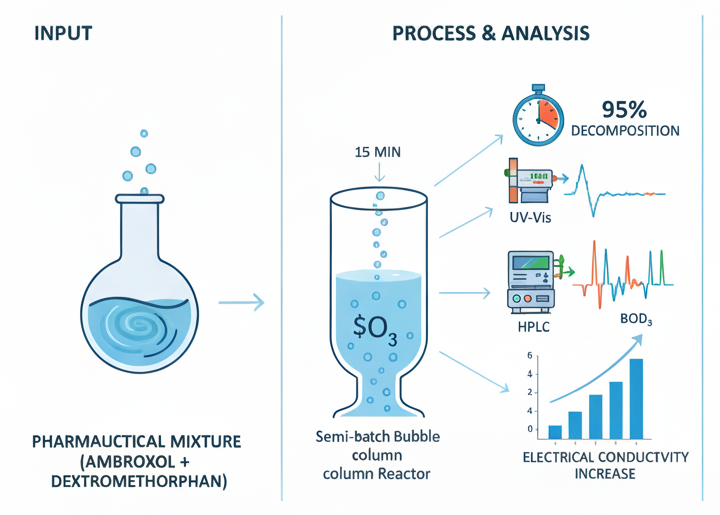
Abstract. Ozonation is wastewater treatment use for the degradation of recalcitrant pollutants such as pharmaceutical compounds; however, the kinetic characterization and transformation pathway analysis remain partial for complex medicinal mixtures. The ozonation of commercial pharmaceutical formulation containing ambroxol and dextromethorphan (Histiacil ® NF) was analyzed at laboratory scale under controlled semi-continuous operational conditions. The wastewater treatment efficiency was evaluated through UV-Vis spectroscopy, BOD₅ variation, electrical conductivity measurements, and HPLC analysis for identification an quantification of final reaction products. Ozonation achieved up to a 95 % decomposition of Histiacil® NF within 15 minutes, as demonstrated by UV–Vis absorbance decline at characteristic wavelengths and confirmed by HPLC analysis. The progressive increase in BOD₅ and electrical conductivity indicated the conversion of the initial molecules of ambroxol and dextromethorphan into smaller, more polar, and potentially biodegradable species. Oxalic acid was identified and quantified as the main accumulated final product by HPLC analysis, which concentration obtained was consistent with stoichiometric predictions. A kinetic model based on pseudo-first-order was established to define both the decomposition of dextromethorphan and the formation and consumption of oxalic acid. The results demonstrate that ozonation is an effective and reproducible treatment strategy for complex pharmaceutical mixtures and highlight the relevance of kinetic modeling as a predictive tool for process optimization and scale-up in water and wastewater treatment applications.
Resumen. El proceso de ozonación es ampliamente utilizado en la degradación de contaminantes recalcitrantes como los compuestos farmacéuticos; sin embargo, la caracterización de la cinética de reacción y el análisis de las rutas de transformación siguen siendo parciales para mezclas farmacéuticas complejas. En el presente trabajo se analizó a escala de laboratorio la ozonación de una formulación comercial que contiene ambroxol y dextrometorfano (Histiacil NF) bajo condiciones operativas controladas.
La eficiencia del tratamiento de degradación se evaluó mediante Espectroscopía UV-Vis, variación de DBO₅, Conductividad Eléctrica y el análisis por HPLC para la identificación y cuantificación de los productos finales de reacción. Mediante este proceso se alcanzó un 95 % de descomposición de Histiacil® NF en 15 minutos, demostrado en la disminución de la absorbancia UV-Vis en longitudes de onda, el incremento progresivo de la DBO₅ y la conductividad eléctrica, lo cual indica la conversión de las moléculas iniciales de ambroxol y dextrometorfano en especies más pequeñas, más polares y potencialmente biodegradables.
El ácido oxálico fue identificado y cuantificado como el principal producto final acumulado mediante análisis por HPLC. Se estableció un modelo cinético basado en pseudo-primer orden para definir tanto la descomposición del dextrometorfano como la formación y consumo del ácido oxálico.
Los resultados demuestran que la ozonación es una estrategia de tratamiento efectiva y reproducible para mezclas farmacéuticas complejas, destacando la relevancia del modelado cinético como una herramienta predictiva para la optimización y escalamiento del proceso en aplicaciones de tratamiento de agua y aguas residuales.
Downloads
References
1. Giudice, L.; Llamas-Clark, E.; DeNicola, N.; Pandipati, S.; Zlatnik, M.; Decena, D.; Woodruff, T.; Conry, J. Int. J. Gynecol. Obstet. 2021, 155, 345-356.
2. Galindo-Miranda, J.; Guízar-González, C.; Becerril-Bravo, E.; Moeller-Chávez, G.; León-Becerril, E.; Vallejo-Rodríguez, R. Water Supply. 2019, 19, 1871-1884.
3. Lahiri, A.; Daniel, S.; Kanthapazham, R.; Vanaraj, R.; Thambidurai, A.; Peter, L. J. Hazard. Mater. Adv. 2023, 100266.
4. Huber, M.; Göbel, A.; Joss, A. H. A.; Löffler, D.; McArdell, C.; Ried, A.; Siegrist, H.; Ternes, T.; von Gunten, U. Environ. Sci. Technol. 2005, 39, 4290-4299.
5. Brüggemann, H.; Köser, H.; Meyer, E.; Nguyen, T.-H. Water Res. 2003, 37, 674-680.
6. Wang, L.; Xu, H.; Lu, J.; Chovelon, J.-M.; Ji, Y. Water Res. 2022, 119275.
7. Xu, J.; Ma, Y.; Wei, J.; Li, F.; Peng, X. Chem. Pap. 2015, 69, 722-728.
8. Zhang, Y.; Lei, D.; Wang, B.; Liu, C.; Jia, Y.; Zhai, N.; Blaney, L.; Yu, G. Environ. Pollut. 2020, 114113.
9. Brown, A.; Ackerman, J.; Cicek, N.; Wong, C. Environ. Pollut. 2000, 114852.
10. Zhi, H.; Mianecki, A.; Kolpin, D.; Klaper, R.; Iwanowicz, L.; LeFevre, G. Water Res. 2021, 117537.
11. Mani, N.; Jun, H.; Beach, J.; Nerurkar, J. Pharm. Dev. Technol. 2003, 8, 385-396.
12. Mostafa, H.; Ibrahim, M.; Sakr, A. Pharm. Dev. Technol. 2013, 18, 454-463.
13. Andreozzi, R.; Canterino, M.; Marotta, R.; Paxeus, R. J. Hazard. Mater. 2005, 122, 243-250.
14. Dantas, R.; Contreras, S.; Sans, C.; Esplugas, S. J. Hazard. Mater. 2008, 150, 790-794.
15. Rosal, R.; Rodríguez, A.; Perdigón-Melón, J.; Petre, A.; García-Calvo, E.; Gómez, M. J.; Agüera, A.; Fernández-Alba, A. Water Res. 2010, 44, 578-588.
16. Fedorova, G.; Grabic, R.; Nyhlén, J.; Järhult, J. D.; Söderström, H. Chemosphere. 2015, 134, 1-8.
17. Zheng, M.; van Beek, S. J.; Sánchez-Montes, I.; Xu, B.; Gamal El-Din, M. J. Environ. Chem. Eng. 2024, 114297.
18. Adamek, E.; Baran, W. J. Hazard. Mater. 2024, 134026.
19. Beltrán, F.; Jiménez-López, M.; Álvarez, P.; Rivas, F. J. Ind. Eng. Chem. 2024.
20. Prada-Vásquez, M. A.; Simarro-Gimeno, C.; Vidal-Barreiro, I.; Cardona-Gallo, S. A.; Pitarch, E.; Hernández, F.; Torres-Palma, R. A.; Chica, A.; Navarro-Laboulais, J. Sci. Total Environ. 2024, 171625.
21. Aseman-Bahiz, E.; Sayyaf, H. J. Contam. Hydrol. 2024, 104419.
22. Ternes, T. A. TrAC Trends Anal. Chem. 2021, 20, 419-434.
23. Ferrer, I.; Thurman, E. M. TrAC Trends Anal. Chem. 2003, 22, 750-756.
24. Cruz-Zavala, E.; Moreno, J. A.; Fridman, L. M. IFAC Proc. Vol. 2011, 44, 3039-3044.
25. Poznyak, T.; García, A. Ozonoterapia. 2008, 15-23.
26. Razumovskii, S. Chem. Kinet. 2005, 259.
27. von Gunten, U. Water Res. 2003, 37, 1443-1467.
28. Lee, Y.; von Gunten, U. Water Res. 2010, 44, 555-566.
29. Tab, A.; Dahmane, M.; Belabed, C.; Bellal, B.; Richard, C.; Trari, M. Sci. Total Environ. 2021, 146451.
Downloads
Published
Issue
Section
License
Copyright (c) 2026 Diana Calderón Suárez, Elizabeth Reyes, Arizbeth Pérez-Martínez, Isaac Chairez

This work is licensed under a Creative Commons Attribution-NonCommercial 4.0 International License.
Authors who publish with this journal agree to the following terms:
- Authors retain copyright and grant the journal right of first publication with the work simultaneously licensed under a Creative Commons Attribution License that allows others to share the work with an acknowledgement of the work's authorship and initial publication in this journal.
- Authors are able to enter into separate, additional contractual arrangements for the non-exclusive distribution of the journal's published version of the work (e.g., post it to an institutional repository or publish it in a book), with an acknowledgement of its initial publication in this journal.