Intramolecular C–H•••Cl Interactions in Amino Amide Trichlorozincates Confirmed by Electron Density Topology
DOI:
https://doi.org/10.29356/jmcs.v70i1.2576Keywords:
QTAIM, ELF, hydrogen-bonding interactions, trichlorozincate, amino amidesAbstract
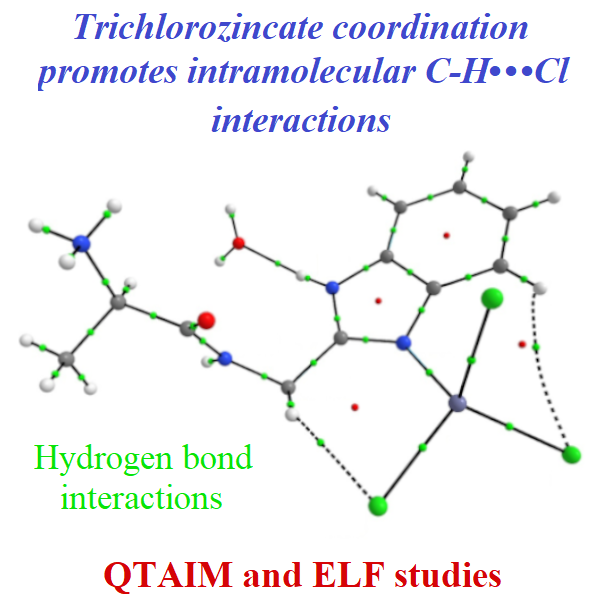
Abstract. In this work, we used QTAIM, ELF topological electron density analysis, NCI, and IRI methodologies to study the presence of intramolecular C–H•••Cl interactions in trichlorozincates derived from amino amides. Bond paths (BP) are present between the chlorines of ZnCl₃- group with the aliphatic H10 and aromatic H4 hydrogens respectively in compounds 1 and 2. ρb and δ(H,Cl) values indicated that the hyperconjugative component n(Cl3)→σ*C10–H10 is more significant in compound 1 than in 2. Likewise, H4•••Cl2 interactions have rb values near the lower limit of the range reported by Koch and Popelier for C-H•••X hydrogen bondings. Additionally, the great ellipticity (ε) > 1 of bond CPH4•••Cl2 predicts the vanish of the BPH4•••Cl2 with a small change in the molecular geometry of compound 1. Again, λ₁ and λ₂ values show that C10–H10B•••Cl3 hydrogen bonding is more stable in compound 1 than the other intramolecular C–H•••Cl interactions present in compounds 1 and 2. The source function (SF) suggests that a methyl group at C10 contributes to weakening the H10•••Cl3 interactions. The enveloped plot of 2ρb confirms a higher charge concentration between the H10B and Cl3 attractors in compound 1 compared to 2. Finally, ELF analysis showed that C–H•••Cl interactions decrease the volume of the monosynaptic basin V(H).
Resumen. En este trabajo, nosotros usamos las metodologías de la topología de la densidad electrónica QTAIM, ELF, NCI, e IRI metodologías para estudiar las interacciones intramoleculares C-H•••Cl en tetraclorozincatos derivados de amino amidas. Caminos de enlace (BP) están presentes entre los cloros del grupo ZnCl3- con los hidrógenos alifáticos H10 y los hidrógenos aromáticos H4 respectivamente en los compuestos 1 y 2. Los valores de rb y δ(H,Cl) indicaron que el componente hipercojugativo n(Cl3)→σ*C10–H10 contribuye de manera más significativa en 1 respecto a 2. Asimismo, las interacciones H4•••Cl2 tienen valores de rb cercanos al límite inferior del rango reportado por Koch and Popelier para los puentes de hidrógeno C-H•••X. Adicionalmente, la gran elipticidad (e) > 1 de CPH4•••Cl2 predice el desvanecimiento del BPH4•••Cl2 en 1 con un pequeño cambio en la geometría de la molécula. Una vez más, los valores λ1 y λ2 muestran que el puente de hidrógeno C10–H10B•••Cl3 de 1 es la interacción intramolecular C–H•••Cl más estable en 1 ó 2. La función fuente (SF) sugiere que la presencia de un grupo metilo en C10 contribuye al debilitamiento de las interacciones H10•••Cl3. El diagrama envolvente de 2rb confirma una mayor concentración de carga entre los atractores H10B y Cl3 en 1 respecto a 2. Finalmente, el análisis ELF mostró que las interacciones C-H•••Cl disminuyen el volumen de la cuenca monosináptica V(H).
Downloads
References
1. Herschlag, D.; Pinney, M. Biochem. 2018, 57, 3338-3352. DOI: https://doi.org/10.1021/acs.biochem.8b00217
2. Thompson, A. L.; White, N. G. Chem. Soc. Rev. 2023, 52, 6254-6269. DOI: https://doi.org/10.1039/D3CS00516J
3. Karas, L. J.; Wu, C. H.; Das, R.; Wu, J. I. Wiley Interdiscip. Rev. Comput. Mol. Sci. 2020, 10, e1477. DOI: https://doi.org/10.1002/wcms.1477
4. Moro, A. C.; Watanabe, F. W.; Anannias, S. R.; Mauro, A. E.; Netto, A. V. G.; Lima, A. P. R.; Ferreira, J. G.; Santos, R. H. A. Inorg. Chem. Commun. 2006, 9, 493-496. DOI: https://doi.org/10.1016/j.inoche.2006.02.012
5. Alabugin, I. V.; Manoharan, M.; Peabody, S.; Weinhold, F. J. Am. Chem. Soc. 2003, 125, 5973-5987. DOI: https://doi.org/10.1021/ja034656e
6. Tresca, B. W.; Zakharov, L. ZN.; Carroll, C. N.; Johnson, D. W.; Haley, M. M. Chem. Commun. 2013, 49, 7240-7242. DOI: https://doi.org/10.1002/anie.201605757
7. Scheiner, S. J. Indian Inst. Sci. 2020, 100, 61-76. DOI: https://doi.org/10.1007/s41745-019-00142-8
8. Castro, M.; Nicolás-Vázquez, I.; Zavala, J. I.; Sánchez-Viesca, F.; Berros, M. J. Chem. Theory Comput. 2007, 3, 681-688. DOI: https://doi.org/10.1021/ct600336r
9. Shanahan, J. P.; Mullis, D. M.; Zeller, M.; Szymczak, N. K. J. Am. Chem. Soc. 2020, 142, 8809-8817. DOI: https://doi.org/10.1021/jacs.0c01718
10. Liu, M.; Yin, C.; Chen, P.; Zhang, M.; Parkin, S.; Zhou, P.; Li, T.; Yu, F.; Long, S. CrysEngComm. 2017, 19, 4345-4354. DOI: https://doi.org/10.1039/c7ce00772h
11. Thallapally, P. K.; Nangia, A. CrystEngComm. 2001, 27, 1-6. DOI: 10.1039/b102780h
12. Islas-Trejo, E.; Tlahuextl, M.; Lechuga-Islas, V. D.; Falcón-León, M.; Tlahuext, H.; Tapia-Benavides, A. R. J. Mol. Struct. 2023, 1274, 134451. DOI: https://doi.org/10.1016/j.molstruc.2022.134451
13. Arunan, E.; Desiraju, G. R.; et al., Pure Appl. Chem. 2011, 83, 1637-1641. DOI: https://doi.org/10.1351/PAC-REC-10-01-02
14. Batsanov, S. S. Inorg. Mater 2001, 37, 871-885. DOI: https://doi.org/10.1023/A:1011625728803
15. Steiner, T. Cryst. Rev. 1996, 6, 1-57. DOI: https://doi.org/10.1039/B313104A
16. Taylor, R.; Kennard, O. J. Am. Chem. Soc. 1982, 104, 5063-5070. DOI: https://doi.org/10.1021/ja00383a012
17. Lakshmi, B.; Smuelson, A. G.; Jovan Jose, K. V.; Gadre, S. R.; Arunan, E. New J. Chem. 2005, 29, 371-377. DOI: https://doi.org/10.1039/B411815D
18. Arunan, E.; Desiraju, G. R.; Kein, R. A.; Sadlej, J.; Scheiner, S.; Alkorta, I.; Clary, D. C.; Crabtree, R. H.; Dannenberg, J. J.; Hobza, P.; Kjaergaard, H. G.; Legon, A. C.; Mennucci, B.; Nesbitt, D. J. Pure Appl. Chem. 2011, 83, 1619-1636. DOI: https://doi.org/10.1351/PAC-REP-10-01-01
19. Bader, R. F. W. Chem. Rev. 1991, 91, 893-828. 10.1021/cr00005a013
20. Bader, R. F. W. J. Phys. Chem. A 1998, 102, 7314-7323. DOI: https://doi.org/10.1021/jp981794v
21. Fuster, F.; Silvi, B. Theor. Chem. Acc. 2000, 104, 13-21. DOI: https://doi.org/10.1007/s002149900100
22. Burguera, S.; Bauzá, A. Molecules. 2024, 29, 5606. DOI: https://doi.org/10.3390/molecules29235606
23. Messali, M.; Jhaa, G; Alrashdi, A. A.; Lee, H.-s., Kaya, S.; Sabik, A.; Abualrejal, M. M. A.; Lgaz, H. Results Phys. 2025, 75, 108331. DOI: https://doi.org/10.1016/j.rinp.2025.108331
24. Panja, S. K.; Kumar, S.; Haddad, B.; Patel, A. R.; Villemin, D.; Amine, H.-M.; Bera, S.; Debdab, M. Physchem. 2024, 4, 369–388.DOI: https://doi.org/10.3390/physchem4040026
25. Koch, U.; Popelier, P. L. A. J. Phys. Chem. 1995, 99, 9747-9754. https://doi.org/10.1021/j100024a016
26. Lu, T.; Chen, Q. Comprehensive Computational Chemistry. 2024, 2, 240-264. DOI: https://doi.org/10.1016/B978-0-12-821978-2.00076-3
27. Crystallographic Data Centre: Cambridge, UK, 2024. https://www.ccdc.cam.ac.uk
28. Frisch, M. J.; Trucks, G. W.; Schlegel, H. B.; et al. Gaussian 03, revisión B.04; Gaussian Inc.: Pittsburgh, PA, 2003.
29. Keith, T. A. AIMALL, versión 19.10.12; TK Gristmill Software: Overland Park, KS, 2019.
30. Lu, T.; Chen, F. J. Comput. Chem. 2012, 33, 580-592. DOI: https://doi.org/10.1002/jcc.22885
31. Meng, E. C.; Goddard, T. D.; Pettersen, E. F.; Couch, G. S.; Pearson, Z. J.; Morris, J. H.; Ferrin, T. E. Protein Sci. 2023, 32, e4792. DOI: 10.1002/pro.4792
32. Love, I. J. Phys. Chem. A 2009, 113, 2640-2646. DOI: https://doi.org/10.1021/jp8106183
33. Hernández-Trujillo, J.; Bader, R. F. W. J. Phys. Chem. A 2000, 104, 1779-1794. DOI: https://doi.org/10.1021/jp994096z
34. Bader, R. F. W.; Matta, C. F. Organometallics. 2004, 23, 6253-6263. DOI: https://doi.org/10.1021/om049450g
35. Vázquez-Tato, M. P.; Seijas, J. A.; Meijide, F.; de Frutos, S.; Vázquez-Tato, J. Int. J. Mol. Sci. 2023, 24, 5359. DOI: https://doi.org/10.3390/ijms24065359
36. Mata, I.; Alkorta, I.; Molis, E.; Espinosa, E. Chem. Eur. J. 2010, 16, 2442-2452. DOI: https://doi.org/10.1002/chem.200901628
37. Fradera, X.; Austen, M. A.; Bader, R. F. W. J. Phys. Chem. A 1999, 103, 304-314. DOI: https://doi.org/10.1021/jp983362q
38. Johnson, E. R.; Keinan, S.; Mori-Sánchez, P.; Contreras-García, J.; Cohen, A. J.; Yang, W. J. Am. Chem. Soc. 2010, 132, 6498-6506. DOI: https://doi.org/10.1021/ja100936w
39. Gatti, C.; Cargnoni, F.; Bertini, L. J. Comput. Chem. 2003, 24, 422-436. DOI: https://doi.org/10.1002/jcc.10205
40. Gatti, C. Struct. Bonding 2012, 147, 193-286. DOI: https://doi.org/10.1007/430_2010_31
41. Becke, A. D.; Edgecombe, K. E. J. Chem. Phys. 1990, 92, 5397- 5403. DOI: https://doi.org/10.1063/1.458517
42. Fuster, F.; Grabowski, S. J. J. Phys. Chem. A 2011, 115, 10078-10086. DOI: https://doi.org/10.1021/jp2056859
43. Alikhani, M. E.; Fuster, F.; Silvi, B. Struct. Chem. 2005, 16, 203-210. DOI: https://doi.org/10.1007/s11224-005-4451-z
44. Lu, vT.; Chen, Q. Chem. :Methods 2021, 231-239. DOI: https://doi.org/10.1002/cmtd.202100007
45. Arunan, E.; Desiraju, G. R.; Kein, R. A.; Sadlej, J.; Scheiner, S.; Alkorta, I.; Clary, D. C.; Crabtree, R. H.; Dannenberg, J. J.; Hobza, P.; Kjaergaard, H. G.; Legon, A. C.; Mennucci, B.; Nesbitt, D. J. Pure Appl. Chem. 2011, 83, 1637-1641. DOI: https://doi.org/10.1351/PAC-REC-10-01-02
Downloads
Published
Issue
Section
License
Copyright (c) 2026 Eltonh Islas Trejo, Angela Margarita Tlahuextl Romero, Antonio Rafael Tapia Benavides

This work is licensed under a Creative Commons Attribution-NonCommercial 4.0 International License.
Authors who publish with this journal agree to the following terms:
- Authors retain copyright and grant the journal right of first publication with the work simultaneously licensed under a Creative Commons Attribution License that allows others to share the work with an acknowledgement of the work's authorship and initial publication in this journal.
- Authors are able to enter into separate, additional contractual arrangements for the non-exclusive distribution of the journal's published version of the work (e.g., post it to an institutional repository or publish it in a book), with an acknowledgement of its initial publication in this journal.