Bioactive Potential of pomegranate (Punica granatum L.) Extracts from Sonora, Mexico: Toward the Valorization of Peel, Seed, and Juice Fractions
DOI:
https://doi.org/10.29356/jmcs.v70i1.2587Keywords:
Pomegranate peel valorization, Bioactive compounds, HPLC-DAD analysis, Antibacterial properties, Functional ingredientsAbstract
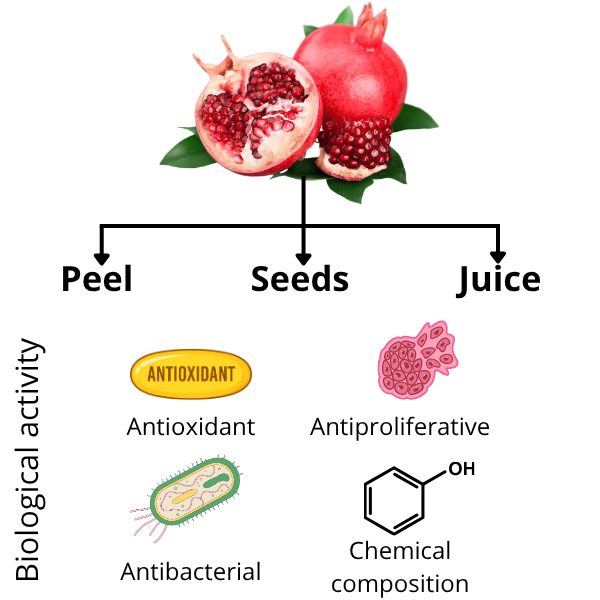
Pomegranate (Punica granatum L.) is widely recognized for its abundance of bioactive compounds with potential health benefits. However, information regarding the chemical composition and biological properties of pomegranates cultivated in northwestern Mexico remains scarce. This study aimed to characterize the chemical profile and evaluate the antioxidant, antiproliferative, antibacterial, and α-glucosidase inhibitory activities of ethanolic and methanolic extracts from peel, seed, and juice of P. granatum fruits grown in Sonora, Mexico. Fruits collected from northwestern Mexico were separated into peel, juice, and seed fractions and extracted with ethanol or methanol. Extracts were characterized by total phenolic and flavonoid contents, and by ellagic acid content determined by HPLC-DAD. Antioxidant activity was assessed by the DPPH radical scavenging assay; antiproliferative activity was evaluated by the MTT assay on HeLa, PC3, and L929 cell lines; antibacterial activity against Escherichia coli and Staphylococcus aureus was determined by the broth microdilution method; and α-glucosidase inhibition was analyzed spectrophotometrically.
Peel extracts exhibited the highest phenolic (up to 251 mg GAE/g DE) and flavonoid contents and the strongest antioxidant activity (EC₅₀ = 14.59 ± 1.04 µg/mL). They also displayed pronounced antiproliferative activity, particularly against PC3 cells (IC₅₀ = 187.82 ± 32.22 µg/mL), and selective antibacterial activity against S. aureus, achieving complete inhibition at 800 µg/mL. Methanolic peel extracts showed complete α-glucosidase inhibition across all tested concentrations. Peel extracts of P. granatum from Sonora exhibited superior chemical richness and multifunctional bioactivity, highlighting their potential as sustainable sources of natural antioxidants, antimicrobials, and hypoglycemic agents for functional food and nutraceutical applications.
Resumen. La granada (Punica granatum L.) es ampliamente reconocida por su abundancia de compuestos bioactivos con potenciales beneficios para la salud. Sin embargo, la información sobre la composición química y las propiedades biológicas de las granadas cultivadas en el noroeste de México es limitada. El objetivo de este estudio fue caracterizar el perfil químico y evaluar las actividades antioxidante, antiproliferativa, antibacteriana y la inhibición de α-glucosidasa de extractos etanólicos y metanólicos obtenidos de la cáscara, semillas y jugo de frutos de P. granatum cultivados en Sonora, México. Los frutos recolectados en el noroeste de México se separaron en fracciones de cáscara, jugo y semillas, y se sometieron a extracción con etanol o metanol. Los extractos se caracterizaron mediante contenido total de fenoles, contenido de flavonoides y cuantificación de ácido elágico por HPLC-DAD. La actividad antioxidante se evaluó mediante el ensayo de captura del radical DPPH; la actividad antiproliferativa se determinó mediante el método MTT en las líneas celulares HeLa, PC3 y L929; la actividad antibacteriana contra Escherichia coli y Staphylococcus aureus se evaluó mediante microdilución en caldo; y la inhibición de α-glucosidasa se analizó espectrofotométricamente. Los extractos de cáscara mostraron los mayores contenidos de fenoles (hasta 251 mg GAE/g DE) y flavonoides, así como la actividad antioxidante más alta (EC₅₀ = 14.59 ± 1.04 µg/mL). También presentaron marcada actividad antiproliferativa, particularmente contra células PC3 (IC₅₀ = 187.82 ± 32.22 µg/mL), además de actividad antibacteriana selectiva contra S. aureus, logrando una inhibición completa a 800 µg/mL. Los extractos metanólicos de cáscara mostraron inhibición total de α-glucosidasa en todas las concentraciones evaluadas. Los extractos de cáscara de P. granatum provenientes de Sonora exhibieron una notable riqueza química y bioactividad multifuncional, destacando su potencial como fuentes sostenibles de antioxidantes naturales, agentes antimicrobianos e hipoglucemiantes para aplicaciones en alimentos funcionales y nutracéuticos.
Downloads
References
1. Ambigaipalan, P.; de Camargo, A. C.; Shahidi, F. J. Agric. Food Chem. 2016, 64, 6584–6604. DOI: http://dx.doi.org/10.1021/acs.jafc.6b02950
2. Liu, Y.; Seeram, N. P. J. Sep. Sci. 2018, 41, 3022–3033. DOI: http://dx.doi.org/10.1002/jssc.201800480
3. https://www.gob.mx/agricultura/articulos/que-hay-detras-de-la-produccion-de-granada?idiom=es, accessed in October, 2025.
4. Vučić, V.; Grabež, M.; Trchounian, A.; Arsić, A. Curr. Pharm. Des. 2019, 25, 1817–1827. DOI: http://dx.doi.org/10.2174/1381612825666190708183941
5. Bielli, P.; Calabrese, L. Cell. Mol. Life Sci. 2002, 59, 1413–1427. DOI: http://dx.doi.org/10.1007/s00018-002-8519-2
6. Hegazi, N. M.; El-Shamy, S.; Fahmy, H.; Farag, M. A. J. Food Compos. Anal. 2021, 97, 103773. DOI: http://dx.doi.org/10.1016/j.jfca.2020.103773
7. Sabraoui, T.; Khider, T.; Nasser, B.; Eddoha, R.; Moujahid, A.; Benbachir, M.; Essamadi, A. Int. J. Food Sci. 2020, 2020, 8885889. DOI: http://dx.doi.org/10.1155/2020/8885889
8. Pathak, P. D.; Mandavgane, S. A.; Kulkarni, B. D. Rev. Chem. Eng. 2015, 31. DOI: http://dx.doi.org/10.1515/revce-2014-0041
9. Sorrenti, V.; Randazzo, C. L.; Caggia, C.; Ballistreri, G.; Romeo, F. V.; Fabroni, S.; Timpanaro, N.; Raffaele, M.; Vanella, L. Front. Microbiol. 2019, 10, 660. DOI: http://dx.doi.org/10.3389/fmicb.2019.00660
10. Shrinet, K.; Singh, R. K.; Chaurasia, A. K.; Tripathi, A.; Kumar, A., in: Natural Bioactive Compounds, Elsevier, 2021, 337–362. DOI: http://dx.doi.org/10.1016/B978-0-12-820655-3.00017-3
11. Banihani, S.; Swedan, S.; Alguraan, Z. Nutr. Res. 2013, 33, 341–348. DOI: http://dx.doi.org/10.1016/j.nutres.2013.03.003
12. Huang, T.; Peng, G.; Kota, B.; Li, G.; Yamahara, J.; Roufogalis, B.; Li, Y. Toxicol. Appl. Pharmacol. 2005, 207, 160–169. DOI: http://dx.doi.org/10.1016/j.taap.2004.12.009
13. Koren-Gluzer, M.; Aviram, M.; Meilin, E.; Hayek, T. Atherosclerosis. 2011, 219, 510–518. DOI: http://dx.doi.org/10.1016/j.atherosclerosis.2011.07.119
14. Ko, K.; Dadmohammadi, Y.; Abbaspourrad, A. Foods. 2021, 10, 657. DOI: http://dx.doi.org/10.3390/foods10030657
15. Singleton, V. L.; Rossi, J. A. Am. J. Enol. Vitic. 1965, 16, 144–158.
16. Popova, M.; Bankova, V.; Butovska, D.; Petkov, V.; Nikolova-Damyanova, B.; Sabatini, A. G.; Marcazzan, G. L.; Bogdanov, S. Phytochem. Anal. 2004, 15, 235–240. DOI: http://dx.doi.org/10.1002/pca.777
17. Cantos, E.; García-Viguera, C.; de Pascual-Teresa, S.; Tomás-Barberán, F. A. J. Agric. Food Chem. 2000, 48, 4606–4612. DOI: http://dx.doi.org/10.1021/jf0002948
18. Usia, T.; Banskota, A. H.; Tezuka, Y.; Midorikawa, K.; Matsushige, K.; Kadota, S. J. Nat. Prod. 2002, 65, 673–676. DOI: http://dx.doi.org/10.1021/np010486c
19. Grunberger, D.; Banerjee, R.; Eisinger, K.; Oltz, E. M.; Efros, L.; Caldwell, M.; Estevez, V.; Nakanishi, K. Experientia 1988, 44, 230–232. DOI: http://dx.doi.org/10.1007/BF01941717
20. Clinical and Laboratory Standards Institute. Methods for Dilution Antimicrobial Susceptibility Tests for Bacteria That Grow Aerobically; Approved Standard, 9th ed.; CLSI: Wayne, PA, 2012; Vol. 32.
21. Laaraj, N.; Bouhrim, M.; Kharchoufa, L.; Tiji, S.; Bendaha, H.; Addi, M.; Drouet, S.; Hano, C.; Lorenzo, J. M.; Bnouham, M.; Mimouni, M. Foods. 2022, 11, 1353. DOI: http://dx.doi.org/10.3390/foods11091353
22. Derakhshan, Z.; Ferrante, M.; Tadi, M.; Ansari, F.; Heydari, A.; Hosseini, M. S.; Conti, G. O.; Sadrabad, E. K. Food Chem. Toxicol. 2018, 114, 108–111. DOI: http://dx.doi.org/10.1016/j.fct.2018.02.023
23. Kumar, S.; Singh, V.; Johar, V.; Varma, S.; Thakur, R.; Banerjee, D. J. Food Chem. Nanotechnol. 2023, S588–S593. DOI: http://dx.doi.org/10.17756/jfcn.2023-s1-074
24. Barathikannan, K.; Venkatadri, B.; Khusro, A.; Al-Dhabi, N. A.; Agastian, P.; Arasu, M. V.; Choi, H. S.; Kim, Y. O. BMC Complement. Altern. Med. 2016, 16, 264. DOI: http://dx.doi.org/10.1186/s12906-016-1237-3
25. Borochov-Neori, H.; Judeinstein, S.; Harari, M.; Bar-Ya’akov, I.; Patil, B. S.; Lurie, S.; Holland, D. J. Agric. Food Chem. 2011, 59, 5325–5334. DOI: http://dx.doi.org/10.1021/jf2003688
26. Ghasemi-Soloklui, A. A.; Kordrostami, M.; Gharaghani, A. Sci. Rep. 2023, 13, 15899. DOI: http://dx.doi.org/10.1038/s41598-023-42749-z
27. Kupnik, K.; Primožič, M.; Vasić, K.; Knez, Ž.; Leitgeb, M. Plants. 2021, 10, 1554. DOI: http://dx.doi.org/10.3390/plants10081554
28. Magangana, T. P.; Makunga, N. P.; Fawole, O. A.; Opara, U. L. Molecules. 2020, 25, 4690. DOI: http://dx.doi.org/10.3390/molecules25204690
29. Habchi, C.; Badran, A.; Srour, M.; Daou, A.; Baydoun, E.; Hamade, K.; Hijazi, A. Processes. 2023, 11, 1111. DOI: http://dx.doi.org/10.3390/pr11041111
30. Nasr, M.; Naeem, S. A.; El-Shenbaby, I.; Mohamed, F. M. A.; Mahmoud, S. M.; Abuamara, T. M. M.; Abd-Elhay, W. M.; Elbayoumy, F. M. A. E.; Elkot, A.; Shikhon, T.; Abo-Akrab, M.; Doma, M. A.; Hasan, A. J. Exp. Pharmacol. 2023, 15, 191–205. DOI: http://dx.doi.org/10.2147/JEP.S404321
31. Shabir, I.; Dar, A. H.; Dash, K. K.; Manzoor, S.; Srivastava, S.; Pandey, V. K.; Shams, R.; Bashir, I.; Khan, S. A.; Mukarram, S. A.; Kovács, B. Appl. Food Res. 2024, 4, 100572. DOI: http://dx.doi.org/10.1016/j.afres.2024.100572
32. Silva, C. R. e A.; Vidal, C. S.; Filho, S. M. de A.; Agatão, I. M.; Berbert, L. C.; Salles, J. B. de; Cardoso, A. M.; Kuster, R. M.; Victório, C. P.; Assis, M. C. de. Molecules. 2025, 30, 2387. DOI: http://dx.doi.org/10.3390/molecules30112387
33. Fawole, O. A.; Makunga, N. P.; Opara, U. L. BMC Complement. Altern. Med. 2012, 12, 200. DOI: http://dx.doi.org/10.1186/1472-6882-12-200
34. Tasnim, F.; Hosen, M. E.; Hasan, A. R.; Hasan, M. T.; Rahaman, M. M.; Hossain, M. M.; Jubayed, M. A. Al; Aktaruzzaman, M.; Altayyar, M.; Yihune, E.; Islam, M. T.; Zaki, M. E. A. Sci. Rep. 2025, 15. DOI: http://dx.doi.org/10.1038/s41598-025-02065-0
35. Scaglione, E.; Sateriale, D.; Mantova, G.; Di Rosario, M.; Continisio, L.; Vitiello, M.; Pagliarulo, C.; Colicchio, R.; Pagliuca, C.; Salvatore, P. Front. Microbiol. 2024, 15, 1383027. DOI: http://dx.doi.org/10.3389/fmicb.2024.1383027
36. Kam, A.; Li, K. M.; Razmovski-Naumovski, V.; Nammi, S.; Shi, J.; Chan, K.; Li, G. Q. Phytother. Res. 2013, 27, 1614–1620. DOI: http://dx.doi.org/10.1002/ptr.4913
37. Shi, R.; Zhou, N.; Zhang, H.; Gong, M.; Han, L. Front. Nutr. 2022, 9, 1014862. DOI: http://dx.doi.org/10.3389/fnut.2022.1014862
38. Kandylis, P.; Kokkinomagoulos, E. Foods. 2020, 9, 122. DOI: http://dx.doi.org/10.3390/foods9020122
39. Costa, N. H. B.; Amadio, G. B.; Souza-Santos, Y. J.; Carvalho, R. A.; Vanin, F. M. Food Sci. Nutr. 2025, 13, e70690. DOI: http://dx.doi.org/10.1002/fsn3.70690
40. Bertolo, M. R. V.; Martins, V. C. A.; Horn, M. M.; Brenelli, L. B.; Plepis, A. M. G. Carbohydr. Polym. 2020, 228, 115386. DOI: http://dx.doi.org/10.1016/j.carbpol.2019.115386
41. Dhande, D. Y.; Nighot, D. V.; Sinaga, N.; Dahe, K. B. Renew. Sustain. Energy Rev. 2021, 149, 111349. DOI: http://dx.doi.org/10.1016/j.rser.2021.111349
Downloads
Published
Issue
Section
License
Copyright (c) 2026 Pablo Mendez-Pfeiffer, Manuel Ballesteros-Monrreal, Dora Valencia, Mayra Mendez-Encinas, Carlos Armando Cañez-Moreno, Nohemi Gamez-Meza, Edgar Omar Rueda-Puente, Jesús Ortega-García

This work is licensed under a Creative Commons Attribution-NonCommercial 4.0 International License.
Authors who publish with this journal agree to the following terms:
- Authors retain copyright and grant the journal right of first publication with the work simultaneously licensed under a Creative Commons Attribution License that allows others to share the work with an acknowledgement of the work's authorship and initial publication in this journal.
- Authors are able to enter into separate, additional contractual arrangements for the non-exclusive distribution of the journal's published version of the work (e.g., post it to an institutional repository or publish it in a book), with an acknowledgement of its initial publication in this journal.