Structural Modification and CO₂-Adsorption Application on Unit Cell and Supercell Zirconium Chloride: Electronic, Dynamic and Hydrated Adsorption System
DOI:
https://doi.org/10.29356/jmcs.v70i1.2561Keywords:
ZrCl3, supercell, adsorption system, dynamic simulationAbstract
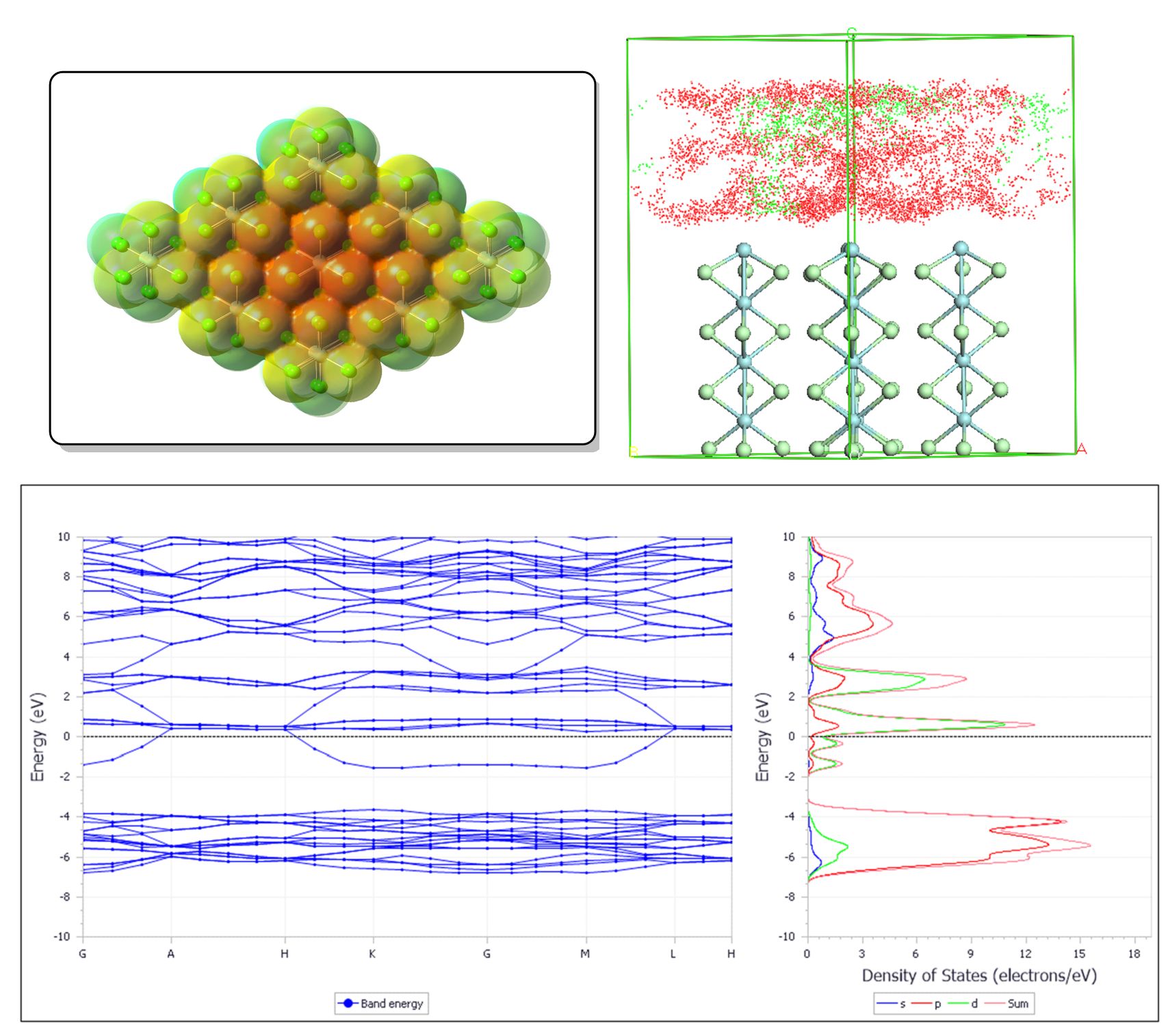
Abstract. Structural modification of catalyzed materials for CO2 adsorption involves altering their physical and chemical properties to enhance their capacity and efficiency in capturing carbon dioxide. ZrCl3 crystal was considered to investigate its properties and modified aspects in the presence of CO2 on the surface of the unit cell structure and the generated supercell. Frontier molecular orbitals (FMOs) of the designed systems were evaluated for the best describing the electronic variation in the presence and absence of CO2 molecules. The presence of CO2 molecule led to adsorption modification slightly changing the band gap with variation in orbital contribution on the surface of the catalyst. Molecular electrostatic potential (MEP) of the optimized structures was generated to give an insight into the most electrophilic and nucleophilic centers present before, and after CO2 adsorption. The band gap calculated for the overall solid-state crystal at the same level of optimization was 2.35 eV expecting the semiconducting behavior. Molecular dynamic simulation over 10000 ps (10 ns) was considered and the results concluded a more stable CO2-unit cell adsorption system with high capacity of adsorbate on the surface. A hydrated system adsorption locator was performed, where the adsorbate distribute itself freely inside the hydration layer. This indicates higher interaction with H2O molecules with significant adsorption energy ranges from -2.00 eV to -1.93 eV.
Resumen. La modificación estructural de materiales catalíticos para la adsorción de CO₂ consiste en alterar sus propiedades físicas y químicas con el fin de mejorar su capacidad y eficiencia para capturar dióxido de carbono. En este trabajo se estudió el cristal de ZrCl₃ para investigar sus propiedades y las modificaciones inducidas por la presencia de CO₂ sobre la superficie de la estructura de la celda unitaria y de la supercelda generada. Se evaluaron los orbitales moleculares de frontera (FMO) de los sistemas diseñados con el propósito de describir las variaciones electrónicas en presencia y ausencia de moléculas de CO₂. La presencia de CO₂ produjo modificaciones en la adsorción que ocasionaron ligeros cambios en la brecha de energía (band gap), acompañados de variaciones en la contribución de los orbitales sobre la superficie del catalizador. Asimismo, se calculó el potencial electrostático molecular (MEP) de las estructuras optimizadas para identificar los centros más electrófilos y nucleófilos antes y después de la adsorción de CO₂. La brecha de energía calculada para el cristal en estado sólido, al mismo nivel de optimización, fue de 2.35 eV, lo que sugiere un comportamiento semiconductor. Se realizaron simulaciones de dinámica molecular durante 10000 ps (10 ns), cuyos resultados mostraron que el sistema de adsorción CO₂–celda unitaria es el más estable y presenta una elevada capacidad para retener el adsorbato sobre la superficie. Además, se llevó a cabo un estudio de localización de la adsorción en un sistema hidratado, en el que el adsorbato se distribuye libremente dentro de la capa de hidratación. Este comportamiento indica una mayor interacción con las moléculas de H₂O, con energías de adsorción comprendidas entre −2.00 eV y −1.93 eV.
Downloads
References
1. Mitchell, S.; Qin, R.; Zheng, N.; et al. Nat. Nanotechnol. 2021, 16, 129–139. DOI: https://doi.org/10.1038/s41565-020-00799-8
2. Lanzafame, P.; Perathoner, S.; Centi, G.; Gross, S.; Hensen, E. J. M. Catal. Sci. Technol. 2017, 7, 5182–5194.
3. Mitchell, S.; Martín, A. J.; Pérez-Ramírez, J. Nat. Chem. Eng. 2024, 1, 13–15. DOI: https://doi.org/10.1038/s44286-023-00005-1
4. Naveen, K. E.; Raju, K.; Beenarani, B. B.; Alsharif, M. H.; Kim, M. K.; Hasan, Z. I. Energy Rep. 2024, 11, 1171–1190. DOI: https://doi.org/10.1016/j.egyr.2023.12.068
5. Shen, Z.; Han, Q.; Luo, X.; et al. Nat. Photonics. 2024, 18, 450–457. DOI: https://doi.org/10.1038/s41566-024-01383-5
6. Li, S.; Jiang, Y.; Xu, J.; et al. Nature. 2024. DOI: https://doi.org/10.1038/s41586-024-08103-7
7. Nat. Energy. 2019, 4, 1. DOI: https://doi.org/10.1038/s41560-018-0323-9
8. Hamad, A.; Jia, B. Int. J. Environ. Res. Public Health. 2022, 19, 11278. DOI: https://doi.org/10.3390/ijerph191811278
9. El, S.; Abdelrehim, E. M. Spectrochim. Acta Part A Mol. Biomol. Spectrosc. 2021, 261, 120006. DOI: https://doi.org/10.1016/j.saa.2021.120006
10. Ibraheem, H. H.; Ali, A. I.; El-Sayed, D. S. J. Mol. Struct. 2024, 138484. DOI: https://doi.org/10.1016/j.molstruc.2024.138484
11. Issa, A. A.; Ibraheem, H. H.; El-Sayed, D. S. J. Mol. Model. 2024, 30, 14. DOI: https://doi.org/10.1007/s00894-023-05815-x
12. Zhang, Y.; Kitchaev, D. A.; Yang, J.; et al. npj Comput. Mater. 2018, 4, 9. DOI: https://doi.org/10.1038/s41524-018-0065-z
13. Marzari, N.; Ferretti, A.; Wolverton, C. Nat. Mater. 2021, 20, 736–749. DOI: https://doi.org/10.1038/s41563-021-01013-3
14. Wu, L.; Zhu, Y.; Yuan, J.; Guo, X.; Zhang, Q. Energies. 2024, 17, 1861. DOI: https://doi.org/10.3390/en17081861
15. Sarikas, A. P.; Gkagkas, K.; Froudakis, G. E. Sci. Rep. 2024, 14, 27360. DOI: https://doi.org/10.1038/s41598-024-76319-8
16. Broom, D. P. Adsorption. 2024, 30, 1565–1591. DOI: https://doi.org/10.1007/s10450-023-00424-9
17. Yuan, Y.; Wang, J.; Adimi, S.; et al. Nat. Mater. 2020, 19, 282–286. DOI: https://doi.org/10.1038/s41563-019-0535-9
18. Kazanskiy, N. L.; Butt, M. A.; Khonina, S. N. Nanomaterials. 2022, 12, 2171. DOI: https://doi.org/10.3390/nano12132171
19. Iqbal, M. A.; Malik, M.; Anwar, N.; et al. Arab. J. Chem. 2023, 16, 105040. DOI: https://doi.org/10.1016/j.arabjc.2023.105040
20. Zhang, F.; Zhou, Y.; Chen, Z.; et al. Adv. Mater. 2022, 34, 2204801. DOI: https://doi.org/10.1002/adma.202204801
21. Shyam, L. G.; Kumar, S.; et al. Int. J. Hydrogen Energy. 2023, 55, 1465–1475. DOI: https://doi.org/10.1016/j.ijhydene.2023.11.286
22. Faizan, M.; Bhamu, K. C.; Murtaza, G.; et al. Sci. Rep. 2021, 11, 6965. DOI: https://doi.org/10.1038/s41598-021-86145-x
23. Curtarolo, S.; Hart, G.; Nardelli, M.; et al. Nat. Mater. 2013, 12, 191–201. DOI: https://doi.org/10.1038/nmat3568
24. Louie, S. G.; Chan, Y. H.; da Jornada, F. H.; et al. Nat. Mater. 2021, 20, 728–735. DOI: https://doi.org/10.1038/s41563-021-01015-1
25. Lu, Z. Mater. Rep. Energy. 2021, 1, 100047. DOI: https://doi.org/10.1016/j.matre.2021.100047
26. Jain, A.; Shin, Y.; Persson, K. Nat. Rev. Mater. 2016, 1, 15004. DOI: https://doi.org/10.1038/natrevmats.2015.4
27. Wu, X.; Kang, F.; Duan, W.; Li, J. Prog. Nat. Sci. Mater. Int. 2019, 29, 247–255. DOI: https://doi.org/10.1016/j.pnsc.2019.04.003
28. Sepehri, A.; Loeffler, T. D.; Chen, B. J. Chem. Phys. 2014, 141. DOI: https://doi.org/10.1063/1.4892640
29. http://accelrys.com/products/collaborative-science/biovia-materials-studio/, accessed in December 2022.
30. Vásquez, G. C.; Maestre, D.; Cremades, A.; et al. Sci. Rep. 2018, 8, 8740. DOI: https://doi.org/10.1038/s41598-018-26728-3
31. Issa, A. A.; Kamel, M. D.; El-Sayed, D. S. J. Mol. Model. 2024, 30, 106. DOI: https://doi.org/10.1007/s00894-024-05896-2
32. Clark, S. J.; Segall, M. D.; Pickard, C. J.; Hasnip, P. J.; Probert, M. I.; Refson, K.; Payne, M. C. Z. Kristallogr. 2005, 220, 567–570. DOI: https://doi.org/10.1524/zkri.220.5.567.65075
33. Choudhary, K.; Zhang, Q.; Reid, A.; et al. Sci. Data. 2018, 5, 180082. DOI: https://doi.org/10.1038/sdata.2018.82
34. Mahmood, W. K.; Dakhal, G. Y.; Younus, D.; et al. J. Mol. Model. 2024, 30, 165. DOI: https://doi.org/10.1007/s00894-024-05956-7
35. Jafarova, V. N.; Orudzhev, G. S. Solid State Commun. 2021, 325, 114166. DOI: https://doi.org/10.1016/j.ssc.2020.114166
36. El-Sayed, D. S. J. Mol. Model. 2023, 29, 96. DOI: https://doi.org/10.1007/s00894-023-05501-y
37. Fiedler, L.; Modine, N. A.; Schmerler, S.; et al. npj Comput. Mater. 2023, 9, 115. DOI: https://doi.org/10.1038/s41524-023-01070-z
38. Pedone, A.; Presti, D.; Menziani, M. C. Chem. Phys. Lett. 2012, 541, 12–15. DOI: https://doi.org/10.1016/j.cplett.2012.05.049
39. Sun, S. Y.; Nie, X. Y.; Huang, J.; Yu, J. G. J. Membr. Sci. 2019, 595, 117528. DOI: https://doi.org/10.1016/j.memsci.2019.117528
40. Gao, W.; Chen, Y.; Li, B.; Liu, S. P.; Liu, X.; Jiang, Q. Nat. Commun. 2020, 11, 1196. DOI: https://doi.org/10.1038/s41467-020-14969-8
41. Brauer, B.; Kesharwani, M. K.; Martin, J. M. L. J. Chem. Theory Comput. 2014, 10, 3791–3799. DOI: https://doi.org/10.1021/ct500513b
42. Shuttleworth, I. G. J. Phys. Chem. Solids. 2015, 86, 19–26. DOI: https://doi.org/10.1016/j.jpcs.2015.06.016
43. Elessawy, N. A.; Exley, J.; El-Sayed, D. S.; et al. J. Environ. Chem. Eng. 2024, 112489. DOI: https://doi.org/10.1016/j.jece.2024.112489
44. Mahmoud, M. E.; Salma, T. H.; Khalil, T. E.; et al. J. Mol. Liq. 2023, 390, 123042. DOI: https://doi.org/10.1016/j.molliq.2023.123042
45. Fukui, K.; Yonezawa, T.; Shingu, H. J. Chem. Phys. 1952, 20, 722–725. DOI: https://doi.org/10.1063/1.1700523
46. Bayly, C. I.; Cieplak, P.; Cornell, W.; Kollman, P. A. J. Phys. Chem. 1993, 97, 10269–10280. DOI: https://doi.org/10.1021/j100142a004
47. Knøsgaard, N. R.; Thygesen, K. S. Nat. Commun. 2022, 13, 468. DOI: https://doi.org/10.1038/s41467-022-28122-0
48. DeMille, D.; Hutzler, N. R.; Rey, A. M.; et al. Nat. Phys. 2024, 20, 741–749. DOI: https://doi.org/10.1038/s41567-024-02499-9
49. Maskery, I.; Sturm, L.; Aremu, A. O.; et al. Polymer. 2018, 152, 62–71. DOI: https://doi.org/10.1016/j.polymer.2017.11.049
50. Li, S.; Chen, R.; Wang, J.; et al. npj Mater. Sustain. 2024, 2, 11. DOI: https://doi.org/10.1038/s44296-024-00014-y
51. Boer, D. G.; Langerak, J.; Pescarmona, P. P. ACS Appl. Energy Mater. 2023, 6, 2634–2656. DOI: https://doi.org/10.1021/acsaem.2c03605
52. Li, N.; Ma, C.; Wang, Z.; Li, D.; Qiao, Z.; Zhong, C. J. Membr. Sci. 2024, 123453. DOI: https://doi.org/10.1016/j.memsci.2024.123453
53. Ashling, C. W.; Johnstone, R. N.; Widmer, J. W.; et al. J. Am. Chem. Soc. 2019, 141, 15641–15648.
54. Nuermaimaitijiang, W.; Shen, R.; Hao, L.; et al. Chem. Eng. J. 2024, 501, 157397. DOI: https://doi.org/10.1016/j.cej.2024.157397
55. Joutsuka, T.; Tada, S. J. Phys. Chem. C. 2023, 127, 6998–7008. DOI: https://doi.org/10.1021/acs.jpcc.3c01185
56. Cavenati, S.; Grande, C. A.; Rodrigues, A. E. J. Chem. Eng. Data. 2004, 49, 1095–1101. DOI: https://doi.org/10.1021/je0498917
57. Millward, A. R.; Yaghi, O. M. J. Am. Chem. Soc. 2005, 127, 17998–17999. DOI: https://doi.org/10.1021/ja0570032
58. Banerjee, R.; Phan, A.; Wang, B.; et al. Science. 2008, 319, 939–943. DOI: https://doi.org/10.1126/science.1152516
59. Zheng, H.; Jiang, Z.; Zhai, H.; Zheng, Z.; Wang, P.; Wang, Z.; Liu, Y.; Qin, X.; Zhang, X.; Huang, Appl. Catal. B: Environ. 2019, 243, 381–385. https://doi.org/10.1016/j.apcatb.2018.10.053
60. Siahrostami, S.; Tripkovic, V.; Rossmeisl, J.; Nørskov, J. K. J. Phys. Chem. C. 2016, 120, 24164–24172. DOI: https://doi.org/10.1021/acs.jpcc.6b07145
Downloads
Published
Issue
Section
License
Copyright (c) 2026 Dehbi Atallah, Ali Abdullah Issa, Doaa S. El Sayed

This work is licensed under a Creative Commons Attribution-NonCommercial 4.0 International License.
Authors who publish with this journal agree to the following terms:
- Authors retain copyright and grant the journal right of first publication with the work simultaneously licensed under a Creative Commons Attribution License that allows others to share the work with an acknowledgement of the work's authorship and initial publication in this journal.
- Authors are able to enter into separate, additional contractual arrangements for the non-exclusive distribution of the journal's published version of the work (e.g., post it to an institutional repository or publish it in a book), with an acknowledgement of its initial publication in this journal.