Binder-Free Lignite-Derived Carbon/NiFe₂O₄ Fiber Structures as a Potential Anode Material for Na-ion Batteries
DOI:
https://doi.org/10.29356/jmcs.v70i1.2456Keywords:
Carbonaceous materials, structural parameters, binary metal oxide fibers, rechargeable batteries, energy storageAbstract
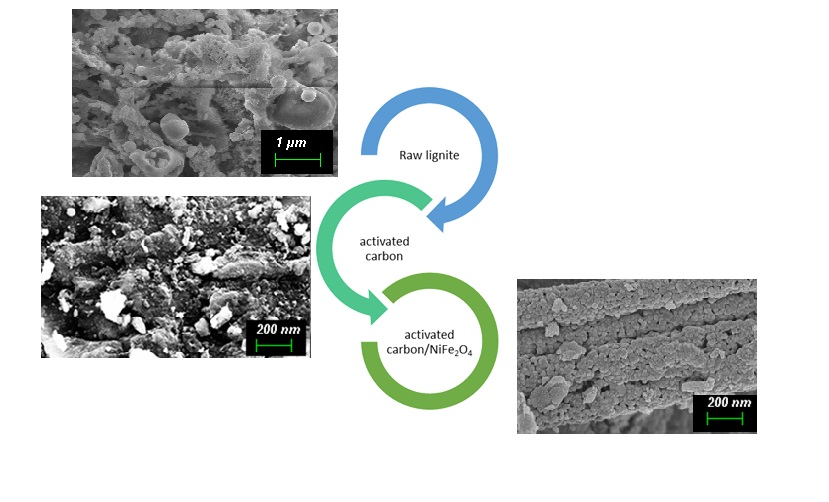
Abstract. Rational structural design is crucial for achieving superior sodium storage performance in anode materials for Na-ion batteries. Although cost-effective coal-based carbon materials are highly attractive, their diverse structures often lead to poor performance during the Na/Na⁺ process. In this study, lignite-based activated carbon/NiFe₂O₄ nanofiber composites were synthesized using a simple low-temperature co-precipitation method at 100 °C. ZnCl₂ and KOH were selected as activating agents for fabricating activated carbons from raw lignite sources. By employing different structural models, the estimated crystallite size of the lignite-based activated carbon ranges from 41 to 47 nm, while the range for NiFe₂O₄ nanofiber incorporation is between 95 and 143 nm. The Raman spectrum of the samples confirms sharp D, G, and shallow 2D bands of activated carbon located at ~1340, 1580, and 2700 cm⁻¹, respectively. The presence of sulfur and silicon residues in the activated carbon structure hinders sodium ion transport. The reduction of silicon content and the elimination of sulfur, combined with the incorporation of NiFe₂O₄ fibers and the creation of additional active zones, enhances the electrochemical performance by providing more Na-storage sites. The results indicate that the lignite-based activated carbon/NiFe₂O₄ nanofiber composites exhibit improved rate performance compared to individual lignite-derived activated carbons.
Resumen. El diseño estructural racional es crucial para lograr un mayor rendimiento almacenamiento de sodio en materiales para ánodos de baterías de iones de Na. Aunque los materiales de carbono a base de carbón rentables son muy atractivos, sus diversas estructuras a menudo dan como resultado un bajo rendimiento durante el proceso Na/Na⁺. En este estudio, se sintetizaron compuestos de nanofibras de carbón activado/NiFe₂O4 a base de lignito mediante una coprecipitación fácil a baja temperatura a 100 °C. Se seleccionaron ZnCl₂ y KOH como agentes activadores para la fabricación de carbones activados a partir de fuentes de lignito en bruto. Con el uso de diferentes modelos estructurales, el tamaño estimado de cristalito del carbón activado a base de lignito está entre 41-47 nm, mientras que es un rango de 95-143 nm con la incorporación de nanofibras de NiFe2O4. El espectro Raman de las muestras confirma una banda D, G nítida y 2D poco profunda de carbón activado que se ubicó en ~1340, 1580 y 2700 cm-1, respectivamente. La presencia de residuos de azufre y silisio en la estructura del carbón activado dificultó el transporte de iones sodio. La reducción del contenido de silicio y la eliminación de azufre, combinada con la incorporación de fibras de NiFe2O4 y la creación de zonas más activas, mejoraron el rendimiento electroquímico al proporcionar sitios adicionales de almacenamiento de iones Na. Los resultados indican que los compuestos de nanofibras de carbón activado a base de lignito/NiFe2O4 exhiben un mejor rendimiento de velocidad en comparación con los carbones activados individuales derivados del lignito.
Downloads
References
1. Bartoli, M.; Piovano, A.; Elia, G.A.; Meligrana, G.; Pedraza, R. et.al. Renew. Sustain. Energy Rev. 2024, 194, 114304. DOI: https://doi.org/10.1016/j.rser.2024.114304
2. Shao, Y.; Zhang, Y.; Jiang, N.; Hao, Y.; Qu, K.; Zeng, Y.; Liu, Z.; Lu, X.; Li, Y.; Yang, Q.; Qiu, J. iScience. 2023, 26, 108470. DOI: https://doi.org/10.1016/j.isci.2023.108470
3. Yan, G.; Mariyappan, S.; Rousse, G.; Jaquet, Q.; Deschamps, M.; David, R.; Mirvaux, B.; Freeland, J.W.; Tarascon, J. Nat. Commun. 2019, 10, 585 DOI: http://dx.doi.org/10.1038/s41467-019-08460-2
4. Yang, Z.; Zhang, C.; Li, F.; Xing, B.; Zhang, Y.; Qu, X.; Yu, J.; Xu, L. J. Energy Storage. 2025, 145, 119901. DOI: http://dx.doi.org/10.1016/j.est.2025.119901
5. Ma, S.; Yan, W.; Dong, Y.; Su, Y. Mater. Today. 2024, 75, 334-358. DOI: https://doi.org/10.1016/j.mattod.2024.03.010
6. Jayamkondan, Y.; Penki, T.R.; Nayak, P.K. Mater. Today Energy. 2023, 36, 101360. DOI: https://doi.org/10.1016/j.mtener.2023.101360
7. Phogat, P.; Rawat, S.; Dey, S.; Wan, M. J. Alloys Compd. 2025, 1020, 179544. DOI: https://doi.org/10.1016/j.jallcom.2025.179544
8. Wang, R.; Fan, Y.; Wang, J.; Li, Y.; Li, X.; Jin, F.; Hu, X. Prog. Nat. Sci.:Mater. Int. 2024, 34, 1281-1294. DOI: https://doi.org/10.1016/j.pnsc.2024.11.002
9. Chen, D.Q.; Zhang, W.; Luo, K.Y. et.al. Energy Environ. Sci. 2021, 14, 2244-2262. DOI: https://doi.org/10.1039/d0ee03916k
10. Yang, Z.; Huang, T.; Liu, G.; Wei, Y.; Zhang, Y.; HXue, H.; Zhang, L. Mater. Today Sustain. 2024, 27, 100929. DOI: https://doi.org/10.1016/j.mtsust.2024.100929
11. Lan, D.; Zhao, Y.; Liu, Y.; Zhu, N.; Cui, J. J. Energy Storage. 2024, 90, 111827. DOI: https://doi.org/10.1016/j.est.2024.111827
12. Lin, Y.; Jia, J.; Wang, J.; Kang, X.; Huang, G.; Xing, B.; Kang, W.; Zhang, C. Chem. Eng. J. 2025, 504, 158858. DOI: https://doi.org/10.1016/j.cej.2024.158858
13. Wang, X.; Lin, J.; Li, F.; Shen, H.; Luo, C. et.al. J. Energy Storage. 2025, 112, 115544. DOI: https://doi.org/10.1016/j.est.2025.115544
14. Sarf, F.; Eroğlu, Ö.; Kızıl, H. Mater. Today: Proc. 2023, 93, 75-78. DOI: https://doi.org/10.1016/j.matpr.2023.07.314
15. Santhoshkumar, P.; Kang, S.H.; Shaji, N.; Lee, C.W. J. Alloys Compd. 2020, 842. DOI: https://doi.org/10.1016/j.jallcom.2020.155649
16. Zhang, Y.; Zhang, Y.; Li, C.; Yan, X. et.al. Coord. Chem. Rev. 2024, 519, 216103. DOI: https://doi.org/10.1016/j.ccr.2024.216103
17. Rezić Meštrović, I.; Somogyi Škoc, M. Polymers 2025, 17, 1456. DOI: http://dx.doi.org/10.3390/polym17111456
18. Oikonomopoulos, I.K.; Perraki, M.; Tougiannidis, N. et.al. Int. J. Coal Geol. 2013, 115, 1-12. DOI: https://doi.org/10.1016/j.coal.2013.04.002
19. Tian, X.; Luo, S.; Wang, G.; Li, L.; Sun, M.; Wang, Q.; Li, C. J Energy Storage. 2025, 113, 115684. DOI: https://doi.org/10.1016/j.est.2025.115684
20. Lan, N.; Shen, Y.; Li, J.; Zeng, L.; Luo, D.; He, H.; Zhang, C. J. Colloid Interface Sci. 2024, 675, 293-301. DOI: https://doi.org/10.1016/j.jcis.2024.06.196
21. Feng, H.; Zhou, T.; Ge, L.; Li, Q.; Zhao, C.; Huang, J.; Wang, Y. Energy. 2024, 292, 130570. DOI: https://doi.org/10.1016/j.energy.2024.130570
22. Tamanna, N.J.; Md. Hossain, S.; Md. Bahadur, N.; Ahmed, S. Results Chem. 2024, 7, 101313. DOI: https://doi.org/10.1016/j.rechem.2024.101313
23. Nasiri, S.; Rabiei, M.; Palevicius, A.; Janusas, G.; Vilkauskas, A.; Nutalapati, V.; Monshi, A. Nano Trends. 2023, 3, 100015. DOI: https://doi.org/10.1016/j.nwnano.2023.100015
24. Lim, J.S.; Yam, F.K. Physica B: Condensed Matter. 2025, 699, 416798, https://doi.org/10.1016/j.physb.2024.416798
25. Nikmehr, S.; Md. Kazemzad, Md. Sabzehmeidani, M.; Nikzad, L.; Ebadzadeh, T. OpenNano. 2024, 16, 100203. DOI: https://doi.org/10.1016/j.onano.2024.100203
26. Jose, A.; Porel, M. Microchem. J. 2025, 208, 112596. DOI: https://doi.org/10.1016/j.microc.2024.112596
27. Toghan, A.; Khairy, M.; Kamar, E.M.; Mousa, M.A. J. Mater. Res. Technol. 2022, 19, 3521-3535. DOI: https://doi.org/10.1016/j.jmrt.2022.06.095
28. Hao, S.; Sheng, X.; Xie, F.; Sun, M.; Diao, F.; Wang, Y. J. Energy Storage. 2024, 80, 110412. DOI: https://doi.org/10.1016/j.est.2023.110412
29. Montero-Muñoz, M.; Ramos-Ibarra, J.E.; Rodríguez-Páez, J.E.; Marques G.E.; Teodoro M.D.; Coaquira J.A.H. Phys. Chem. Chem. Phys. 2020, 14, 7329-7339. DOI: https://doi.org/10.1039/c9cp06744b
30. Muhaymin, A.; Mohamed, H.E.A.; Hkiri, K.; Safdar, A.; Kotsedi, L.; Maaza, M. Mater. Today Chem. 2024, 40, 102286. DOI: https://doi.org/10.1016/j.mtchem.2024.102286
31. Baek, J.; Shin, H.; Chung, D.C.; Kim, B. J. Ind. Eng. Chem.2017, 54, 324-331. DOI: https://doi.org/10.1016/j.jiec.2017.06.007
32. Li, Y.; Ni, B.; Li, X. Nano-Micro Lett. 2019, 11, 60. DOI: https://doi.org/10.1007/s40820-019-0291-z
33. Yoshikawa, Y.; Teshima, K.; Futamura, R.; Tanaka, H.; Neimark, A.V.; Kaneko, K. J. Colloid Interface Sci. 2020, 578, 422-430. DOI: https://doi.org/10.1016/j.jcis.2020.06.002
34. Cançado, L.G.; Monken, V.P.; Campos, J.L.E.; Santos, J.C.C.; Backes, C.; Chacham, H.; Neves, B.R.A.; Jorio, A. Carbon. 2024, 220, 118801. DOI: https://doi.org/10.1016/j.carbon.2024.118801
35. He, H.; Zhang, Q.; Wang, H.; Zhang, H. et.al. J. Power Sources. 2017, 354, 179-188. DOI: https://doi.org/10.1016/j.jpowsour.2017.04.035
36. Zhang, H.; Gao, F.; Zhang, D.; Gao, C.; Huang, G. Carbon. 2024, 230, 119602. DOI: https://doi.org/10.1016/j.carbon.2024.119602
37. Pandey, V.K.; Verma, S.; Verma, B. Synth. Met. 2025, 311, 117844. DOI: https://doi.org/10.1016/j.synthmet.2025.117844
38. Wu, H.; Li, L.; Yuan, W. Chem. Eng. J. 2022, 442, 136259. DOI: https://doi.org/10.1016/j.cej.2022.136259
Downloads
Published
Issue
Section
License
Copyright (c) 2025 Fatma Sarf, Emin Yakar

This work is licensed under a Creative Commons Attribution-NonCommercial 4.0 International License.
Authors who publish with this journal agree to the following terms:
- Authors retain copyright and grant the journal right of first publication with the work simultaneously licensed under a Creative Commons Attribution License that allows others to share the work with an acknowledgement of the work's authorship and initial publication in this journal.
- Authors are able to enter into separate, additional contractual arrangements for the non-exclusive distribution of the journal's published version of the work (e.g., post it to an institutional repository or publish it in a book), with an acknowledgement of its initial publication in this journal.