Synthesis of Octahedral Bipyramid TiO₂ Nanoparticles Free of Growth Agent as Congo Red Photocatalyst
DOI:
https://doi.org/10.29356/jmcs.v70i1.2436Keywords:
TiO₂, nanoparticles, photocatalyst, bipyramidal, Congo red dyeAbstract
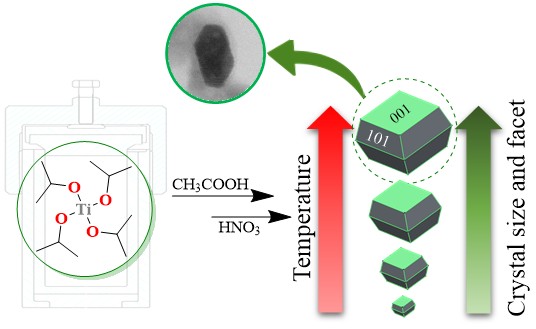
In this work, we prepared anatase TiO2 nanoparticles with octahedral bipyramidal shapes with different (001)/(101) ratio facets as photocatalysts for Congo red (CR) dye. The general method to prepare such nano-TiO2 photocatalysts involves a peptization step with HNO3 and hydrothermal treatment at different temperatures, making this a facile and friendly method to controllably synthesize TiO2 with octahedral bipyramidal shape and tuned (001)/(101) ratio free of capping surfactants or direction agent like HF. The photocatalytic activity of these anatase TiO2 nanoparticles was evaluated through CR dye photodegradation under UV light illumination. It was shown that all samples can present a photocatalytic activity, and the degradation efficiency and kinetics depend on nanoparticle size and (001)/(101) ratio facets.
Resumen. En este trabajo preparamos nanopartículas de TiO2 anatasa con forma bipiramidal octaédrica con diferentes facetas de proporción (001)/(101) como fotocatalizadores para el colorante Congo rojo (CR). El método general parapreparar dichos nano-fotocatalizadores de TiO2 implica un paso de peptización con HNO3 y un tratamiento hidrotermal a diferentes temperaturas, lo que hace de este un método fácil y amigable para sintetizar de manera controlada TiO2 con forma bipiramidal octaédrica y proporción ajustada (001)/(101) libre de surfactantes de recubrimiento o agentes de dirección como HF. La actividad fotocatalítica de estas nanopartículas de TiO2 anatasa se evaluó a través de la fotodegradación del colorante RC bajo iluminación de luz UV. Se demostró que todas las muestras pueden presentar una actividad fotocatalítica y la eficiencia de degradación y la cinética dependen del tamaño de las nanopartículas y de la proporción de facetas (001)/(101).
Downloads
References
1. Tran, H. D.; Nguyen, D. Q.; Do, P. T.; Tran, U. N. P. RSC Adv. 2023, 13, 16915–16925. DOI: https://doi.org/10.1039/D3RA01970E
2. Reynoso-Soto, E. A.; Pérez-Sicairos, S.; Reyes-Cruzaley, A. P.; Castro-Riquelme, C. L.; Félix-Navarro, R. M.; Paraguay-Delgado, F.; Alonso-Núñez, G.; Lin-Ho, S. W. J. Mex. Chem. Soc. 2013, 57, 298-305. DOI: https://doi.org/10.29356/jmcs.v57i4.193
3. Thongam, D. D.; Chaturvedi, H. Nano Express 2021, 2, 12005. DOI: https://doi.org/10.1088/2632-959X/abeb8d
4. Abdelrahman, E. A.; Hegazey, R. M.; Ismail, S. H.; El-Feky, H. H.; Khedr, A. M.; Khairy, M.; Ammar, A. M. Arab. J. Chem. 2022, 15, 104372. DOI: https://doi.org/https://doi.org/10.1016/j.arabjc.2022.104372
5. Pearson, A.; Jani, H.; Kalantar-zadeh, K.; Bhargava, S. K.; Bansal, V. Langmuir. 2011, 27, 6661–6667. DOI: https://doi.org/10.1021/la2007765
6. Lee, T.-Y.; Lee, C.-Y.; Chiu, H.-T. ACS Omega. 2018, 3, 10225–10232. DOI: https://doi.org/10.1021/acsomega.8b01251
7. Liu, X.; Du, G.; Li, M. ACS Omega. 2019, 4, 14902–14912. DOI: https://doi.org/10.1021/acsomega.9b01648
8. Yang, H. G.; Sun, C. H.; Qiao, S. Z.; Zou, J.; Liu, G.; Smith, S. C.; Cheng, H. M.; Lu, G. Q. Nature. 2008, 453, 638–641. DOI: https://doi.org/10.1038/nature06964
9. Sun, D.; Yang, W.; Zhou, L.; Sun, W.; Li, Q.; Shang, J. K. Appl. Catal. B Environ. 2016, 182, 85–93. DOI: https://doi.org/https://doi.org/10.1016/j.apcatb.2015.09.005
10. Liu, G.; Sun, C.; Yang, H. G.; Smith, S. C.; Wang, L.; Lu, G. Q. (Max); Cheng, H.-M. Chem. Commun. 2010, 46, 755–757. DOI: https://doi.org/10.1039/B919895D
11. Nguyen, C. K.; Cha, H. G.; Kang, Y. S. Cryst. Growth Des. 2011, 11, 3947–3953. DOI: https://doi.org/10.1021/cg200815t
12. Dinh, C.-T.; Nguyen, T.-D.; Kleitz, F.; Do, T.-O. ACS Nano. 2009, 3, 3737–3743. DOI: https://doi.org/10.1021/nn900940p
13. Zhao, X.; Jin, W.; Cai, J.; Ye, J.; Li, Z.; Ma, Y.; Xie, J.; Qi, L. Adv. Funct. Mater. 2011, 21, 3554–3563. DOI: https://doi.org/https://doi.org/10.1002/adfm.201100629
14. Shaban, M.; Abukhadra, M. R.; Ibrahim, S. S.; Shahien, M. G. Appl. Water Sci. 2017, 7, 4743–4756. DOI: https://doi.org/10.1007/s13201-017-0637-y
15. Saini, D.; Aggarwal, R.; Sonker, A. K.; Sonkar, S. K. ACS Appl. Nano Mater. 2021, 4, 9303–9312. DOI: https://doi.org/10.1021/acsanm.1c01810
16. Chowdhury, A. P.; Anantharaju, K. S.; Keshavamurthy, K.; Rokhum, S. L. J. Chem. 2023, 2023, 9780955. DOI: https://doi.org/https://doi.org/10.1155/2023/9780955
17. Harja, M.; Buema, G.; Bucur, D. Sci. Rep. 2022, 12, 6087. DOI: https://doi.org/10.1038/s41598-022-10093-3
18. Al-Farraj, E. S.; Abdelrahman, E. A. ACS Omega. 2024, 9, 4870–4880. DOI: https://doi.org/10.1021/acsomega.3c08485
19. Tong, H.; Zhou, Y.; Chang, G.; Li, P.; Zhu, R.; He, Y. Appl. Surf. Sci. 2018, 444, 267–275. DOI: https://doi.org/https://doi.org/10.1016/j.apsusc.2018.03.069
20. Liu, S.; Yu, J.; Jaroniec, M. Chem. Mater. 2011, 23, 4085–4093. DOI: https://doi.org/10.1021/cm200597m
21. Kinsinger, N. M.; Wong, A.; Li, D.; Villalobos, F.; Kisailus, D. Cryst. Growth Des. 2010, 10, 5254–5261.DOI: https://doi.org/10.1021/cg101105t
22. Lee, D.-S.; Lee, S.-Y.; Rhee, K. Y.; Park, S.-J. Curr. Appl. Phys. 2014, 14, 415–420. DOI: https://doi.org/https://doi.org/10.1016/j.cap.2013.12.018
23. Wang, Z.; Lv, K.; Wang, G.; Deng, K.; Tang, D. Appl. Catal. B Environ. 2010, 100, 378–385. DOI: https://doi.org/https://doi.org/10.1016/j.apcatb.2010.08.014
24. Nie, S.; Zhao, X.; Liu, B. RSC Adv. 2015, 5, 103386–103393. DOI: https://doi.org/10.1039/C5RA13006A
25. Liu, N.; Zhao, Y.; Wang, X.; Peng, H.; Li, G. Mater. Lett. 2013, 102–103, 53–55. DOI: https://doi.org/https://doi.org/10.1016/j.matlet.2013.03.106
26. Li, H.; Vrinat, M.; Berhault, G.; Li, D.; Nie, H.; Afanasiev, P. Mater. Res. Bull. 2013, 48, 3374–3382.DOI: https://doi.org/https://doi.org/10.1016/j.materresbull.2013.05.017
27. Wei, T. Y.; Wan, C. C. Ind. Eng. Chem. Res. 1991, 30, 1293–1300. DOI: https://doi.org/10.1021/ie00054a033
28. Ito, S.; Chen, P.; Comte, P.; Nazeeruddin, M. K.; Liska, P.; Péchy, P.; Grätzel, M. Prog. Photovoltaics Res. Appl. 2007, 15, 603–612. DOI: https://doi.org/https://doi.org/10.1002/pip.768
Downloads
Published
Issue
Section
License
Copyright (c) 2026 Paulina Vargas-Rodriguez, Carla Marlene Toledo Bonola, Carolina Silva-Carrillo, Brenda Cecilia Alcantar-Velazquez, Rosa-María Félix-Navarro, Rosalio Velarde-Barraza, Edgar-Alonso Reynoso-Soto

This work is licensed under a Creative Commons Attribution-NonCommercial 4.0 International License.
Authors who publish with this journal agree to the following terms:
- Authors retain copyright and grant the journal right of first publication with the work simultaneously licensed under a Creative Commons Attribution License that allows others to share the work with an acknowledgement of the work's authorship and initial publication in this journal.
- Authors are able to enter into separate, additional contractual arrangements for the non-exclusive distribution of the journal's published version of the work (e.g., post it to an institutional repository or publish it in a book), with an acknowledgement of its initial publication in this journal.