Effects of Eco-Agricultural Production of Phenolic Active Principles Synthesis in sect. Nepetoideae (Lamiaceae) Species
DOI:
https://doi.org/10.29356/jmcs.v69i4.2224Keywords:
Lamiaceae, ecological cultivation, phenolics, rosmarinic acid, HPLCAbstract
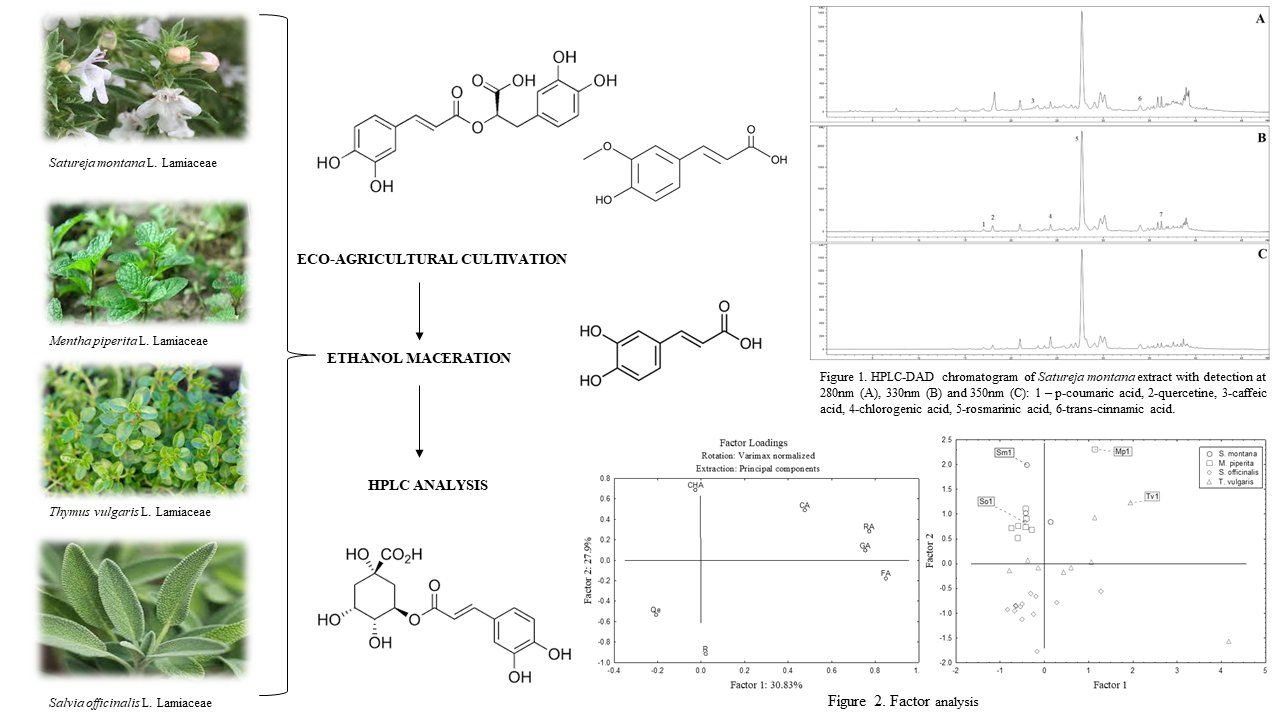
Abstract. One way of cultivating different aromatic Lamiaceae species, especially those classified in the Nepetoideae section, is eco-agricultural production. This modern trend makes new products with less environmental pollution and a high value for human health and nutrition. Winter savory (Satureja montana), peppermint (Mentha piperita), thyme (Thymus vulgaris), and sage (Salvia officinalis) are highly important medicinal plants that were introduced and are being successfully cultivated in agricultural fields in Vojvodina. This study aimed to determine 10 phenolic compounds in ethanolic extracts of peppermint, sage, thyme, and winter savory cultivated according to eco-agricultural principles. The amount of examined phenolic compounds was measured using liquid chromatography method (HPLC-DAD). In all four extracts, rosmarinic acid (RA) was the most abundant compound, with the highest amount recorded in peppermint (12863.6 µg/g), followed by thyme (7083.76 µg/g). Other detected compounds ranged from 29.29 to 484.37 µg/g for chlorogenic acid, 22.67 to 979.77 µg/g for caffeic acid, 11.8 to 339.59 µg/g for ferulic acid, not detected (ND) to 45.93 µg/g for p-coumaric acid, 14.9 to 63.72 µg/g for cinnamic acid, ND to 68.13 µg/g for gallic acid, LOD to 125.03 µg/g for rutin, 38.98 to 82.75 µg/g for quercetin. Quercitrin was detected only in sage (50.78 µg/g). The results suggest that peppermint especially accumulates higher amounts of RA when cultivated under ecological conditions. Therefore, it represents a valuable resource of biologically active compounds, and the whole process could contribute to sustainable development if post-distillation waste material is used.
Resumen. Una forma de cultivar diferentes especies aromáticas de Lamiaceae, especialmente aquellas clasificadas en la sección Nepetoideae, es la producción ecoagrícola. Esta nueva tendencia genera nuevos productos con menor contaminación ambiental y un alto valor para la salud y nutrición humana. La ajedrea (Satureja montana), la menta (Mentha piperita), el tomillo (Thymus vulgaris) y la salvia (Salvia officinalis) son plantas medicinales muy importantes que se introdujeron y se cultivan con éxito en los campos agrícolas de Vojvodina. Este estudio tuvo como objetivo determinar 10 compuestos fenólicos en extractos etanólicos de menta, salvia, tomillo y ajedrea cultivadas según principios ecoagrícolas. La cantidad de compuestos fenólicos examinados se midió utilizando el método de cromatografía líquida (HPLC-DAD). En los cuatro extractos, el ácido rosmarínico (AR) fue el compuesto más abundante, registrándose la mayor cantidad en la menta (12,863.6 µg/g), seguida del tomillo (7,083.76 µg/g). Otros compuestos detectados variaron de 29.29 a 484.37 µg/g para el ácido clorogénico, de 22.67 a 979.77 µg/g para el ácido cafeico, de 11.8 a 339.59 µg/g para el ácido ferúlico, de no detectado (ND) a 45.93 µg/g para el ácido p-cumárico, de 14.9 a 63.72 µg/g para el ácido cinámico, de ND a 68.13 µg/g para el ácido gálico, de LOD a 125.03 µg/g para la rutina, de 38.98 a 82.75 µg/g para la quercetina. La quercetina se detectó solo en salvia (50.78 µg/g). Los resultados sugieren que la menta, especialmente, acumula mayores cantidades de RA cuando se cultiva en condiciones ecológicas. Por lo tanto, representa una valiosa fuente de compuestos biológicamente activos y todo el proceso podría contribuir al desarrollo sostenible si se utilizan los residuos de la post-destilación.
Downloads
References
1. Bekut, M.; Brkić, S.; Kladar, N.; Dragović, G.; Gavarić, N.; Božin, B. Pharmacol. Res. 2018, 133. DOI: 10.1016/j.phrs.2017.12.016. DOI: https://doi.org/10.1016/j.phrs.2017.12.016
2. Zhao, F.; Chen, Y.P.; Salmaki, Y.; Drew, B.T.; Wilson, T.C.; Scheen, A.C.; Celep, F.; Bräuchler, C.; Bendiksby, M.; Wang, Q.; Min, D.Z.; Peng, H.; Olmstead, R.G.; Li, B.; Xiang, C.L. BMC Biol. 2021, 19, 2. DOI: 10.1186/s12915-020-00931-z. DOI: https://doi.org/10.1186/s12915-020-00931-z
3. Takhtadzhi︠a︡n, A. L.; Takhtajan, L. A.; Takhtajan, A., in: Diversity and classification of flowering plants. Columbia University Press: 1997.
4. Mimica-Dukic, N.; Bozin, B. Curr. Pharm. Des. 2008, 14, 3141-3150. DOI: 10.2174/138161208786404245. DOI: https://doi.org/10.2174/138161208786404245
5. Astutik, S.; Pretzsch, J.; Ndzifon Kimengsi, J. Sustainability. 2019, 11, 5483. DOI: 10.3390/su11195483. DOI: https://doi.org/10.3390/su11195483
6. Marcelino, S.; Hamdane, S.; Gaspar, P.D.; Paço, A. Sustainability. 2023, 15, 14095. DOI: 10.3390/su151914095. DOI: https://doi.org/10.3390/su151914095
7. Shang, Y.; Hasan, M.; Ahammed, G. J.; Li, M.; Yin, H.; Zhou, J. Molecules. 2019, 24, 2558. DOI: 10.3390/molecules24142558. DOI: https://doi.org/10.3390/molecules24142558
8. Möhring, N.; Finger, R. Food Policy. 2022, 106, 102188. DOI: ff10.1016/j.foodpol.2021.102188. DOI: https://doi.org/10.1016/j.foodpol.2021.102188
9. Shao, Y.; Chen, Z.; Xiao, H.; Zhu, Z.; Li, B. Environ. Sci. Eur. 2019, 31, 22. DOI: 10.1186/s12302-019-0204-2. DOI: https://doi.org/10.1186/s12302-019-0204-2
10. Golijan, J. Lekovite sirovine. 2016, 74-83. DOI: 10.5937/leksir1636074G. DOI: https://doi.org/10.5937/leksir1636074g
11. Sikora, V.; Stojanović, A.; Popović, V.; Brdar-Jokanović, M.; Aćimović, M.; Kiprovski, B. Selekcija i semenarstvo. 2017, 23, 49-55. DOI: 10.5937/SelSem1701049S. DOI: https://doi.org/10.5937/SelSem1701049S
12. Jeremić, K.; Todorović, N.; Goločorbin-Kon, S.; Pavlović, N.; Milošević, N.; Gavarić, N.; Lalić-Popović, M. Timočki medicinski glasnik. 2019, 44, 56-62. DOI: https://doi.org/10.5937/tmg1902056J
13. Raja, R. R. Res. J. Med. Plant 2012, 6, 203-213. DOI: 10.3923/rjmp.2012.203.213. DOI: https://doi.org/10.3923/rjmp.2012.203.213
14. Hase, T.; Shishido, S.; Yamamoto, S.; Yamashita, R.; Nukima, H.; Taira, S.; Toyoda, T.; Abe, K.; Hamaguchi, T.; Ono, K. Sci. Rep. 2019, 9, 8711. DOI: https://doi.org/10.1038/s41598-019-45168-1
15. Fletcher, R. S.; Slimmon, T.; Kott, L. S. Open Agric. J. 2010, 4. DOI: https://doi.org/10.2174/1874331501004010010
16. https://sweetgum.nybg.org/science/ih/herbarium-details/?irn=126775 accessed in January 2025.
17. Zlatković, B. K.; Bogosavljević, S. S.; Radivojević, A. R.; Pavlović, M. A. J. Ethnopharmacol. 2014, 151, 704-713. DOI: 10.1016/j.jep.2013.11.037. DOI: https://doi.org/10.1016/j.jep.2013.11.037
18. World Health Organisation (WHO). WHO Traditional Medicinal Strategy: 2014-2023, 2013, https://iris.who.int/bitstream/handle/10665/92455/9789241506090_eng.pdf;jsessionid=90AB2063DEA42EADA317D933706EEFCD?sequence=1, accessed in August 2020.
19. Zhang, X.-L.; Guo, Y.-S.; Wang, C.-H.; Li, G.-Q.; Xu, J.-J.; Chung, H. Y.; Ye, W.-C.; Li, Y.-L.; Wang, G.-C. Food Chem. 2014, 152, 300-306. DOI: 10.1016/j.foodchem.2013.11.153. DOI: https://doi.org/10.1016/j.foodchem.2013.11.153
20. Grygierczyk, G.; Sajewicz, M.; Staszek, D.; Wojtal, Ł.; Waksmundzka-Hajnos, M.; Kowalska, T. J. Liq. Chromatogr. Relat. Techn. 2009, 32, 1223-1240. DOI: https://doi.org/10.1080/10826070902854607
21. Roby, M. H. H.; Sarhan, M. A.; Selim, K. A.-H.; Khalel, K. I. Ind Crops Prod. 2013, 43, 827-831. DOI: 10.1016/j.indcrop.2012.08.029. DOI: https://doi.org/10.1016/j.indcrop.2012.08.029
22. Shekarchi, M.; Hajimehdipoor, H.; Saeidnia, S.; Gohari, A. R.; Hamedani, M. P. Pharmacogn. Mag. 2012, 8, 37. DOI: 10.4103/0973-1296.93316. DOI: https://doi.org/10.4103/0973-1296.93316
23. Mišan, A.; Mimica-Dukić, N.; Mandić, A.; Sakač, M.; Milovanović, I.; Sedej, I. Open Chem. 2011, 9, 133-142. DOI: 10.2478/s11532-010-0126-8. DOI: https://doi.org/10.2478/s11532-010-0126-8
24. El Tawab, A. M. A.; Shahin, N. N.; AbdelMohsen, M. M. Chem. Biol. Interact. 2014, 224, 196-205. DOI: 10.1016/j.cbi.2014.11.001. DOI: https://doi.org/10.1016/j.cbi.2014.11.001
25. Kremer, D.; Kosir, I. J.; Koncic, M. Z.; Cerenak, A.; Potocnik, T.; Srecec, S.; Kosalec, I. Curr. Drug Targets 2015, 16, 1623-1633. DOI: 10.2174/1389450116666150202161926. DOI: https://doi.org/10.2174/1389450116666150202161926
26. Ćetković, G. S.; Mandić, A. I.; Čanadanović‐Brunet, J. M.; Djilas, S. M.; Tumbas, V. T. J. Liq. Chromatogr. Rel. Technol. 2007, 30, 293-306. DOI: 10.1080/108260706010635. DOI: https://doi.org/10.1080/10826070601063559
27. Sofic, E.; Copra-Janicijevic, A.; Salihovic, M.; Tahirovic, I.; Kroyer, G. Med. Plants - Int. J. Phytomed. Relat. Ind. 2010, 2, 97-102. DOI: 10.5958/j.0975-4261.2.2.015. DOI: https://doi.org/10.5958/j.0975-4261.2.2.015
28. Gavarić, N.; Kladar, N.; Mišan, A.; Nikolić, A.; Samojlik, I.; Mimica-Dukić, N.; Božin, B. Ind. Crops Prod. 2015, 74, 457-464. DOI: 10.1016/j.indcrop.2015.05.070. DOI: https://doi.org/10.1016/j.indcrop.2015.05.070
29. Kozlowska, M.; Laudy, A. E.; Przybyl, J.; Ziarno, M.; Majewska, E. Acta Pol. Pharm. 2015, 72, 757-767.
30. Farnad, N.; Heidari, R.; Aslanipour, B. J. Food Meas. Charact. 2014, 8, 113-121. DOI: 10.1007/s11694-014-9171-x. DOI: https://doi.org/10.1007/s11694-014-9171-x
31. Moldovan, R.; Oprean, R.; Benedec, D.; Hanganu, D.; Duma, M.; Oniga, I.; Vlase, L. Dig. J. Nanomater. Biostruct. 2014, 9, 559-566.
32. Shan, B.; Cai, Y. Z.; Sun, M.; Corke, H. J. Agric. Food Chem. 2005, 53, 7749-7759. DOI: 10.1021/jf051513y. DOI: https://doi.org/10.1021/jf051513y
33. Kozics, K.; Klusová, V.; Srančíková, A.; Mučaji, P.; Slameňová, D.; Hunáková, Ľ.; Kusznierewicz, B.; Horváthová, E. Food Chem. 2013, 141, 2198-2206. DOI: 10.1016/j.foodchem.2013.04.089. DOI: https://doi.org/10.1016/j.foodchem.2013.04.089
34. Proestos, C.; Chorianopoulos, N.; Nychas, G.-J.; Komaitis, M. J. Agric. Food Chem. 2005, 53, 1190-1195. DOI: 10.1021/jf040083t. DOI: https://doi.org/10.1021/jf040083t
35. Wojdyło, A.; Oszmiański, J.; Czemerys, R. Food Chem. 2007, 105, 940-949. DOI: 10.1016/j.foodchem.2007.04.038. DOI: https://doi.org/10.1016/j.foodchem.2007.04.038
36. Zgórka, G.; Głowniak, K. J. Pharm. Biomed. Anal. 2001, 26, 79-87. DOI: 10.1016/S0731-7085(01)00354-5. DOI: https://doi.org/10.1016/S0731-7085(01)00354-5
37. Milevskaya, V.; Temerdashev, Z.; Butyl’skaya, T.; Kiseleva, N. J. Anal. Chem. 2017, 72, 342-348. DOI: 10.1134/S1061934817030091. DOI: https://doi.org/10.1134/S1061934817030091
38. Ben Farhat, M.; Jordán, M. a. J.; Chaouech-Hamada, R.; Landoulsi, A.; Sotomayor, J. A. J. Agric. Food Chem. 2009, 57, 10349-10356. DOI: 10.1021/jf901877x. DOI: https://doi.org/10.1021/jf901877x
39. Farhat, M. B.; Landoulsi, A.; Chaouch-Hamada, R.; Sotomayor, J. A.; Jordán, M. J. Ind. Crops Prod. 2013, 49, 904-914. DOI: 10.1016/j.indcrop.2013.06.047. DOI: https://doi.org/10.1016/j.indcrop.2013.06.047
40. Coisin, M.; Necula, R.; Grigoras, V.; Gille, E.; Rosenhech, E.; Zamfirache, M. M. Analele Stiintifice ale Universitatii" Al. I. Cuza" din Iasi. 2012, 58, 35.
41. Lima, C. F.; Valentao, P. C.; Andrade, P. B.; Seabra, R. M.; Fernandes-Ferreira, M.; Pereira-Wilson, C. Chem. Biol. Interact. 2007, 167, 107-115. DOI: 10.1016/j.cbi.2007.01.020. DOI: https://doi.org/10.1016/j.cbi.2007.01.020
42. Petersen, M.; Simmonds, M. S. Phytochemistry. 2003, 62, 121-125. DOI: https://doi.org/10.1016/S0031-9422(02)00513-7
43. Lin, Y.-L.; Chang, Y.-Y.; Kuo, Y.-H.; Shiao, M.-S. J. Nat. Prod. 2002, 65, 745-747. DOI: 10.1021/np010538y. DOI: https://doi.org/10.1021/np010538y
44. Huang, S.-s.; Zheng, R.-l. Cancer Lett. 2006, 239, 271-280. DOI: 10.1016/j.canlet.2005.08.025. DOI: https://doi.org/10.1016/j.canlet.2005.08.025
45. Sanbongi, C.; Takano, H.; Osakabe, N.; Sasa, N.; Natsume, M.; Yanagisawa, R.; Inoue, K. i.; Sadakane, K.; Ichinose, T.; Yoshikawa, T. Clin. Exp. Allergy 2004, 34, 971-977. DOI: 10.1111/j.1365-2222.2004.01979.x. DOI: https://doi.org/10.1111/j.1365-2222.2004.01979.x
46. Lee, J.; Kim, Y. S.; Park, D. Biochem. Pharmacol. 2007, 74, 960-968. DOI: 10.1016/j.bcp.2007.06.007. DOI: https://doi.org/10.1016/j.bcp.2007.06.007
47. Osakabe, N.; Yasuda, A.; Natsume, M.; Yoshikawa, T. Carcinogenesis 2004, 25, 549-557. DOI: 10.1093/carcin/bgh034. DOI: https://doi.org/10.1093/carcin/bgh034
48. Lin, Y.; Shi, R.; Wang, X.; Shen, H.-M. Curr. Cancer Drug Targets 2008, 8, 634-646. DOI: 10.2174/156800908786241050. DOI: https://doi.org/10.2174/156800908786241050
49. Psotova, J.; Svobodova, A.; Kolarova, H.; Walterova, D. J. Photochem. Photobiol. B: Biol. 2006, 84, 167-174. DOI: 10.1016/j.jphotobiol.2006.02.012. DOI: https://doi.org/10.1016/j.jphotobiol.2006.02.012
50. Naveed, M.; Hejazi, V.; Abbas, M.; Kamboh, A. A.; Khan, G. J.; Shumzaid, M.; Ahmad, F.; Babazadeh, D.; FangFang, X.; Modarresi-Ghazani, F. Biomed. Pharmacother. 2018, 97, 67-74. DOI: 10.1016/j.biopha.2017.10.064. DOI: https://doi.org/10.1016/j.biopha.2017.10.064
51. Mancuso, C.; Santangelo, R. Food Chem. Toxicol. 2014, 65, 185-195. DOI: 10.1016/j.fct.2013.12.024. DOI: https://doi.org/10.1016/j.fct.2013.12.024
Downloads
Published
Issue
Section
License
Copyright (c) 2025 Katarina Radovanović, Biljana Božin, Nebojša Kladar, Milica Aćimović, Maja Hitl, Neda Gavarić

This work is licensed under a Creative Commons Attribution-NonCommercial 4.0 International License.
Authors who publish with this journal agree to the following terms:
- Authors retain copyright and grant the journal right of first publication with the work simultaneously licensed under a Creative Commons Attribution License that allows others to share the work with an acknowledgement of the work's authorship and initial publication in this journal.
- Authors are able to enter into separate, additional contractual arrangements for the non-exclusive distribution of the journal's published version of the work (e.g., post it to an institutional repository or publish it in a book), with an acknowledgement of its initial publication in this journal.